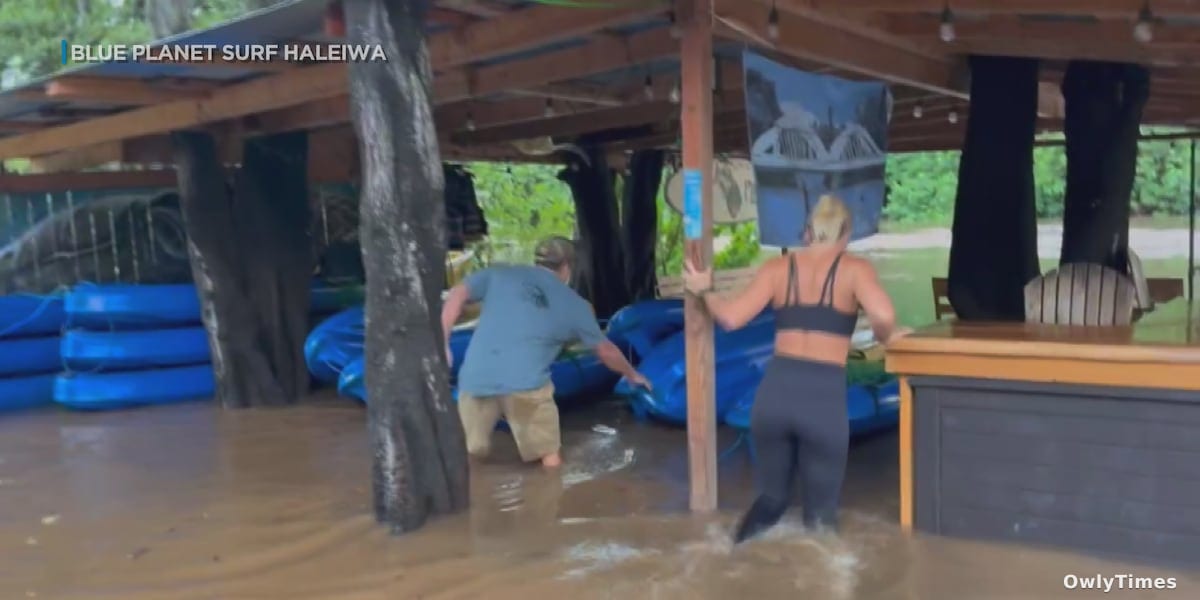

$20,000. That’s the immediate financial impact estimated by Robert Stehlik, owner of Blue Planet Surf in Haleiwa, following Saturday’s flash floods on Oahu. While images of parishioners at Anchor Church in Kaneohe shoveling debris paint a picture of widespread disruption, Stehlik’s quantified loss reveals a critical vulnerability for small businesses operating in Hawaii’s increasingly volatile climate – and foreshadows potential ripple effects across the tourism-dependent economy. This isn’t simply a story about storm damage; it’s a case study in escalating risk exposure and the growing cost of doing business in paradise.
Watershed Runoff and Retail Revenue
The anecdotal accounts from both Guy Souza of Anchor Church and Robert Stehlik point to a common denominator: overwhelmed drainage systems unable to cope with unusually high water volumes. Souza’s description of the flooding as “almost like a Noah’s Ark” underscores the sheer scale of the event, while Stehlik’s observation that he’d “never seen the water come up this high” on the Anahulu River is particularly concerning. Blue Planet Surf’s location on the riverbank inherently increases its risk, but the severity of the flooding suggests a systemic failure to adequately manage watershed runoff. This isn’t an isolated incident; Hawaii experienced similar flooding events in April 2023 and December 2021, each triggering localized business closures and repair costs. The frequency is the key indicator. While a single flood might be written off as an anomaly, a pattern suggests a climate trend demanding proactive financial planning.
Drawn from hawaiinewsnow.com.
The $20,000 Question: Beyond Immediate Repairs
Stehlik’s $20,000 estimate encompasses both physical damages and a week-long closure. This figure, while substantial for a small business, likely represents a conservative lower bound. Consider the broader economic impact: lost rental revenue from surfboards and paddleboards, potential cancellations of lessons, and diminished foot traffic to Haleiwa town as a whole. Haleiwa, a major North Shore tourist destination, relies heavily on water sports rentals. A week-long disruption at a key operator like Blue Planet Surf translates to a quantifiable loss in tourism dollars. Furthermore, the cost of flood insurance in high-risk zones is steadily increasing, adding another layer of financial burden. According to the National Flood Insurance Program (NFIP), average annual premiums in Hawaii rose 11.3% in 2023, significantly outpacing the national average of 7.6%. This trend will likely accelerate as climate models predict more frequent and intense rainfall events.
Honolulu’s Data Collection and the Federal Aid Equation
The City and County of Honolulu’s call for residents to report storm damage isn’t merely a bureaucratic exercise. It’s a crucial step in quantifying the overall economic impact and building a case for federal assistance. The data collected will be instrumental in determining eligibility for programs administered by the Federal Emergency Management Agency (FEMA). However, the city’s disclaimer – that the form is not an application for relief – is a critical detail. Accessing federal aid is a complex process, often requiring extensive documentation and a demonstrated level of widespread damage exceeding local capacity to respond. Hawaii’s congressional delegation will need to actively advocate for the state’s needs, but the burden of proof rests on demonstrating the scale of the economic disruption. The city’s proactive data collection is a positive sign, but it’s only the first step in a potentially lengthy and uncertain process.
What this means for your wallet
The immediate impact for tourists is likely minimal, but the long-term consequences are worth considering. Increased costs for businesses like Blue Planet Surf will inevitably be passed on to consumers in the form of higher rental rates and tour prices. More significantly, the escalating risk of climate-related disruptions could deter investment in Hawaii’s tourism infrastructure, potentially leading to a decline in the quality and availability of services. The question consumers – and potential investors – should be asking is this: at what point do the costs of climate adaptation and disaster recovery outweigh the benefits of operating a business, or visiting a destination, in Hawaii? Watch for a surge in flood insurance claims and a corresponding increase in premiums across the state in the coming months. This will be a clear indicator of whether Hawaii is adequately prepared for the climate challenges ahead.





