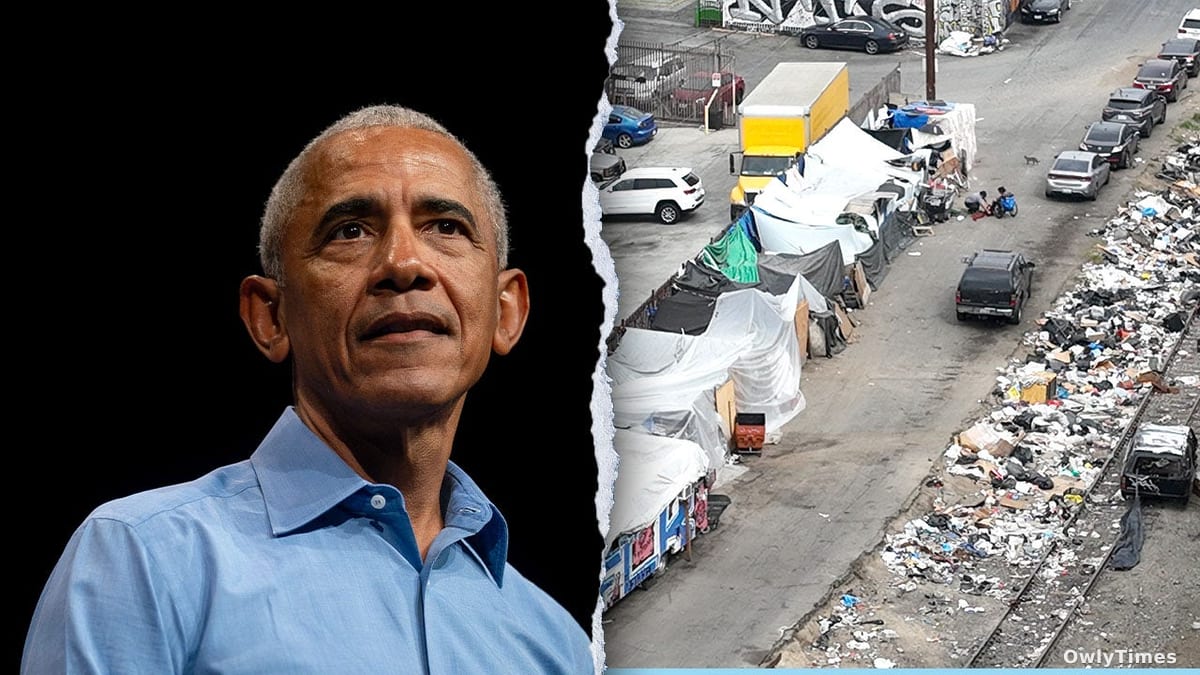

The Political Calculation Behind Obama’s “Atrocity” Remark
Barack Obama’s recent characterization of the Los Angeles homelessness crisis as an “atrocity” wasn’t a spontaneous expression of moral outrage. It was a calculated intervention, timed to subtly pressure a Democratic Party increasingly reliant on framing social issues as matters of individual rights rather than collective responsibility. The former president’s comments, made during a conversation with YouTuber Brian Tyler Cohen, weren’t about the existence of homelessness – that’s been widely acknowledged – but about the political viability of solutions. Obama’s core message: empathy alone won’t solve the crisis, and policies perceived as enabling unchecked encampments are politically unsustainable. This isn’t a departure from his previous stances, but a pragmatic acknowledgement of the shifting political landscape.
This piece references the Fox News report.
The immediate “who benefits and who loses” dynamic is clear. Karen Bass, the current Mayor of Los Angeles, stands to lose political capital. While she has made addressing homelessness a central tenet of her administration, Obama’s critique implicitly questions the effectiveness of her approach and the broader strategy of “housing first” without accompanying conditions or accountability. Conversely, more conservative voices – like David Marcus, who recently argued in favor of stricter policies – gain validation. But the larger beneficiaries are moderate Democrats, particularly those in swing districts, who can now more easily justify supporting policies that prioritize public order alongside social services. The risk for Bass is not necessarily a direct challenge to her leadership, but a narrowing of the political space in which she can operate.
This moment echoes historical precedents in urban policy. The late 20th-century “broken windows” theory, popularized by James Q. Wilson and George L. Kelling, argued that visible signs of disorder – like broken windows – invite further crime and social decay. While controversial, the theory gained traction because it resonated with a public increasingly concerned about urban safety. Obama’s comments tap into a similar vein of public anxiety. He explicitly acknowledges that “the average person doesn’t want to have to navigate around a tent city,” framing the issue not just as a moral failing, but as a practical impediment to building broad-based support for solutions. This is a direct appeal to the political center, a space Democrats have struggled to maintain in recent years.
Gavin Newsom, California’s Governor, attempts to position himself as a pragmatic counterpoint to the crisis, touting a 9% statewide drop in homelessness and framing California as a “model” for the nation. His spokesperson, Tara Gallegos, emphasized the state’s investments in shelters, mental health reform, and encampment removal. However, a 9% decrease, while positive, must be viewed in context. California’s homelessness problem remains the largest in the nation, with over 181,000 people experiencing homelessness in 2023 – a figure that dwarfs other states. Newsom’s claim of “turning this crisis around” feels less convincing when juxtaposed with the sheer scale of the problem and the billions already spent. The political risk for Newsom is appearing tone-deaf to the lived realities of those experiencing homelessness, and to the frustrations of residents who see little tangible improvement.
The crucial political chess move to watch next isn’t whether Bass or Newsom respond directly to Obama’s critique. It’s whether moderate Democrats in Congress will use his comments as leverage to demand greater accountability and stricter conditions attached to federal funding for homelessness programs. Specifically, will they push for provisions that require recipients of housing assistance to actively participate in treatment programs or job training? The outcome of that debate will reveal whether Obama’s intervention was merely a rhetorical gesture, or a genuine attempt to recalibrate the Democratic Party’s approach to one of the nation’s most intractable social problems.





