
Beyond the Headlines: What Orange County Restaurant Closures Reveal About Preventative Public Health
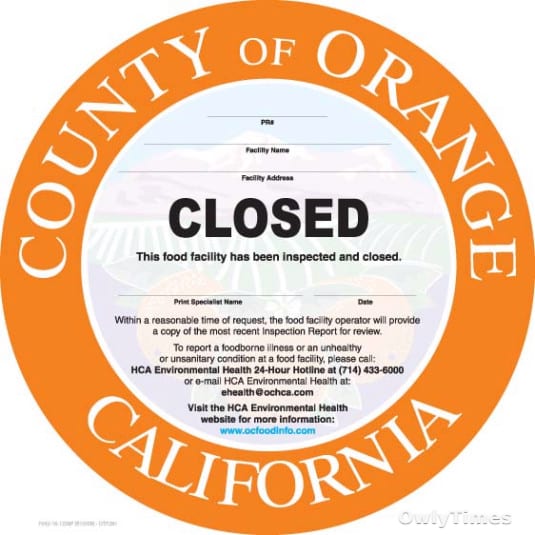
The weekly list of Orange County restaurant closures, dutifully published by the OC Health Care Agency, often reads like a rote recitation of violations. Cockroaches, rodents, plumbing issues – these are the familiar culprits. But focusing solely on the closures themselves obscures a more critical question: what does the frequency and nature of these violations tell us about the effectiveness of preventative measures, and the broader health of our food service infrastructure? Between February 12th and 19th, a snapshot of local inspections reveals a pattern that demands closer scrutiny than simply noting which establishments were temporarily shuttered. It’s not just that restaurants close, but why, and how quickly they return to compliance, that speaks volumes.
The data, released publicly, details eight closures on February 18th and 19th, with six subsequently reopening within a day or two after addressing the cited issues. StoneFire Grill in Brea, Irrawaddy Taste of Burma in Stanton, and Bun World in Anaheim all faced closures due to cockroach infestations, reopening on February 20th. The kitchen and bar at Aventura Sailing Association in Dana Point dealt with a rodent infestation, also reopening on February 20th. Saigon 9 in Garden Grove, along with Lopez & Lefty’s in Anaheim, experienced similar rodent issues, with Saigon 9 reopening on February 19th and Lopez & Lefty’s following suit. Notably, WaBa Grill in Anaheim and food service at the Buena Park Grand Hotel And Suites were also closed on February 18th for cockroach and rodent infestations respectively, both reopening the same day. Two additional closures, Charcol in Huntington Beach and Capital at Irvine Spectrum Center, were related to plumbing disrepair.
What’s immediately striking is the prevalence of pest-related closures. Six out of eight initial closures stemmed from cockroach or rodent infestations. While these issues aren’t uncommon in a region with a warm climate and dense urban areas, the sheer number within a single week raises concerns. It’s easy to dismiss these as isolated incidents, but consider this: the OC Health Care Agency publishes this list weekly. This isn’t an anomaly; it’s a recurring pattern. The speed of reopening, while reassuring, also suggests that these weren’t deeply entrenched, systemic problems, but rather conditions that could be addressed with relatively swift intervention. This begs the question: if the issues are readily fixable, why are they occurring in the first place? Are current preventative measures – regular pest control, proper food storage, structural maintenance – sufficient, or are we relying too heavily on reactive closures rather than proactive prevention?
Source material: ocregister.com.
It’s crucial to understand what the OC Health Care Agency’s data doesn’t tell us. The reports detail the violation that led to closure, and confirmation of reopening, but they don’t offer insight into the frequency of inspections at these establishments, the severity of the infestations prior to closure, or the specific corrective actions taken. A cockroach infestation, for example, can range from a few scattered sightings to a full-blown, widespread problem. Without that nuance, it’s difficult to assess the true risk to public health. Furthermore, the data doesn’t account for establishments that addressed violations identified during inspections without requiring a closure. These “near misses” represent a significant portion of the agency’s work and provide a more complete picture of overall compliance. Dr. Maria Nguyen, a public health entomologist at UC Irvine, emphasizes this point: “Closures are the visible tip of the iceberg. The real story is in the ongoing inspections and the preventative measures restaurants are taking – or not taking – to avoid reaching that point.”
Limitations to Consider
The OC Health Care Agency’s database is a valuable resource, but it’s essential to approach the data with a critical eye. The list represents a snapshot in time, and doesn’t reflect long-term trends or the overall hygiene standards of Orange County restaurants. It’s also important to remember that inspections are often triggered by complaints, meaning the listed establishments may not be representative of the entire industry. A restaurant with a robust internal quality control system and proactive pest management may rarely appear on the closure list, while one with lax standards may be repeatedly cited. Finally, the database doesn’t provide information on the types of food served at each establishment, which could influence the risk of pest infestations or foodborne illnesses.
Looking ahead, the focus should shift from simply reacting to violations to proactively identifying and mitigating risks. The OC Health Care Agency could enhance its data reporting by including inspection frequency, violation severity scores, and details on corrective actions taken. Furthermore, investing in educational programs for restaurant owners and staff on best practices for food safety and pest management could significantly reduce the number of closures. Perhaps most importantly, a more transparent system for public reporting of inspection results – beyond just the closure list – would empower consumers to make informed choices and incentivize restaurants to maintain higher standards. The question now isn’t just which restaurants are closing, but what systemic changes can be implemented to ensure a safer and healthier dining experience for everyone in Orange County. Will we see a move towards more frequent, unannounced inspections, or will we continue to rely on a reactive system that only addresses problems after they’ve already emerged?





