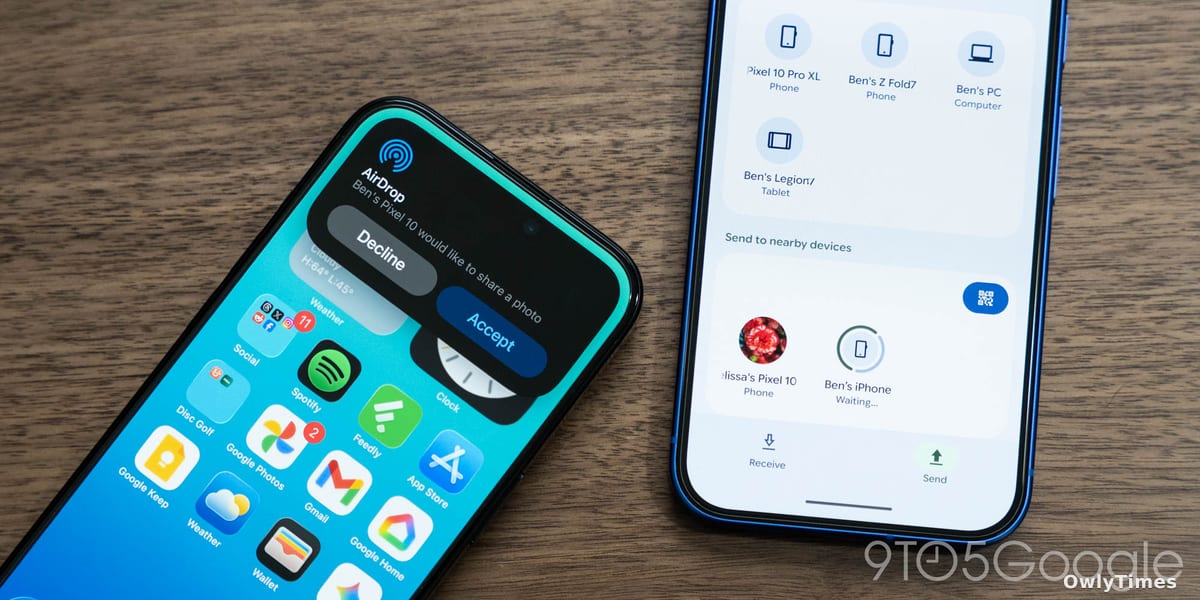

Is the future of your phone less about what company made it and more about whether it can talk to the other one? Google’s latest move with Quick Share – finally bridging the chasm to Apple’s AirDrop – feels less like a feature launch and more like a reluctant admission that walled gardens are crumbling. The real story here isn't seamless file sharing; it's the quiet erosion of the ecosystem lock-in that’s fueled both Google and Apple’s dominance for over a decade. For years, the simple act of sending a photo from an Android phone to an iPhone was a frustrating exercise in emailing yourself or resorting to data-hungry messaging apps. Now, with the rollout to the Pixel 9, 9 Pro, 9 Pro XL, and 9 Pro Fold (and belatedly, the Pixel 9 Pro Fold), that’s…changing. Sort of.
The 10-Minute Window of Opportunity
Let’s be clear: this isn’t the elegant, one-tap experience AirDrop users enjoy. Google is essentially forcing iPhone, iPad, and macOS users to temporarily disable their AirDrop privacy settings, opening themselves up to “Everyone” for a full ten minutes. This isn’t a bug; it’s a workaround. Apple hasn’t exactly been rushing to embrace interoperability, and Google has taken matters into its own hands. While Google assures us the connection is direct, peer-to-peer, and doesn’t route data through servers, the ten-minute vulnerability is a significant usability hurdle. It’s a tacit acknowledgement that true seamlessness requires Apple’s cooperation, and a not-so-subtle jab at their closed approach. The fact that users have to actively choose to be discoverable for a period of time highlights the inherent tension between convenience and security – a tension Apple has historically prioritized on the security side.
This piece references the 9to5Google report.
Beyond the Pixel: A Limited Rollout
The initial rollout is also notably limited. While the Pixel 9 family gets the upgrade, the more affordable Pixel 9a is conspicuously left out. This isn’t surprising – Google often reserves new features for its premium devices – but it underscores a familiar pattern. Innovation tends to trickle down, leaving budget-conscious consumers waiting. And it’s those consumers who are often most reliant on cross-platform compatibility, frequently juggling devices across different operating systems within a household. The requirement to download a “Quick Share Extension” via Settings > System services > Available Updates adds another layer of friction. It’s a far cry from the plug-and-play experience Apple cultivates, and it speaks to the inherent complexity of retrofitting interoperability onto existing systems.
Security First, But at What Cost?
Google is keen to emphasize the security of this implementation. “The connection is direct and peer-to-peer,” they state, “meaning your data is never routed through a server, shared content is never logged, and no extra data is shared.” This is a smart move, given the scrutiny surrounding data privacy. However, the ten-minute AirDrop setting is a potential security risk, even if the data transfer itself is secure. It’s a trade-off: convenience versus control. Google is offering a solution, but it’s a solution that requires users to temporarily lower their guard. The company also expressed openness to collaborating with Apple on “Contacts Only” support, which would streamline the process and address the privacy concerns. But given Apple’s history, that collaboration feels less like a likely outcome and more like a polite gesture.
The Future of Phone Ownership
This isn’t just about sharing vacation photos faster. It’s about a fundamental shift in how we think about phone ownership. For years, the ecosystem – the seamless integration of hardware, software, and services – has been a key differentiator. But as those ecosystems become increasingly porous, the value proposition diminishes. The fact that Google had to engineer this workaround independently, rather than through a standardized protocol, is telling. It suggests that the future of mobile technology isn’t about building better walls, but about building better bridges. Expect to see more pressure on Apple to open up its ecosystem, not necessarily out of altruism, but because consumers are demanding it. My prediction? Within the next 18 months, we’ll see a third-party app emerge that effectively replicates Quick Share’s functionality without requiring the ten-minute AirDrop setting change, forcing Apple’s hand and finally delivering the truly seamless cross-platform experience users deserve. The question isn’t if the walls will come down, but how messy the demolition will be.