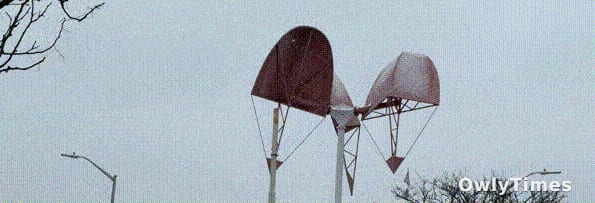

Is anyone actually looking at the things around us, or are we just moving through a landscape of forgotten investments? That’s the question nagging at me after digging into the story of “Gift of the Wind,” the 46-foot kinetic sculpture dominating Porter Square. It’s a fixture of Cambridge life, a rotating red landmark most of us probably haven’t given a second thought to in years. But the story of this sculpture isn’t about art; it’s about priorities, deferred maintenance, and the slow erosion of public investment in things that actually make a place feel…well, like a place.
The sculpture, designed by Japanese artist Susumu Shingu, arrived in 1985 as part of “Arts on the Line,” a remarkably ambitious program spearheaded by the MBTA. Modeled after successful transit art initiatives in Paris and Stockholm, Arts on the Line was, at the time, the largest of its kind in the United States, injecting public art into the newly extended Red Line stations – Harvard, Porter, Davis, and Alewife. It was a bold statement: public transportation shouldn’t just get you somewhere, it should enrich the journey. The real story here isn’t the artistic merit of Shingu’s work – though it’s undeniably striking – it’s the sheer audacity of a public agency believing it had a responsibility to beauty, not just efficiency.
What’s unsettling isn’t the sculpture’s age – more than 40 years and still spinning in sun and snow is a testament to its construction – it’s the MBTA’s current stance. When asked about recent maintenance, officials admitted to…none. And, crucially, there’s no funding earmarked for restoration. This isn’t a case of a hidden crisis; it’s a publicly acknowledged neglect. Consider this: the T is currently grappling with a multi-billion dollar backlog of deferred maintenance across its entire system. A 2023 report estimated the agency needs $11.4 billion just to bring its infrastructure to a state of good repair. In that context, a sculpture restoration might seem trivial. But that’s precisely the problem.
Pallas Lombardi, the director of Arts on the Line, remembers the installation of Gift of the Wind as a logistical feat, a middle-of-the-night operation involving a crane, a closed-off Massachusetts Avenue, and a collective problem-solving effort when the initial spin revealed a mechanical hiccup. Her recollection isn’t just nostalgic; it highlights a culture of investment and care that’s largely vanished. Lombardi, now 80 and retired in North Carolina, described the moment the sculpture finally spun perfectly as a feeling of “incredible relief and joy.” That joy feels…distant now. The T’s current response – “no funding at this juncture” – isn’t just bureaucratic language; it’s a signal that the agency views these investments as optional, expendable.
Based on the original bostonglobe.com report.
The rust visible on the sculpture isn’t just an aesthetic issue. It’s a physical manifestation of this neglect. It’s a slow, visible decay that mirrors a broader trend: the defunding of public spaces and the erosion of the idea that art and beauty are essential components of a functioning society. We’ve become accustomed to accepting a baseline of decline, to seeing infrastructure crumble and public art fade, without demanding better. The cost of restoring Gift of the Wind is likely a fraction of the T’s overall budget, but the symbolic cost of not restoring it is far greater. It’s a quiet acceptance of a diminished public realm.
So, here’s what to watch for: the next time a strong wind whips through Porter Square, pay attention to Gift of the Wind. Not just to its movement, but to its condition. Because the real question isn’t whether this sculpture will eventually stop spinning – it’s whether we’ll reach a point where we simply stop noticing when things fall apart. And if we stop noticing, what else will we let slip away?