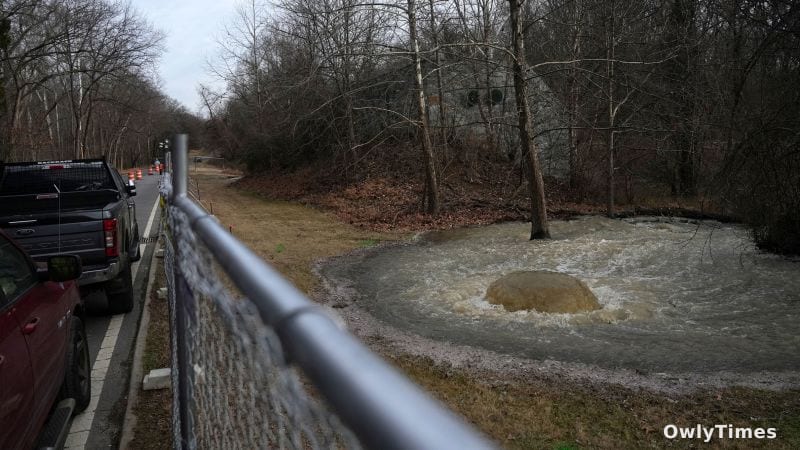

The strategic calculation is clear: in the face of a significant environmental crisis, the Biden administration, spearheaded by Donald Trump, is prioritizing a demonstration of federal authority and a pointed political challenge to Democratic leadership over immediate disaster response. The nearly 250 million gallons of raw sewage spilled into the Potomac River presents a genuine ecological emergency, with bacteria levels elevated up to nine miles downstream as of earlier this month. Yet, the response isn’t unified action, but a public dispute over procedure and responsibility, revealing a calculated effort to leverage a crisis for political gain.
Who benefits and who loses in this scenario is immediately apparent. Trump and his administration gain an opportunity to portray Democratic governance as incompetent and reliant on federal intervention, while simultaneously highlighting the perceived inadequacies of existing disaster relief infrastructure – particularly FEMA, currently operating under a funding lapse. Wes Moore, the Governor of Maryland, and Muriel Bowser, the Mayor of DC, stand to lose politically, forced to navigate a crisis while simultaneously defending their leadership against accusations of negligence and obstruction. The broader public, and the Potomac River ecosystem, are the ultimate losers, facing potential health risks and environmental damage while political posturing takes precedence. This dynamic echoes historical precedents, most notably the federal response to Hurricane Katrina in 2005, where criticisms of slow and inadequate aid fueled accusations of racial and political bias in resource allocation.
This piece references the CNN report.
The core of the dispute centers on the Stafford Act of 1974, which dictates that federal disaster assistance is typically provided at the request of a state governor. Karoline Leavitt, the White House Press Secretary, explicitly cited this law, stating that local officials must request help “so that the federal government can go and take control of this local infrastructure that has been abandoned and neglected by Governor Moore in Maryland for far too long.” This framing isn’t simply about legal procedure; it’s about establishing a narrative of local failure necessitating federal intervention – a narrative that conveniently positions Trump as the decisive leader stepping in to resolve a problem created by Democratic mismanagement. Moore countered this narrative directly, pointing out the spill occurred on federal land and within infrastructure managed by DC Water, effectively arguing the federal government already bears responsibility. His pointed retort – “If the president wants me to ask nicely — here’s my nice ask of the president: Mr. President, please do your job” – underscores the deliberate provocation at play.
The contrasting approaches of Bowser and Moore are also revealing. While Moore has publicly challenged Trump’s demands, Bowser opted for a more tactical route, formally requesting federal support with a detailed list of needs, including cleanup reimbursement and an assessment of the breach by the Army Corps of Engineers. This difference highlights a calculated risk assessment: Bowser prioritizes securing resources for her constituents, even if it means engaging with Trump on his terms, while Moore, a rising star in the Democratic Party with potential 2028 presidential ambitions, appears willing to risk a public confrontation to establish a clear distinction between his leadership and Trump’s. This echoes the political calculations made by governors during the COVID-19 pandemic, where navigating federal aid requests often involved balancing public health needs with political considerations.
The situation is further complicated by the ongoing funding lapse at FEMA, part of the Department of Homeland Security. Trump has attempted to leverage this situation, claiming “true Patriots” from the agency would respond despite the shutdown, while simultaneously highlighting the “Democrat caused Disasters” – a claim unsupported by evidence. This messaging is reinforced by Kristi Noem, the Homeland Security Secretary, who tweeted that Democrats had “shut down @FEMA funding” despite the agency’s continued, albeit hampered, operations. Reporting from CNN’s Gabe Cohen reveals a travel freeze impacting disaster deployments, directly contradicting Trump’s assertions. This dissonance between rhetoric and reality underscores a deliberate attempt to exploit the funding impasse for political advantage, potentially laying the groundwork for future cuts to disaster relief programs. Lee Zeldin, head of the EPA, offered a more measured response, noting the ongoing cleanup efforts led by DC Water and Maryland’s regulatory oversight, but also emphasized the lack of a formal request for federal support as of Tuesday.
The political chess move to watch next is not whether FEMA will deploy resources – the agency is already “monitoring” the situation – but whether Trump will escalate the conflict with Moore further. Will he continue to publicly demand a formal request, framing any reluctance as evidence of Democratic incompetence? Or will he pivot to a narrative of federal success, claiming credit for any eventual cleanup efforts, regardless of the initial obstruction? The answer will likely reveal the extent to which this crisis is being viewed as a genuine emergency versus a political opportunity.





