
The wind howled a defiant counterpoint to the crack of the bat, whipping around Baum-Walker Stadium as Zack Stewart launched a solo home run against UT-Arlington on Sunday. It wasn’t just a home run; it was a statement. A statement not just about the sixth-ranked Arkansas Razorbacks’ 11-1 run-rule victory, but about a larger shift happening in college baseball – a relentless pursuit of power, and the quiet resilience required to thrive even when that power isn’t immediately apparent. The win, secured after a frustrating Friday night loss, felt less like a simple series victory and more like a recalibration for a team with national championship aspirations.
This Arkansas team, now 9-3, isn’t simply winning games; they’re dissecting opposing pitching, identifying weaknesses, and exploiting them with a calculated aggression. The mirror-image home runs from Stewart and Camden Kozeal – both left-handed hitters driving fastballs to center field with exit velocities exceeding 107 mph – weren’t coincidence. They were the product of focused scouting and a lineup brimming with hitters capable of turning on a mistake. But beyond the impressive stat lines and booming hits, the Razorbacks’ weekend revealed a crucial element of championship contenders: the ability to win without everything clicking.
This article draws on reporting from wholehogsports.com.
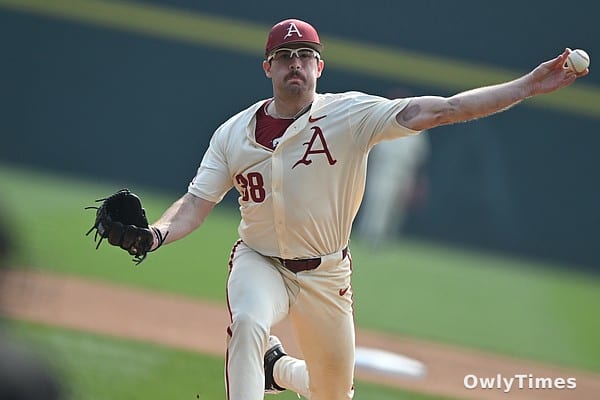
Colin Fisher, the junior left-hander who earned the win, didn’t have his “everything working,” as he admitted after the game, referencing his dominant one-hit shutout against Xavier the previous week. Yet, he delivered six innings of one-run ball, allowing just five hits and striking out seven. His 85-pitch outing, 62 of which were strikes, wasn’t about overpowering hitters; it was about pitching through adversity, relying on his fastball when his off-speed stuff wasn’t sharp. This is a subtle but significant distinction. In an era where pitchers are often judged solely on velocity and movement, Fisher’s performance underscored the enduring value of command, composure, and the ability to execute a game plan even when not feeling at your best. His current streak of 19 innings without allowing an earned run – boasting a microscopic 0.53 WHIP and 26 strikeouts – isn’t just a statistical anomaly; it’s a testament to his mental fortitude.
The offensive explosion wasn’t limited to the long ball. Carson Brumbaugh, the nine-hole hitter, went 2 for 3 with two doubles and a career-high two runs and one RBI, embodying a “back to basics” approach. He spoke of simply trying to “hit the ball through the middle,” a deceptively simple adjustment that unlocked a productive day at the plate. This speaks to a broader trend in baseball – a rejection of the “launch angle” revolution in favor of a more balanced, contact-oriented approach. While power remains valuable, teams are increasingly recognizing the importance of putting the ball in play and manufacturing runs. The five-run sixth inning, sparked by Brumbaugh’s double, was a masterclass in situational hitting and aggressive baserunning, showcasing the Razorbacks’ versatility.
But the weekend wasn’t without its blemishes. A fielding error led to UT-Arlington’s lone run, a reminder that even dominant teams are susceptible to mistakes. And UT-Arlington coach Mike Trapasso’s blunt assessment – “We just didn’t put up a fight” – highlights a growing disparity in college baseball. Programs with significant financial resources, like Arkansas, are able to attract top talent and invest in state-of-the-art facilities, creating a competitive imbalance that makes it increasingly difficult for smaller programs to compete. The Mavericks’ struggles underscore the challenges facing mid-major programs in an increasingly professionalized college baseball landscape.
The Razorbacks’ upcoming midweek matchup against Oral Roberts presents a different kind of test. The Golden Eagles, while currently 5-6, have shown flashes of potential, and Arkansas can’t afford to take them lightly. More importantly, this game offers an opportunity for Dave Van Horn and his staff to assess their team’s consistency and identify areas for improvement before entering the grueling SEC schedule. Will the Razorbacks continue to manufacture runs when the power isn’t falling in? Can Fisher maintain his composure even when his best stuff isn’t working? And, crucially, will the program’s success continue to widen the gap between the haves and have-nots in college baseball? These are the questions that will define Arkansas’ season, and the answers will resonate far beyond the confines of Baum-Walker Stadium.

