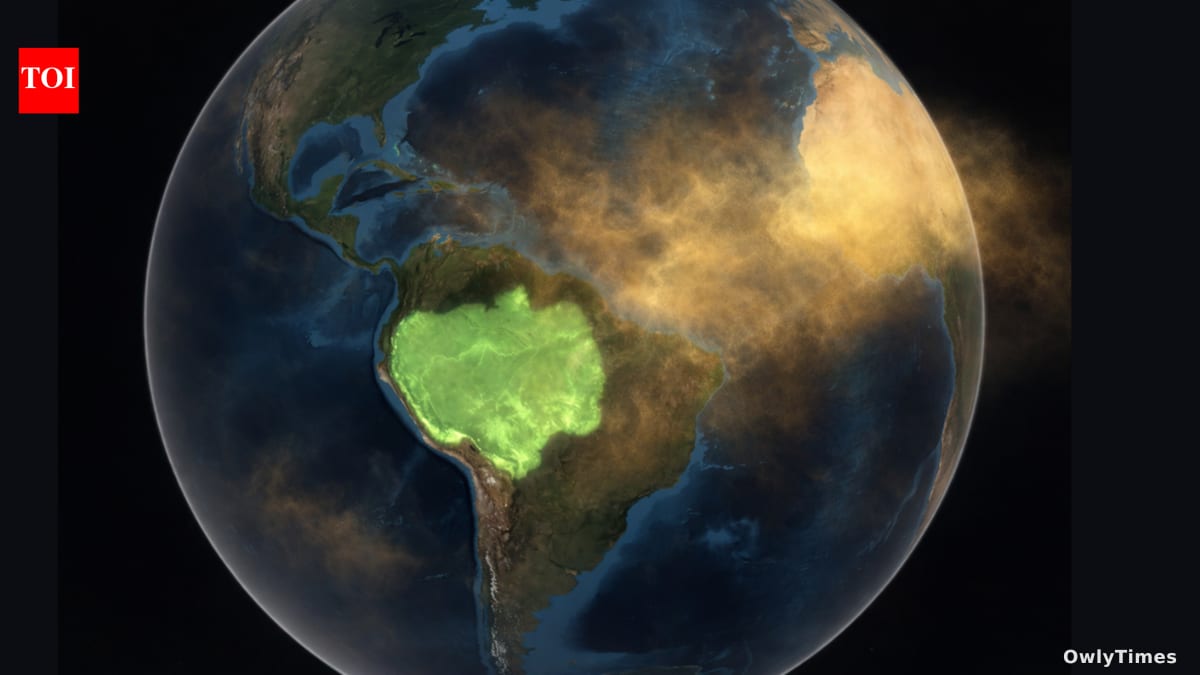

The image is striking: vast plumes of dust, visible from space, traveling 6,000 miles across the Atlantic Ocean. For decades, scientists observed this phenomenon – Saharan dust reaching the Amazon rainforest – but assumed it was a largely inert transfer of material. Recent research, however, reveals a far more critical connection, one that challenges our understanding of rainforest health and highlights the surprising interconnectedness of global ecosystems. The story isn’t simply about dust blowing in the wind; it’s about a vital nutrient lifeline, and increasingly, about how climate change could disrupt it.
In 2015, a team led by atmospheric scientist Hongbin Yu of the University of Maryland’s Earth System Science Interdisciplinary Center (ESSIC), in collaboration with NASA’s Goddard Space Flight Center, published findings detailing the scale of this trans-Atlantic nutrient transfer. Using data from NASA’s CALIPSO satellite – launched in 2006 and equipped with a laser-based lidar instrument – Yu and his colleagues quantified, for the first time, the amount of dust actually completing the journey. While headlines often state the Amazon “relies” on Saharan dust, the study’s nuance is crucial: it demonstrates a significant contribution of phosphorus, a key nutrient, rather than complete dependence. Approximately 27.7 million tons of dust leave the Sahara annually, with around 15 percent – roughly 22,000 tons of phosphorus – deposited over the Amazon basin. To put that in perspective, NASA estimates this equates to nearly 689,290 semi-trucks departing the Sahara and 104,908 dumping their loads into the Amazon each year.
Original reporting: timesofindia.indiatimes.com.
The importance of this phosphorus delivery stems from the Amazon’s surprisingly nutrient-poor soils. Despite its incredible biodiversity, around 90 percent of Amazonian soils are deficient in phosphorus, essential for plant growth. Heavy rainfall and the Amazon’s extensive river system constantly leach nutrients, including phosphorus and nitrogen, from the basin. The Sahara, particularly the Bodélé Depression in Chad – an ancient lakebed rich in the remains of microorganisms – serves as a crucial source to replenish what’s lost. The CALIPSO satellite’s lidar technology, which uses pulses of light to distinguish dust from other atmospheric particles, allowed Yu’s team to track this three-dimensional plume between 2007 and 2013, providing a robust dataset for their analysis. The 22,000 tons of phosphorus arriving annually closely matches the estimated amount lost through natural hydrological processes, suggesting a delicate balance maintained by this long-distance atmospheric river.
However, the system isn’t static. The research revealed significant year-to-year variability in dust transport, with an 86 percent difference between the largest plume (2007) and the smallest (2011) observed during the study period. This variability appears linked to rainfall patterns in the Sahel, the semi-arid region south of the Sahara. Increased rainfall in the Sahel correlates with decreased dust transport, potentially due to increased vegetation cover reducing exposed soil or shifts in wind patterns. Yu emphasized this interconnectedness, stating, “This is a small world, and we’re all connected together.” He also highlighted the reciprocal relationship between dust and climate, noting, “Dust affects climate and, at the same time, climate change will affect dust.” This is where the story moves beyond a simple description of a natural process and into a realm of potential disruption.
Limitations to consider include the inherent challenges of measuring atmospheric phenomena over vast distances. While CALIPSO provides valuable data, it’s still a snapshot in time and space. The study acknowledges uncertainties regarding the precise amount of dust needed to maintain Amazonian productivity, and the complex interplay of factors influencing dust mobilization and transport. Furthermore, the data analyzed covers 2007-2013; more recent trends, particularly in the context of accelerating climate change and altered rainfall patterns in the Sahel, require further investigation. The current geopolitical climate, with recent escalations in conflict in the Middle East, also introduces a potential, though currently unquantified, variable. Disruptions to regional stability could impact land use and dust mobilization, though the direct effect on Saharan dust plumes remains speculative.
The next crucial research steps involve long-term monitoring of both dust transport and rainfall patterns in the Sahel, coupled with detailed analysis of Amazonian soil nutrient levels. Understanding how climate change is altering these dynamics is paramount. Specifically, researchers need to determine whether increased droughts in the Sahel, predicted by many climate models, will lead to more frequent and intense dust storms, or if altered wind patterns will diminish the flow of dust to the Amazon. The question isn’t just about how much dust is traveling, but when and under what conditions. Will the Amazon be able to adapt if the timing of phosphorus delivery shifts, or if the amount of dust decreases significantly? The answer to that question will determine not only the future health of the Amazon rainforest, but also our understanding of the resilience of interconnected ecosystems in a changing world.