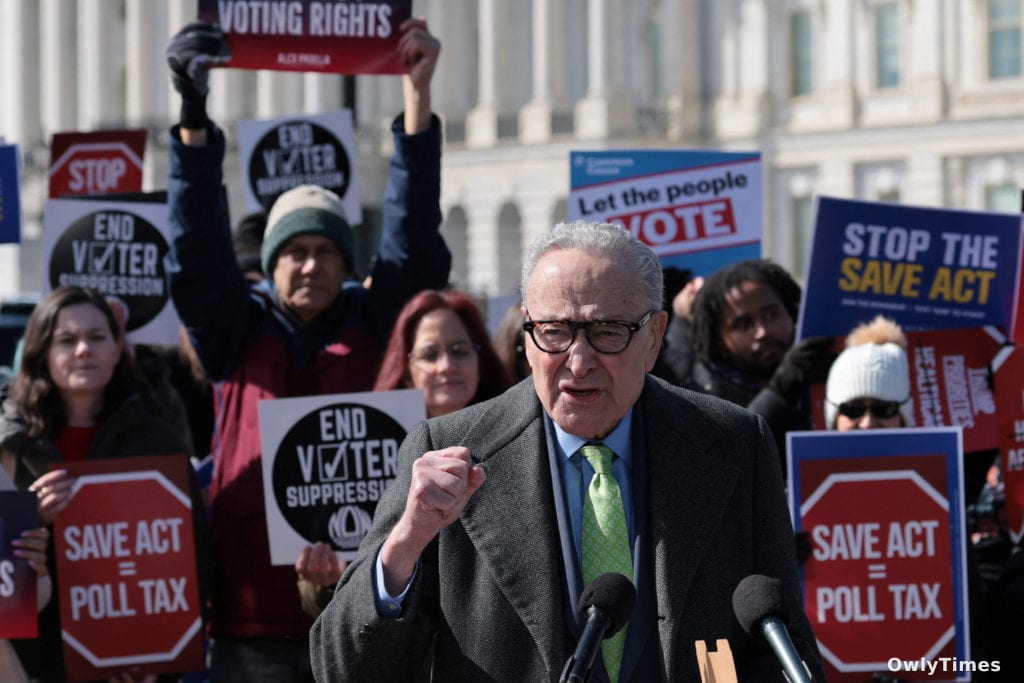

The Strategic Tightening of Electoral Access
The push for the Safeguard American Voter Eligibility Act, or SAVE America Act, isn’t about safeguarding anything; it’s about a calculated constriction of the electorate, leveraging anxieties about election integrity to reshape the rules of access. While framed as a response to the exceedingly rare instances of non-citizen voting, the bill’s core function – mandating in-person submission of citizenship documentation for voter registration – reveals a strategic intent to disproportionately impact specific demographics and consolidate political power. The debate surrounding the bill, as highlighted by Senate Minority Leader Chuck Schumer on March 17th, isn’t simply about policy details, but about who controls the gateway to the ballot box.
Original reporting: PBS.
Beyond the Fact Check: The Real Impact of In-Person Requirements
Schumer’s claim that the SAVE America Act would force 95% of Americans to alter their registration habits, based on the assertion that only 5% currently register in person, is technically inaccurate according to federal surveys indicating a higher percentage of in-person registrations. However, focusing on the precise percentage obscures the larger point. The bill doesn’t merely require in-person registration; it demands in-person submission of documentary proof of citizenship. This is a critical distinction. Eliza Sweren-Becker of the Brennan Center for Justice correctly points out this impacts not just new voters or those moving states, but potentially a vast number of citizens who believe they are already properly registered. The logistical burden – travel costs, time off work, accessibility for those with disabilities – will fall heaviest on low-income individuals, students, and communities of color, groups that statistically lean Democratic. This isn’t accidental.
Historical Echoes of Disenfranchisement
The SAVE America Act echoes a long and troubling history of voter suppression tactics in the United States. Following Reconstruction, Southern states employed poll taxes, literacy tests, and grandfather clauses to systematically disenfranchise African American voters. While overtly racist measures are now prohibited, the effect of creating procedural hurdles remains the same: reducing participation among targeted groups. The SAVE America Act, passed by the House in February with the strong backing of President Donald Trump, doesn’t rely on explicit discrimination, but on the plausible deniability of administrative burdens. This parallels the “motor voter” backlash of the 1990s, where states responded to increased registration through DMV access with stricter ID requirements, ostensibly to prevent fraud but demonstrably reducing turnout. The current bill is a more aggressive iteration of that same strategy.
The Politics of Perceived Fraud
The timing and framing of the SAVE America Act are inextricably linked to the persistent, and repeatedly debunked, claims of widespread voter fraud propagated by President Trump and his allies. The bill’s passage through the House, following years of these exaggerations, isn’t a response to a genuine crisis, but a capitalization on a manufactured one. The rarity of non-citizen voting – a point consistently emphasized by election officials – is irrelevant to the political calculus. The narrative of a compromised electoral system serves to justify increasingly restrictive measures, and to mobilize a base of voters motivated by distrust. This is a classic example of problem-reaction-solution politics: create a perceived problem, exploit the resulting anxiety, and then offer a solution that simultaneously addresses the anxiety and advances a political agenda.
The Next Chess Move: State-Level Implementation and Litigation
The immediate political chess move to watch isn’t further action in the Senate, but the potential for state-level implementation should the bill become law. Republican-controlled states will likely move swiftly to enact the most restrictive interpretations of the in-person documentation requirement, maximizing its impact on voter registration. Simultaneously, expect a flurry of legal challenges from voting rights organizations like the Brennan Center, arguing the law violates the 14th and 15th Amendments. The question isn’t simply whether the SAVE America Act will pass, but how it will be implemented, and whether the courts will intervene to mitigate its potentially disenfranchising effects. The battleground will shift from Washington to state capitals and courtrooms, and the outcome will determine the shape of American elections for years to come.





