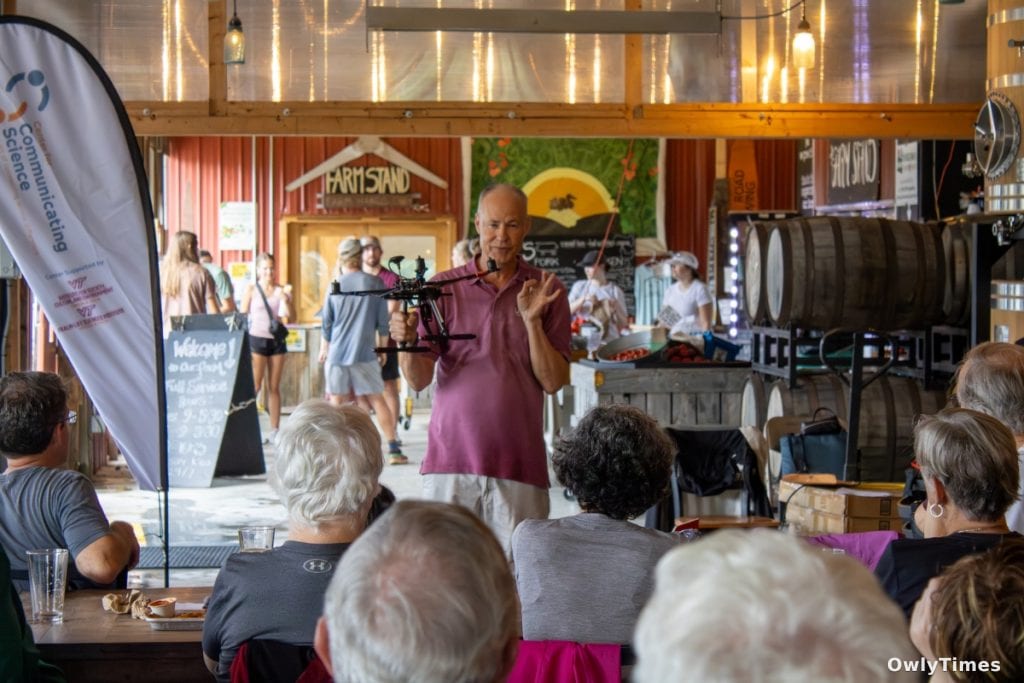

How do we bridge the widening chasm between specialized academic research and the public’s daily curiosity? For nearly a decade, a dedicated group in the New River Valley has treated this not as a communication problem, but as a community-building project. By moving scientific discourse out of lecture halls and into the Rising Silo Brewery in Blacksburg, Virginia, the Center for Communicating Science has created a "third space"—a social environment separate from home or work—that fosters genuine human connection alongside intellectual discovery.
Since its inception in April 2017, Science on Tap New River Valley has hosted more than 80 events, drawing a cumulative audience of over 4,400 attendees. While the raw numbers are impressive, the true metric of the program’s success lies in the diversity of its speakers. Two-thirds of the presenters have been affiliated with Virginia Tech, but the remaining third includes independent researchers, artists, farmers, and mental health professionals. This deliberate inclusion of non-academic voices challenges the traditional hierarchy of expertise, grounding complex topics like neuroscience or the behavior of hermit crabs in the shared reality of the local community.
The organizers—a coalition including Carrie Kroehler, Patty Raun, Katie Burke, and Deborah Good—have now codified their approach in a new publication for the Journal of Community Engagement and Scholarship. The primary goal of this documentation is to address the common friction points that often stifle science outreach. According to Amy Hagen, a Ph.D. candidate and lead author of the paper, many scientists are held back by a lack of institutional support, rigid logistics, and, perhaps most importantly, the persistent "language barrier" created by academic jargon.
The study highlights a crucial distinction: Science on Tap is not designed to persuade or promote specific agendas. Instead, it functions as a low-stakes laboratory for communication. For the scientists, it is a chance to practice translating dense concepts into accessible narratives; for the audience, it is a rare opportunity to engage directly with the people behind the research. As long-time attendee Barb Glazer, a retired Montgomery County school teacher, notes, the program succeeds because it prioritizes engagement over instruction. By humanizing the process of discovery, the organizers have managed to move the needle on public science literacy in a way that traditional, top-down outreach often fails to do.
However, the organizers are candid about the hurdles that remain for anyone looking to replicate this model. The "recipe" provided in their paper is intended as a starting point, not a guarantee, as the success of the series remains heavily dependent on sustained local commitment and the willingness of researchers to step out of their comfort zones. While the program has thrived in Blacksburg, it is unclear if the same model can be scaled to environments where the cultural intersection of "third spaces" and academic institutions is less established.
The next step for the research team involves observing whether other communities can successfully adapt these "ingredients" to their own local contexts. Future reports from the Center for Communicating Science will likely monitor the emergence of similar programs elsewhere, as these efforts will reveal whether the success of Science on Tap is a localized phenomenon tied to the unique geography of the New River Valley or a scalable framework for democratizing scientific knowledge across the country.