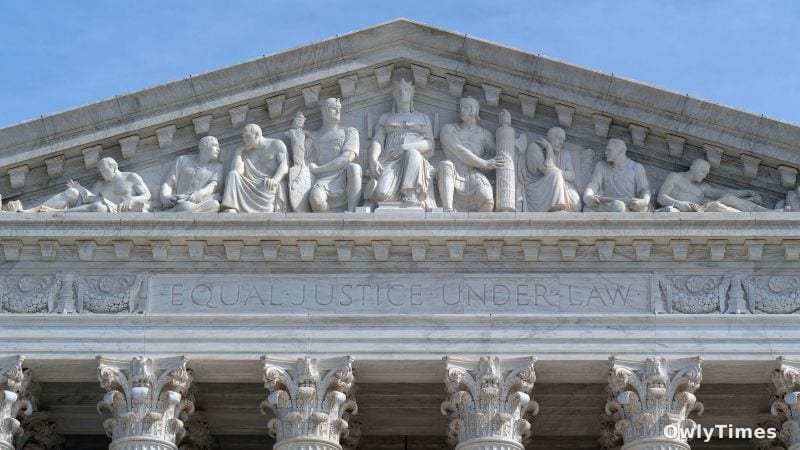

The Supreme Court’s questioning Monday regarding United States v. Hemani wasn’t about marijuana legalization, despite the headlines. It was a strategic probe into the limits of federal power to regulate firearms, framed by a historical argument that exposes a fundamental tension within Second Amendment jurisprudence. The case, centering on Ali Danial Hemani’s possession of a Glock and 60 grams of marijuana, isn’t about whether Hemani should have had a gun; it’s about whether Congress has the authority to disarm individuals based on drug use, and how far the Court will go to enforce a historically-grounded interpretation of the Second Amendment. The strategic calculus at play is a recalibration of power – a potential shift away from deference to executive and legislative branches toward judicial scrutiny of gun control measures.
The core of the dispute lies in a 1968 law prohibiting “unlawful users” of drugs from owning firearms. The Biden administration, represented by principal deputy solicitor general Sarah Harris, attempted to anchor the law in colonial-era precedents of disarming the intoxicated. However, this argument quickly ran aground on the justices’ skepticism, particularly from conservative justices like Neil Gorsuch, who pointed to the absurdity of applying the law retroactively to historical figures with commonplace habits. “John Adams took a tankard of hard cider with his breakfast every day. James Madison reportedly drank a pint of whiskey every day,” Gorsuch quipped, highlighting the incongruity of applying modern restrictions to past practices. This wasn’t merely rhetorical; it was a direct challenge to the government’s attempt to establish a historical analogue justifying the current prohibition. Who benefits from upholding the law? The federal government’s ability to regulate firearms, and by extension, to control a key aspect of public safety. Who loses? Individuals who use marijuana, even in states where it’s legal, and potentially anyone who uses prescription drugs not as prescribed.
Original reporting: CNN.
The timing of this case is particularly pointed. While President Biden pardoned his son, Hunter Biden, after a conviction under the same law involving crack cocaine, the broader legal landscape surrounding marijuana is rapidly changing. Roughly half of US states have legalized recreational use, creating a direct conflict with federal prohibition. This dissonance was not lost on the justices, with Gorsuch directly questioning the government’s position given this “sort of illegal and sort of isn’t” status of marijuana. The administration’s attempt to reclassify marijuana via executive order, signed by Trump in December, feels less like a solution and more like a tacit acknowledgement of the legal quagmire. The 300 annual prosecutions under this law – carrying a potential 15-year sentence – represent a relatively small number, but the principle at stake is enormous. A broad ruling against the government could open the door to challenges of other federal gun control measures.
The case also intersects with the Court’s recent Second Amendment decisions, particularly the 2022 New York State Rifle & Pistol Association, Inc. v. Bruen ruling, which mandated that gun restrictions have a historical analogue to be constitutional. This historical test, however, is proving increasingly difficult to apply, as evidenced by Justice Ketanji Brown Jackson’s exasperated comment: “I don’t understand how this works any more in any meaningful way.” The Court’s decision to decline hearing cases regarding non-violent felons’ gun rights further underscores this tension. By refusing to address that broader issue, the Court signaled a focus on the narrower, but potentially more impactful, question of drug use and gun ownership. The case of Melynda Vincent, convicted of bank fraud for a $498.12 bad check, highlights the potential for the law to ensnare individuals with little connection to violent crime.
The 5th US Circuit Court of Appeals’ ruling in Hemani’s favor, focusing on laws barring guns for those actively intoxicated, provides a potential roadmap for the Supreme Court. A decision upholding that standard would significantly narrow the government’s ability to disarm individuals based on past or regular drug use. However, the concerns voiced by justices like Samuel Alito and John Roberts about courts making individual determinations about “dangerousness” suggest a reluctance to completely dismantle the law. The political chess move to watch next isn’t the immediate aftermath of the Hemani decision, but rather the subsequent wave of litigation that will inevitably follow. Will plaintiffs attempt to broaden the scope of the Hemani ruling to challenge other gun control measures? Will Congress attempt to rewrite the 1968 law to address the Court’s concerns? The answer to that question will reveal the true extent of the Court’s impact on the Second Amendment landscape.





