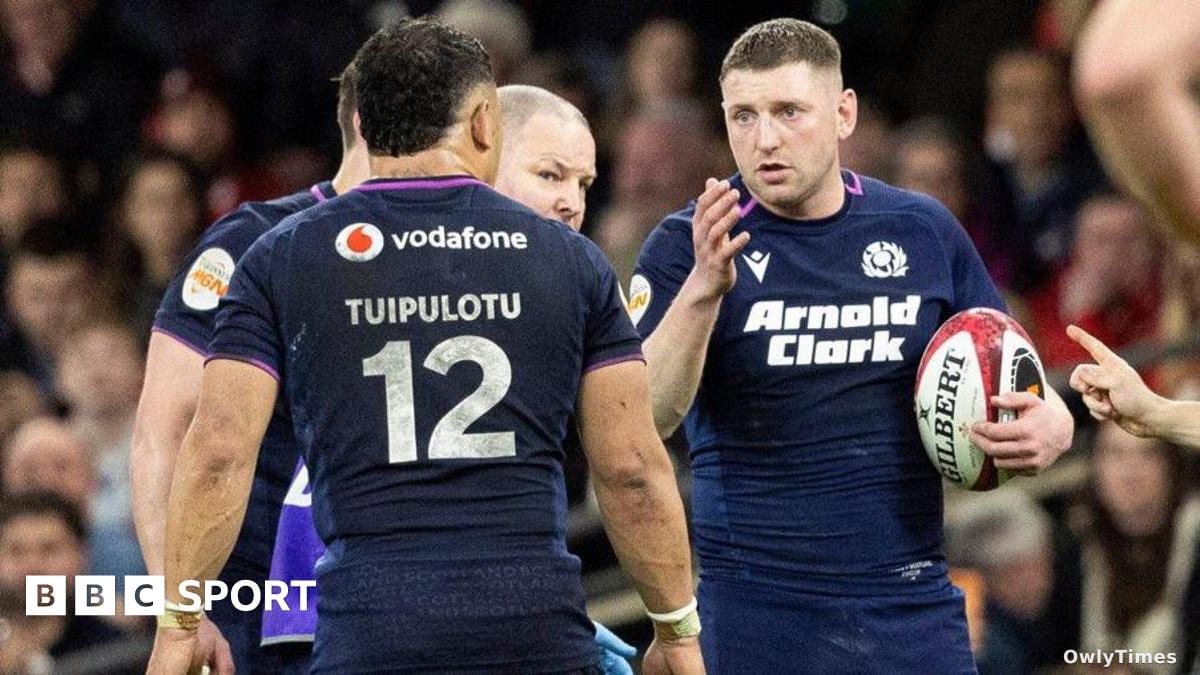

The roar at Murrayfield this Saturday won’t just be for Scotland; it will be a collision of national ambition and calculated rugby dominance. As France, the reigning champions, arrive undefeated and still chasing a Grand Slam, the atmosphere is thick with a tension that transcends the usual Six Nations fervor. It’s not simply a game, but a potential turning point – for Scotland’s historic title hopes, and for the evolving power dynamics within the tournament itself. While headlines focus on the Grand Slam chase, the deeper story is about Scotland’s opportunity to prove they’ve moved beyond being competitive, and into the realm of truly challenging the established order.
The High-Stakes Aerial Duel
The modern game, reshaped by changes to the escort rule, has become a battle for the skies, and France currently reigns supreme. They’ve booted the ball more than any other team in the Six Nations, retaining possession from nine more kicks than their closest competitor, Ireland. This isn’t just about winning back possession; it’s about creating scoring opportunities directly from aerial contests, as evidenced by Louis Bielle-Bierrey’s try against Italy, capitalizing on a crumb from a kick collected by Antoine Dupont. Scotland, however, aren’t conceding air space without a fight. They’re second in kick retention percentage, and scrum-half Ben White leads the tournament with 10 retained kicks. The key now isn’t just matching France’s aerial prowess, but disrupting their rhythm. Gregor Townsend faces a crucial decision: does he stick with the returning Duhan van der Merwe, or unleash Kyle Rowe, whose strength under the high ball and counter-attacking threat could be vital? The stakes are higher than ever, as a single misjudged contest could swing the momentum irrevocably.
Reporting from the BBC informs this analysis.
Confronting French Physicality
Beyond the kicking game, Scotland faces a brute force challenge. While not as consistently emphasized this tournament as in previous years, France still possesses a formidable power game, anchored by behemoths like second-row Emmanuel Meafou, a 6ft 8in, 145kg force of nature. They lead the Championship in total meters carried and average meters gained per carry, and boast the top six most dominant tacklers. The memory of last year’s defeat in Paris, where France ultimately overpowered Scotland in the final quarter, looms large. The disallowed try from Huw Jones and a subsequent French score after a Darcy Graham knock-on felt like pivotal moments where Scotland’s resilience was simply outmatched. This isn’t just about matching physicality; it’s about neutralizing it.
Dempsey’s Return and the Energy of Murrayfield
The potential return of number eight Jack Dempsey, after a bicep injury initially ruled him out for the remainder of the tournament, could be a game-changer. His belligerent ball-carrying style would add a crucial dimension to Scotland’s attack. Equally important will be the contribution of Rory Darge, whose eight turnovers lead the tournament and whose ability to disrupt French ball will be paramount. But physicality alone won’t suffice. Scotland’s defensive record – having missed the fewest tackles in the Championship – needs to be maintained, and their set-piece must be rock solid. Crucially, the energy of the Murrayfield crowd will be a significant factor. The home advantage, combined with a carefully managed bench, could provide the lift needed to withstand France’s inevitable surges. It’s a delicate balance: conserving energy for a grueling battle while simultaneously unleashing the full force of Scottish passion.
The Imperative of a Fast Start
Scotland’s tendency to start slowly against Italy and Wales nearly proved costly. While they salvaged victories, they can’t afford a similar sluggish beginning against a team as ruthless as France. Fabien Galthie’s side has exploded out of the blocks in every match this tournament, scoring six tries in the opening quarter across their three games. Ireland were 22-0 down at halftime in Paris, Wales conceded within 90 seconds, and Italy trailed 19-0 before the half-hour mark. Scotland needs to replicate the intensity they showed against England, where they raced to a 17-0 lead. While France won’t be as charitable as England were, a fast start isn’t just desirable – it’s essential. This isn’t simply about scoring points; it’s about imposing Scotland’s will on the game and forcing France to react.
This match isn’t just about a potential Six Nations title for Scotland; it’s about a statement. Can they consistently challenge the dominance of France, and signal a shift in the balance of power within the tournament? The outcome will reveal whether Scotland is ready to move beyond being a contender, and truly become a force to be reckoned with. The question now isn’t just who will win on Saturday, but what this game will mean for the future of Scottish rugby – and for the competitive landscape of the Six Nations as a whole. Will we see a new era of Scottish ascendancy, or will France continue their reign?

