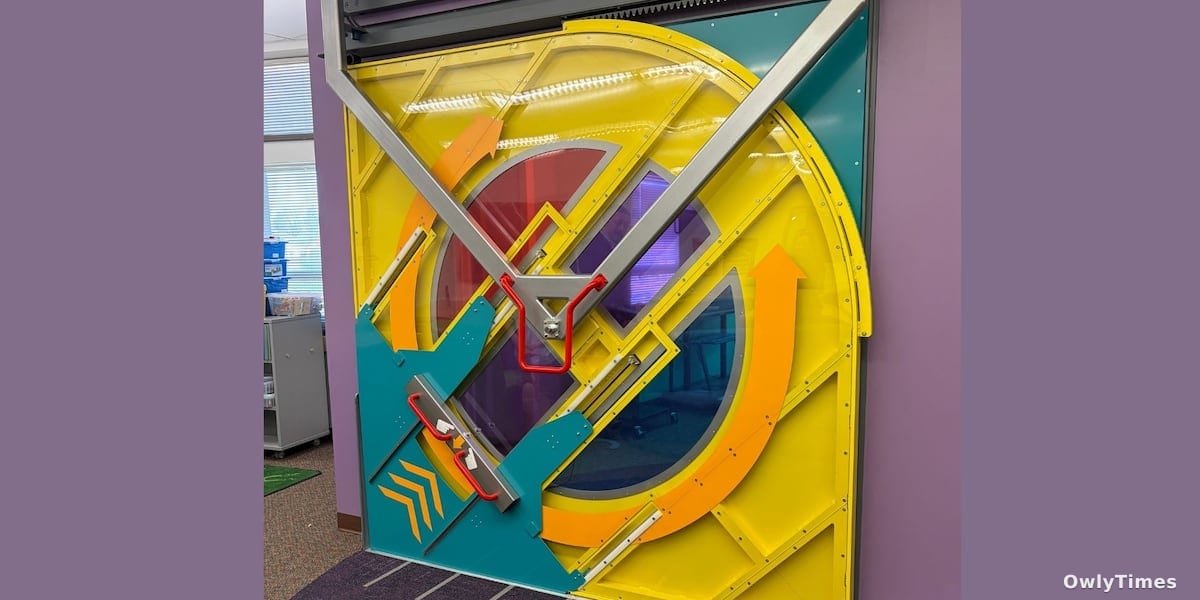

How do we translate the abstract principles of physics into the tactile environment of a primary school classroom? At McAuliffe Elementary School in the Cimarron Hills area, the answer has taken a literal, heavy-duty form. While school architecture is often relegated to the background of the educational experience, the newly unveiled “STEM Door” suggests that the physical infrastructure of a building can serve as an active pedagogical tool rather than a passive barrier.
Engineering a Lesson in Mechanical Advantage
The installation, which stands eight feet tall, is far more than a standard portal between the library and the STEM Lab. Designed in partnership with RTA Architects, the structure weighs nearly 800 pounds, a figure that would typically necessitate heavy machinery or industrial-grade hardware to maneuver. However, the true scientific achievement here is not the mass of the door, but its accessibility.
Despite its imposing scale, the door is designed to be rolled open and closed by elementary students. This design choice highlights a fundamental concept in physics: mechanical advantage. By utilizing a specific track and pulley system, the architects have allowed children to interact with a massive object, providing a visceral demonstration of how engineering can reduce the force required to perform work.
Distinguishing Design from Pedagogy
It is essential to clarify what this installation actually represents versus how it might be perceived. Headlines regarding school improvements often lean into the aesthetic or the novelty of a project, but the intent here is firmly rooted in experiential learning. The school leadership and the design team moved beyond mere utility, choosing the final design out of three different options during the planning phase.
This selection process, finalized in the summer of 2025, prioritized the door's capacity to serve as a demonstrative model for geometry and motion. While the door is not a replacement for a formal curriculum, it functions as a “living” experiment. Students are not just reading about how mass and friction operate in a textbook; they are physically engaging with those variables every time they transition between learning spaces.
Limitations to Consider in Structural Learning
While the integration of STEM concepts into school design is an innovative approach, it is worth noting the inherent limitations of such an installation. A single door, regardless of its engineering, cannot encompass the full breadth of scientific inquiry. The efficacy of the “STEM Door” as a teaching tool depends entirely on the educators' ability to bridge the gap between the physical movement of the door and the mathematical principles it represents. Without structured guidance, the door risks becoming a curiosity rather than a catalyst for academic growth.
Moving Toward Kinetic Literacy
The success of this project will be measured by how consistently the school incorporates the door into its daily science lessons. As students continue to navigate the space, the next reading of student engagement metrics regarding the STEM Lab will show whether this physical investment translates into a deeper understanding of kinetic concepts. By turning the school building itself into a laboratory, McAuliffe Elementary is testing the hypothesis that environmental immersion can foster a more intuitive grasp of physics, setting a precedent for how we might reconsider the architecture of our learning environments.