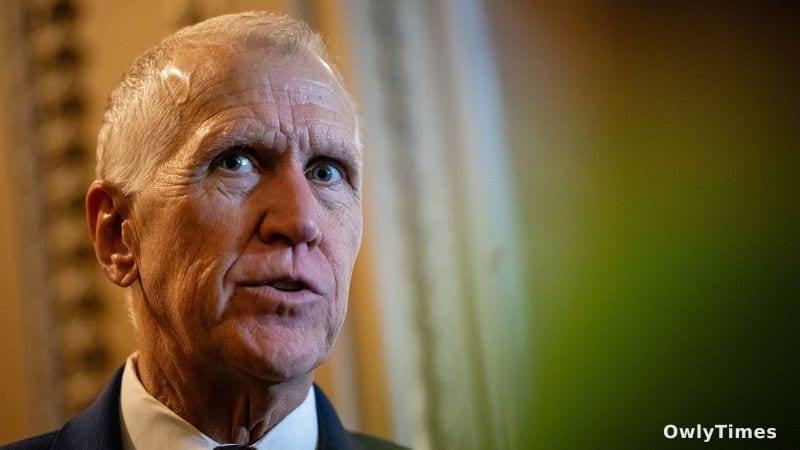

The Strategic Calculation Behind Tillis’s Filibuster Defense
The debate surrounding the “SAVE America Act” isn’t about election security; it’s about the future of the Senate itself. Thom Tillis’s forceful opposition to altering the filibuster rules, even to pass a priority bill for Donald Trump, isn’t a principled stand against voter ID requirements – it’s a calculated defense of minority power within the chamber. Tillis understands that a “talking filibuster,” while seemingly a procedural tweak, fundamentally shifts the balance of power, potentially ceding control of the Senate agenda to Chuck Schumer and the Democrats. This isn’t about this bill failing; it’s about preventing a precedent that could hamstring future Republican administrations.
The core of Tillis’s argument, laid out in his Thursday statement, is that eliminating the traditional filibuster – or even moving to a “talking filibuster” requiring extended debate – would empower the minority party to obstruct the majority’s will indefinitely. He specifically warns that Democrats would be able to “block every single Trump judge and executive branch nominee,” effectively turning the Senate into a permanent state of legislative gridlock. This isn’t hyperbole; the current 60-vote threshold for cloture is the primary check on majority rule in the Senate, and eroding it carries significant risks for both parties. The immediate consequence is the likely failure of the “SAVE America Act,” which, despite being a Trump priority, lacks the necessary support to overcome a filibuster.
Who benefits and who loses here is starkly defined. Republicans, particularly those prioritizing long-term institutional power, lose if the filibuster is weakened. Democrats, eager to confirm judges and advance their legislative agenda, stand to gain. But the calculus is more nuanced within the Republican party itself. While Trump and his allies see the “SAVE America Act” as a crucial step towards bolstering election integrity, Tillis, a retiring Senator, is free from the immediate political pressures of reelection and can afford to prioritize the broader institutional health of the Senate. This explains his willingness to publicly oppose a bill championed by his party’s leader. The fact that Tillis co-sponsored an earlier version of the bill underscores that his objection isn’t to the content of the legislation, but to the method being proposed to pass it.
Drawn from CNN.
This situation echoes historical precedents where attempts to reform Senate rules backfired, altering the balance of power in unintended ways. The 1917 change to limit filibusters, initially intended to expedite wartime legislation, ultimately paved the way for the expansion of presidential power and the decline of senatorial independence. Similarly, the 2013 “nuclear option” – eliminating the filibuster for executive branch and judicial nominations – arguably contributed to the increasingly polarized confirmation battles we see today. Tillis is acutely aware of this history and is attempting to prevent a similar outcome. He’s also highlighting a practical concern: the bill’s potential impact on states with established mail-in voting systems, like Utah, Florida, Alaska, and Montana, a point that reveals a tension between national-level election reform and states’ rights.
Tillis’s critique extends beyond the procedural implications, questioning the strategic wisdom of pursuing a bill destined to fail. He argues that focusing on legislation lacking the necessary votes is a “misuse of the Senate’s time” and advocates for a bipartisan approach to election integrity measures – a call for compromise that, given the current political climate, appears unlikely to be heeded. However, the underlying message is clear: the pursuit of short-term political gains shouldn’t come at the expense of long-term institutional stability. The question now is whether other Republicans will heed Tillis’s warning and resist pressure to dismantle the filibuster, or if the allure of a legislative victory will outweigh the potential consequences. The next political chess move to watch is whether Mitch McConnell will publicly endorse or distance himself from the “talking filibuster” proposal, signaling the direction of the Republican party on this critical issue.





