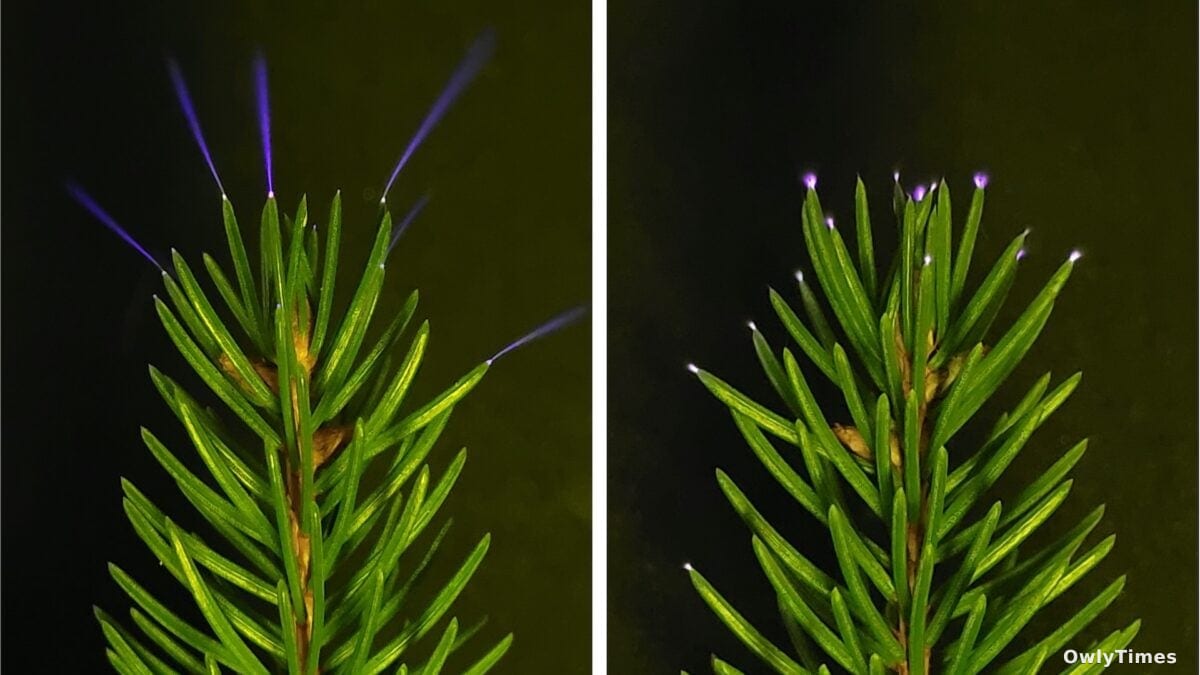

Beyond Lightning: A Newly Observed Electrical Phenomenon in Forests
For decades, the dramatic spectacle of lightning has dominated our understanding of electrical activity during thunderstorms. But what if a subtler, more pervasive electrical dance was occurring on the trees themselves, invisible to the naked eye? A recent study from Pennsylvania State University, published in Geophysical Research Letters, provides the first direct observation of “coronae” – tiny, brief electrical discharges – occurring on tree leaves during active thunderstorms. This isn’t about debunking established physics; it’s about revealing a layer of complexity to atmospheric electricity that’s been theorized for nearly a century but never definitively witnessed in nature. The implications extend beyond simply adding another fascinating detail to storm phenomena; it challenges our models of how charge transfers between the atmosphere and the ground, and potentially influences forest ecosystems.
The core question driving this research, led by meteorologist Patrick McFarland, was whether the laboratory-demonstrated phenomenon of coronae could actually occur in the chaotic environment of a real thunderstorm. Scientists have long understood the principle: a strong electrical field from a thunderstorm induces an opposite charge in the ground. This charge seeks the path of least resistance to neutralize itself, and in forests, that often means concentrating at the sharp points of leaves. However, proving this in the field required a dedicated, and somewhat unconventional, approach. The team didn’t rely on existing weather stations or observation towers. Instead, they equipped a Toyota Sienna minivan with a suite of specialized instruments – a weather station, electric field detector, laser rangefinder, and a custom-built periscope feeding an ultraviolet camera. As McFarland wryly noted, the twelve-inch hole cut in the roof “totally killed the resale value,” but it was essential for capturing the faint ultraviolet emissions produced by the coronae.
What the study actually found, and what’s often lost in initial reporting, isn’t simply that coronae exist on trees. It’s the frequency and behavior of these discharges. Over a 90-minute period during a thunderstorm in Pembroke, North Carolina, the team documented 41 coronae on the tips of sweetgum tree leaves. Each discharge lasted roughly three seconds and frequently “hopped” between adjacent leaves. Crucially, similar activity was observed in subsequent storm chases across the East Coast, on loblolly pines and other species, suggesting this isn’t a species-specific quirk. This consistency, despite varying storm strengths and tree types, is a key finding. It suggests coronae are a common occurrence during thunderstorms, potentially illuminating tens or even hundreds of leaves on a single tree. The fact that these discharges are in the ultraviolet spectrum explains why they’re invisible to the human eye, and why they’ve remained undetected for so long.
Original reporting: gizmodo.com.
It’s important to consider the limitations of this research. The study relied on mobile observation, meaning the team could only analyze a limited number of trees during each storm. While the data suggests widespread occurrence, a comprehensive assessment of coronal activity across diverse forest ecosystems requires a more extensive, long-term monitoring network. Furthermore, the study focused primarily on documenting the presence of coronae, not their precise impact. We don’t yet know the extent to which these discharges contribute to atmospheric chemistry, influence tree physiology, or even play a role in triggering larger-scale lightning events. The team also acknowledges the challenge of differentiating between true coronal discharges and other sources of ultraviolet emissions during a thunderstorm.
Looking ahead, McFarland and his team are focused on refining their detection methods and expanding their observational network. A critical next step is to correlate coronal activity with other atmospheric parameters, such as humidity and wind speed, to identify the conditions that favor their formation. Perhaps even more intriguing is the potential to investigate the biological effects of these discharges on trees. Could coronae influence tree growth, defense mechanisms, or even communication between trees? The answers to these questions could reshape our understanding of the complex interplay between forests and the atmosphere, revealing a hidden electrical world operating right above our heads. The question now isn’t if trees are electrically active during storms, but how that activity shapes the ecosystems we depend on.