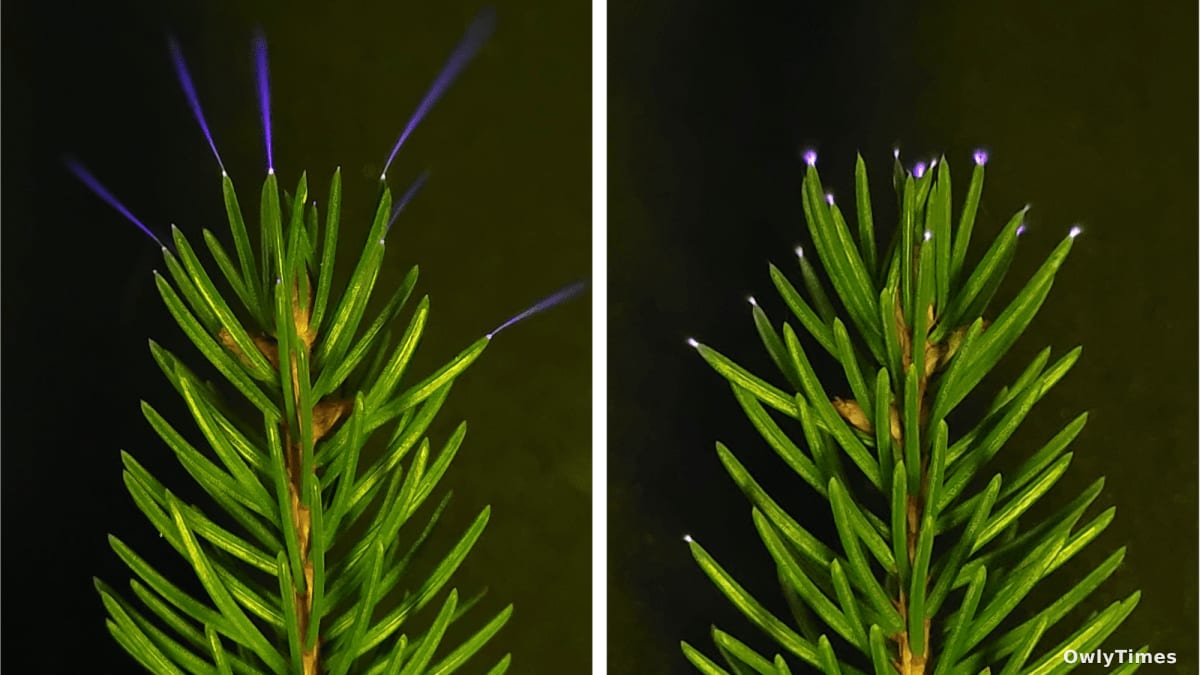

For a century, the idea lingered as a tantalizing possibility – that thunderstorms don’t just rumble over forests, but actively interact with them, painting the treetops in a fleeting, invisible glow. Now, a team led by Patrick McFarland at The Pennsylvania State University has moved that possibility into the realm of confirmed observation. Their work, published in Geophysical Research Letters in June 2024, details the first-ever direct observation of “coronae” – weak electrical discharges – flickering on the tips of leaves during an actual thunderstorm. This isn’t simply about witnessing a beautiful, hidden phenomenon; it’s about recognizing a potentially significant, and previously unquantified, interaction between atmospheric electricity and the biological world, one that could have implications for forest health and even tree evolution.
The long-held speculation stemmed from anomalies detected in the electric fields surrounding forests during storms. Scientists theorized that the intense charge buildup in storm clouds would induce an opposite charge in the ground, creating an electrical gradient. That charge, seeking the path of least resistance, would concentrate at the highest points – the leaves of trees. While laboratory experiments over the past 50 years successfully recreated this effect, demonstrating the formation of coronae under controlled conditions, proving it happened in the chaotic reality of a thunderstorm proved elusive. The challenge wasn’t a lack of theory, but a lack of observational tools capable of detecting these faint discharges amidst the visual and electrical noise of a storm.
Based on the original popsci.com report.
William Brune, whose lab work contributed to the understanding of these phenomena, observed in laboratory settings that these discharges “look like a blue glow” when conditions are right. But translating that laboratory observation to the field required ingenuity. The team, led by McFarland, essentially built a mobile laboratory inside a 2013 Toyota Sienna minivan. Equipped with a weather station, electric field detector, laser rangefinder, and, crucially, a roof-mounted periscope feeding into an ultraviolet-sensitive camera, the “storm-chasing van” allowed them to detect the coronae’s UV emissions – a signature invisible to the naked eye under stormy skies. The team’s dedication to the project is evident in the modifications made to the vehicle, including vibration-dampening pads for sensitive instruments and, notably, a twelve-inch hole cut in the roof to accommodate the periscope.
During a thunderstorm in Pembroke, North Carolina, the team focused their camera on branches of a sweetgum tree. Analyzing the footage, they identified 41 coronae occurring over 90 minutes. These weren’t isolated events; the discharges lasted up to three seconds, shifting between leaves as the branches swayed in the wind. Importantly, the team observed similar coronae on loblolly pines and during four other storms across a wide geographic range, suggesting the phenomenon isn’t limited to specific tree species or storm intensities. This consistency strengthens the argument that coronae are a widespread occurrence during thunderstorms, potentially radiating from hundreds of leaves on each treetop. McFarland suggests that, with superhuman vision, one might perceive “a swath of glow on the top of every tree under the thunderstorm,” resembling a cascade of UV-flashing fireflies.
However, it’s crucial to understand what the study actually found versus what headlines might imply. The research confirms the existence of coronae in natural thunderstorms, a significant step forward. It does not yet quantify the overall impact of these discharges on forest ecosystems. While laboratory studies dating back to the 1960s have shown that electrical current can damage cell membranes and disrupt photosynthesis, the team hasn’t yet established a direct link between coronae and widespread forest damage. The observed discharges can subtly burn leaf tips, and repeated exposure could potentially compromise the cuticle – the protective waxy layer on leaves. But the extent of this damage, and its long-term consequences, remain open questions.
Limitations to consider include the relatively small sample size of storms observed and the focus on only a few tree species. The team’s methodology, while innovative, relies on detecting UV emissions, which could be influenced by factors other than coronae. Furthermore, the study doesn’t address the potential for coronae to contribute to atmospheric chemistry or influence cloud formation, areas where electrical discharges are known to play a role. The team acknowledges that the observed coronae represent only a small fraction of the total electrical energy released during a thunderstorm, and the impact of the remaining energy remains largely unknown.
The next crucial step, as McFarland emphasizes, is collaboration with forest ecologists and botanists. Future research should focus on quantifying the cumulative damage caused by coronae over time, assessing the vulnerability of different tree species, and investigating whether trees have evolved mechanisms to mitigate the effects of these electrical discharges. Perhaps trees in regions with frequent thunderstorms exhibit adaptations to protect their leaves, or even harness the electrical energy in some way. The question now isn’t just whether these ethereal glows exist, but whether they represent a subtle, ongoing negotiation between the atmosphere and the forests that cover our planet – and what the long-term consequences of that interaction might be. Will we see evidence of altered forest composition in areas prone to frequent, intense thunderstorms, favoring species more resilient to electrical stress? That’s a question worth watching for in the coming years.





