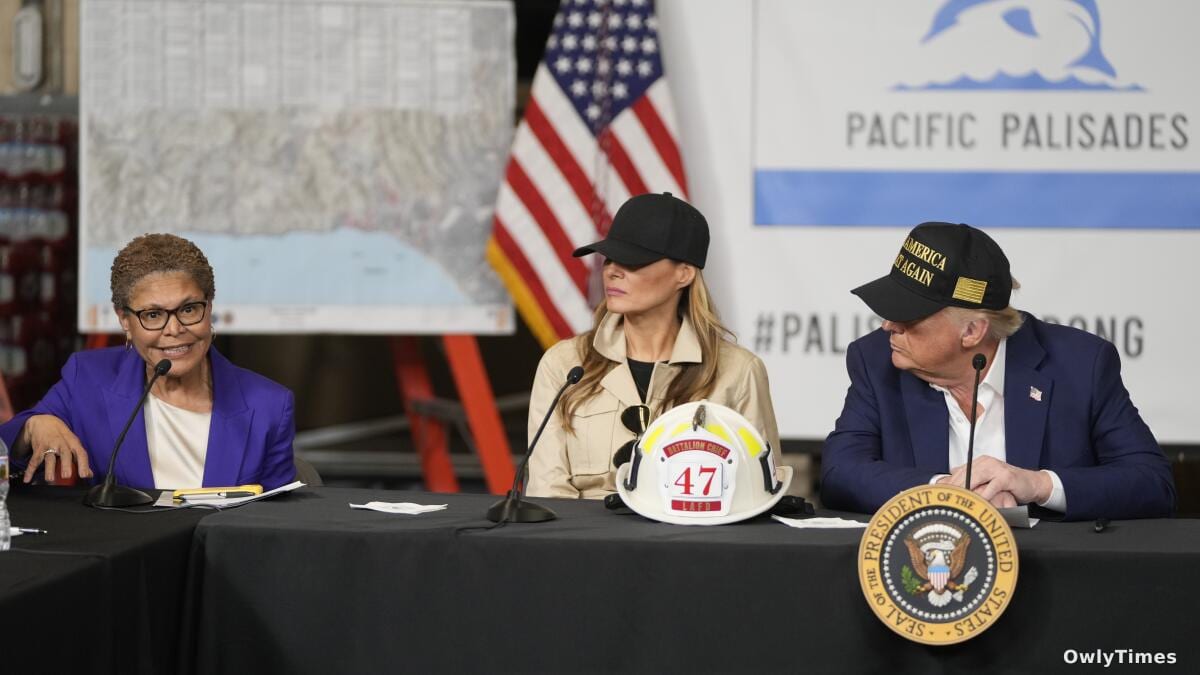

The sudden pivot toward cooperation between the White House and Los Angeles leadership represents a strategic recalibration in the face of a yearlong political stalemate. By moving from a posture of public hostility to one of "cordial" negotiation, President Trump has effectively traded his aggressive rhetoric regarding local governance for a more pragmatic leverage point: the control of federal purse strings. The recent Oval Office meeting, which lasted an hour and a half, signals that both the administration and local officials have recognized that the political cost of a stalled recovery in California has become unsustainable for all parties involved.
The Calculus of Federal Intervention
For the Trump administration, the shift serves a dual purpose. By engaging directly with Los Angeles Mayor Karen Bass and County Supervisor Kathryn Barger, the President moves to reclaim the narrative on disaster recovery, pivoting away from accusations of bureaucratic incompetence toward a display of executive decisive action. The involvement of Environmental Protection Agency Administrator Lee Zeldin, who was tapped by Trump in February to oversee the rebuilding process, appears to have been the catalyst for this change. Zeldin’s on-the-ground presence and his role in facilitating the approval of approximately 2,000 permits provided the administrative proof-of-concept necessary for the White House to justify a shift in tone.
The political winners in this arrangement are clear: the residents of the affected areas, who stand to benefit from a potential $16 billion infusion of federal aid, and the local officials, who can now point to direct White House engagement as a sign of progress. The primary losers are the insurance providers, particularly State Farm, which has become a shared target for both the White House and local authorities. By aligning against the insurance industry, Trump and California Democrats are effectively shifting the burden of the recovery’s financial failures away from their respective administrations and onto private entities.
Navigating the Insurance Impasse
The tension surrounding the recovery efforts has historically centered on the pace of rebuilding and the role of the federal government in local permitting. Earlier this year, the President took the extreme step of ordering a federal takeover of the permitting process, citing the perceived incompetence of local leadership. However, the recent collaboration has reframed this conflict as an issue of corporate accountability. With State Farm facing roughly $7 billion in fire-related claims, the pressure to pay out is mounting from both the federal executive branch and the California insurance commissioner’s office.
This creates an unusual alignment between the Republican White House and Democratic local officials. By framing the insurance industry as the obstacle to recovery, they have created a common enemy that masks the previous year of litigation and public finger-pointing. The success of this strategy relies on the ability of Barger and Bass to move past the memory of Trump calling the Mayor "incompetent" just months ago.
The Path Through Congress
Despite the newfound warmth in the Oval Office, the actual distribution of the $16 billion—$8 billion for the city and $8 billion for the county—remains a legislative hurdle. The request is part of a larger $33.9 billion package championed by Gov. Gavin Newsom, which includes broader fire prevention and economic measures. The next phase of this chess match will occur on Capitol Hill, where Barger and Bass must secure congressional appropriations.
The political move to watch next will be the formal submission of the aid request to Congress. The success of this effort will depend on whether the bipartisan cooperation demonstrated in the Oval Office by Barger, a Republican, and Bass, a Democrat, can survive the scrutiny of a divided legislature. The next reading of the progress on these appropriations will determine whether this meeting was a substantive breakthrough or merely a temporary alignment of interests aimed at insulating both levels of government from the ongoing frustrations of the 2025 fire victims.