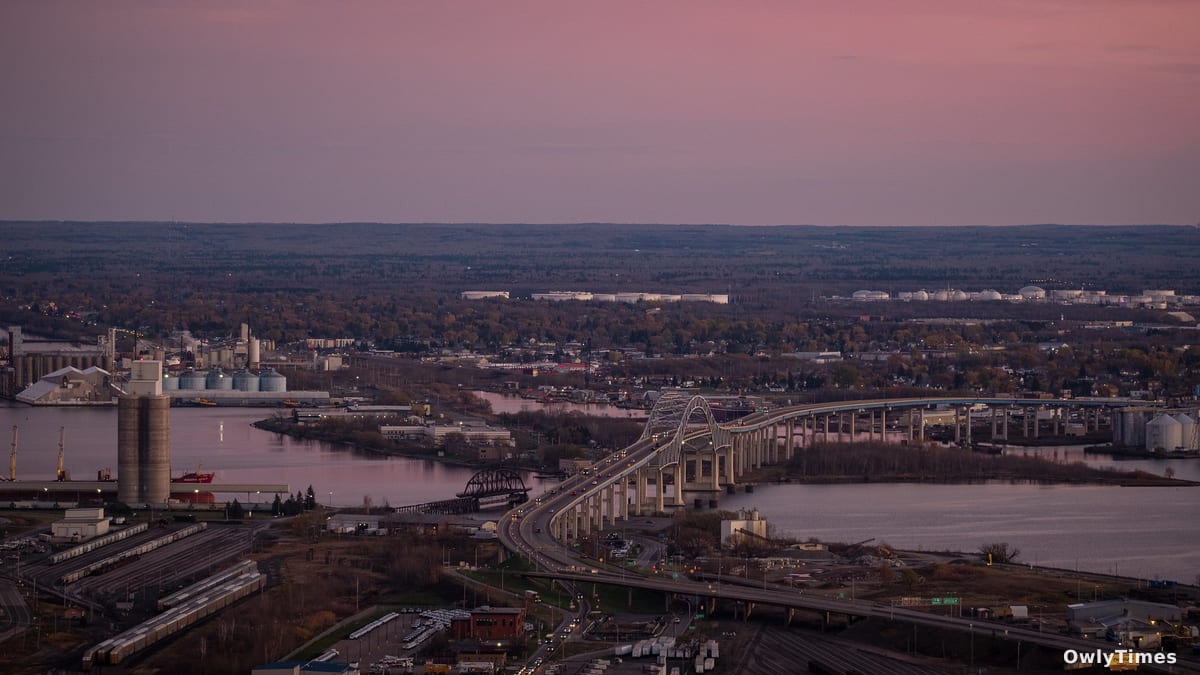

$1.8 billion is hanging in the balance, and with it, the future of commerce and transportation in the Twin Ports of Superior, Wisconsin, and Duluth, Minnesota. The potential blockage of federal funding for the Blatnik Bridge replacement, promised under the previous Infrastructure Act, isn’t simply a political standoff – it’s a calculated risk assessment playing out in boardrooms and on Main Street. Follow the money, and a clear picture emerges: a region that has meticulously planned for a five-year disruption is now bracing for the possibility of no disruption at all, a scenario that could be even more financially damaging.
The Cost of Uncertainty: Beyond Construction Delays
The Blatnik Bridge, slated for replacement by 2030, has become the linchpin of economic forecasting for northwestern Wisconsin. As Jim Caesar, executive director of the Development Association of Superior and Douglas County, pointed out to WPR, the region’s business community has already begun factoring in a five-year construction period. This isn’t merely about traffic congestion; it’s about supply chain adjustments, rerouting logistics, and potentially absorbing increased transportation costs. The Superior Business Improvement District even proposed a special tax district to mitigate the impact on local businesses – a proactive measure predicated on the assumption of forward momentum. Now, that momentum is threatened. The $1.8 billion project, with $400 million commitments from both Wisconsin and Minnesota, is effectively stalled while the Trump administration weighs its options, a tactic described by Kelly Peterson of the Superior Business Improvement District as “ramping up anxiety only to not follow through.” This isn’t a new strategy for the former president, but its application to critical infrastructure projects introduces a unique level of economic vulnerability.
Source material: wpr.org.
A Regional Economy Built on a Bridge
The scale of the potential disruption is significant. The Blatnik Bridge isn’t just a transportation artery; it’s a vital component of the regional economy. A delay, or worse, a complete cancellation of the project, doesn’t just impact construction jobs. It jeopardizes the long-term viability of businesses reliant on efficient freight transport, particularly those involved in manufacturing and resource extraction. The alternative – relying solely on the Bong Bridge – creates a single point of failure, increasing vulnerability to disruptions and potentially driving up transportation costs. Consider this: a 2023 study by the American Transportation Research Institute found that congestion costs the trucking industry an estimated $95 billion annually nationwide. While the Twin Ports aren’t a major national bottleneck, increased reliance on a single bridge will inevitably translate to higher costs for businesses, ultimately passed on to consumers.
Political Silence and the State’s Stake
The lack of public response from key political figures is noteworthy. WPR’s attempts to solicit comment from U.S. Transportation Secretary Sean Duffy and Senator Tammy Baldwin went unanswered. This silence, while perhaps strategic, underscores the delicate political balancing act at play. Wisconsin’s commitment of $400 million to the project represents a substantial investment, and a failure to secure federal matching funds would leave the state holding the bag. Moreover, the delay impacts not only Wisconsin’s funds but also Minnesota’s $400 million contribution, creating a ripple effect of financial uncertainty across state lines. Caesar highlighted this interconnectedness, noting that a delay “holds up the state money from both Minnesota and Wisconsin as well.” This isn’t a partisan issue; it’s a matter of responsible fiscal management and fulfilling commitments to constituents.
The Long Game: Waiting Out the Administration?
The question now is whether businesses should proceed as planned, banking on a resolution, or prepare for the worst. While Minnesota Department of Transportation officials have reportedly been instructed to continue working on the project, the underlying uncertainty remains. Peterson rightly points out the escalating costs of construction – a delay won’t result in savings; it will likely exacerbate the financial burden. Waiting out the administration, as some suggest, is a gamble. While a change in presidential administration in 2029 could restore funding, the cost of materials and labor will inevitably increase over the next seven years, potentially rendering the original budget obsolete. The “pittance” that $400 million might become, as Peterson fears, is a very real possibility.
What this means for your wallet: If you live in or rely on goods transported through the Twin Ports, prepare for potential price increases. The uncertainty surrounding the Blatnik Bridge replacement isn’t just a business problem; it’s a consumer problem. Watch for businesses to begin factoring in “risk premiums” into their pricing, anticipating potential transportation disruptions. More importantly, pay attention to whether state legislators begin to explore alternative funding mechanisms – and whether those mechanisms will require increased taxes or fees. The next six months will be critical in determining whether the Blatnik Bridge replacement remains a viable project, or becomes another example of infrastructure promises unfulfilled.





