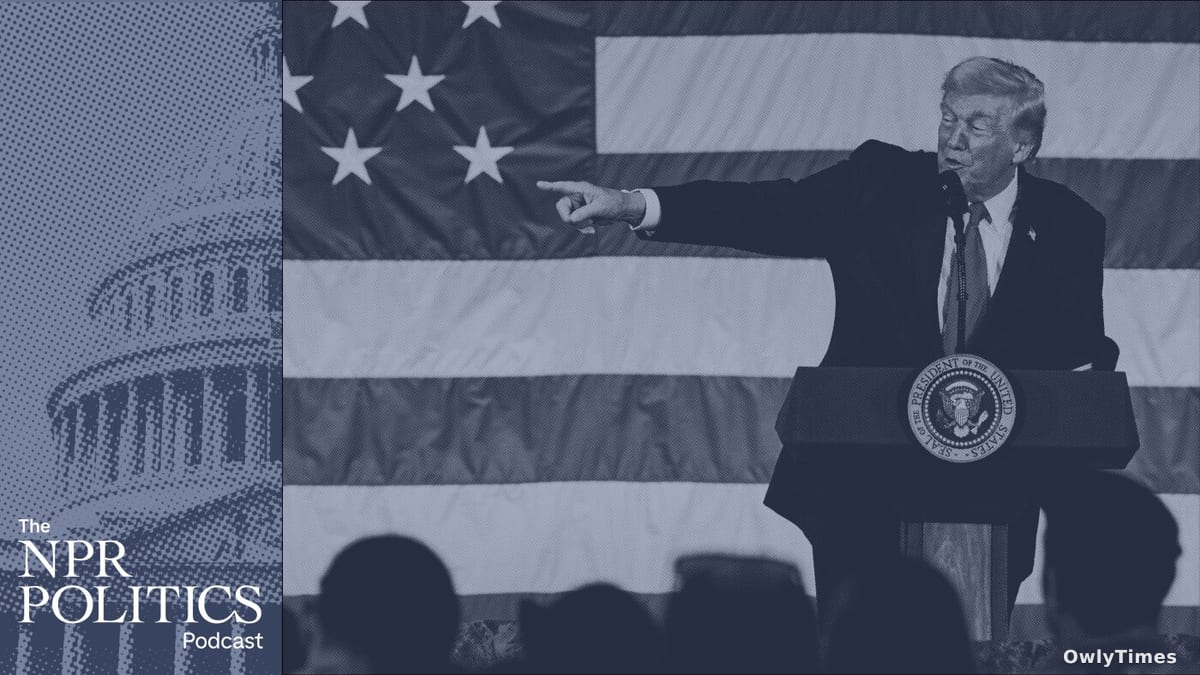

The flurry of lawsuits filed by Donald Trump against the United States government isn’t about legal redress; it’s a meticulously calculated continuation of a political strategy honed over decades – weaponizing the justice system to control narratives, rally supporters, and financially benefit from the resulting attention. The demand for “billions” in damages, as reported by NPR’s Politics Podcast featuring Ashley Lopez, Carrie Johnson, and Tamara Keith, isn’t a realistic expectation of court-ordered payouts, but a performance designed to reinforce a carefully constructed image of victimhood and grievance. This isn’t a novel tactic, but a modern iteration of a playbook as old as American politics itself, one that finds echoes in the legal battles waged by figures like Joseph McCarthy and even, arguably, Andrew Jackson.
The Calculus of Contention: Lawsuits as Political Theater
The core strategic advantage for Trump lies in shifting the focus from potential legal liabilities – stemming from investigations into his business practices and actions surrounding the January 6th insurrection – to a posture of offense. By being the plaintiff, demanding massive compensation from the government, he reframes himself as the target of a “witch hunt,” a theme consistently deployed throughout his political career. The specific amount demanded – “billions” – is deliberately hyperbolic, designed not for judicial consideration, but for media amplification. This tactic bypasses traditional fact-checking and relies on the sheer volume of coverage to imprint the narrative of persecution onto the public consciousness. The NPR report highlights this dynamic, noting how Trump consistently utilizes lawsuits as tools to dominate news cycles. This isn’t about winning in court; it’s about winning in the court of public opinion.
Original reporting: NPR.
Who Benefits and Who Loses in This Legal Offensive?
The immediate beneficiaries are Trump himself and his fundraising apparatus. The lawsuits provide fodder for relentless email blasts and rally speeches, effectively monetizing grievance. His supporters, primed to believe in a deep-state conspiracy, are likely to contribute generously to legal defense funds, even if the bulk of those funds are diverted to other purposes. The losing parties are more diffuse. The U.S. Justice Department, already stretched thin, now faces the burden of defending against frivolous lawsuits. Public trust in the legal system erodes as the process is perceived as being manipulated for political gain. And, critically, the focus on these manufactured conflicts distracts from legitimate investigations and policy debates. The cost isn’t merely financial; it’s the further polarization of an already fractured political landscape. The podcast contributors, Lopez, Johnson, and Keith, implicitly acknowledge this cost by focusing on the significance of the claims, rather than their legal merit.
Historical Parallels: From Jackson to McCarthy
The use of legal challenges to advance a political agenda isn’t unique to Trump. Andrew Jackson’s battles with the Second Bank of the United States, while not direct lawsuits against the government, involved a sustained campaign to undermine a federal institution he viewed as an obstacle to his populist vision. Similarly, Joseph McCarthy’s accusations of communist infiltration, though largely unsubstantiated, relied on public hearings and accusations that functioned as a form of legalistic harassment, destroying reputations and chilling dissent. Trump’s strategy differs in its directness – he’s actively suing the government – but the underlying principle is the same: weaponizing the legal system to attack perceived enemies and consolidate power. The scale of the financial demand, however, is a distinctly modern escalation, reflecting the increased role of money in politics and the power of media amplification.
The Production Behind the Performance
The meticulous production of this political theater shouldn’t be overlooked. The NPR Politics Podcast itself, produced by Casey Morell and Bria Suggs, and edited by Rachel Baye, with Muthoni Muturi as executive producer, demonstrates the media’s role in amplifying these claims, even while analyzing their strategic intent. The very act of discussing the lawsuits, dissecting their motivations, and providing context lends them legitimacy. This isn’t a criticism of responsible journalism, but a recognition of the inherent challenge in covering a politician who understands how to manipulate the news cycle. The podcast’s existence, and its sponsorship opportunities through NPR Politics Podcast+, further illustrates the economic incentives at play in maintaining a constant stream of political content, even when that content is driven by manufactured controversy.
The political chess move to watch next isn’t whether Trump wins any of these lawsuits – he likely won’t. It’s whether he can successfully leverage the resulting publicity to position himself as a martyr, and whether that narrative gains traction among Republican voters as the 2024 election cycle intensifies. Specifically, will he be able to translate this perceived persecution into increased fundraising and voter turnout, and will any potential Republican rivals attempt to emulate this strategy, further normalizing the weaponization of the legal system for political ends?





