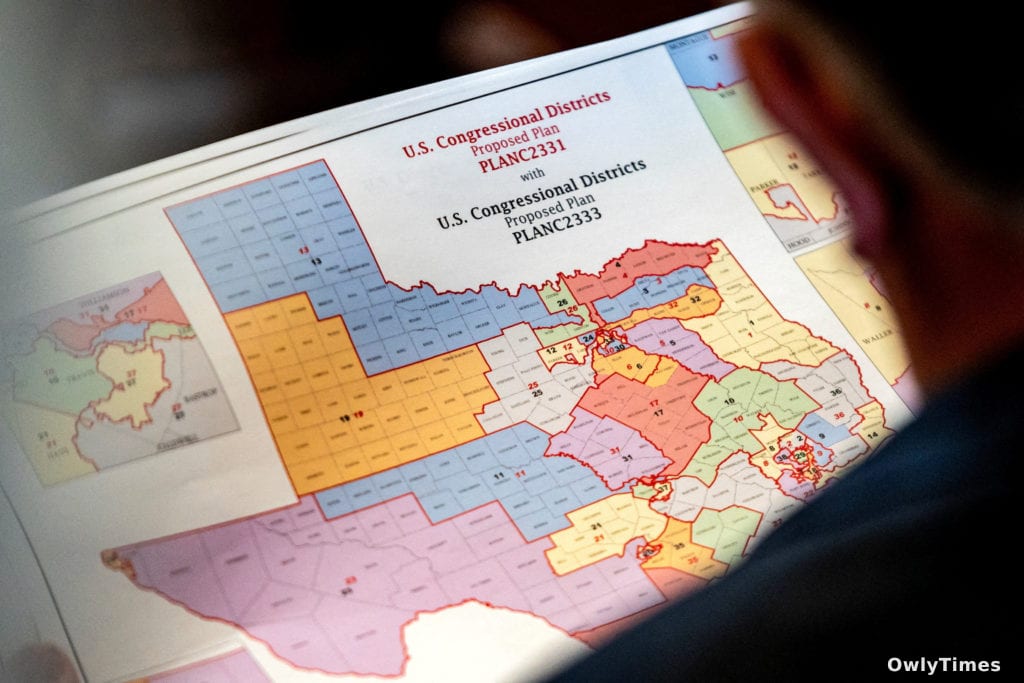

The strategic calculus behind Texas’s recently enacted congressional map is starkly clear: to solidify and expand Republican power in the U.S. House of Representatives by fundamentally reshaping the state’s electoral landscape. Adopted earlier this year, the map is an aggressive gerrymander designed to boost Republican representation in the upcoming midterm elections, a move explicitly aimed at achieving a target set by former President Donald Trump. This isn't merely about winning more seats; it's about engineering a structural advantage that could reverberate for a decade.
Engineering Electoral Dominance through "Cracking"
The core tactic employed by Texas Republicans is known as "cracking." This method involves meticulously dissecting and distributing Democratic-leaning voters across multiple congressional districts, diluting their collective strength. Instead of concentrating these voters into a few reliably Democratic districts, the strategy spreads them thin, ensuring that in each new configuration, they are outnumbered by Republican-leaning voters. The intended outcome is a dramatic shift: if successful, Democrats will see their representation in Texas shrink from their current 13 districts to a mere eight out of the state's 38 congressional seats. This projected five-seat gain for Republicans underscores a calculated effort to manipulate electoral geography for partisan advantage.
See the original PBS story for the full account.
The precision required for such a maneuver is immense, relying heavily on predictive models of voter behavior. As the source material notes, one common approach involves scrutinizing the most recent general election results, viewing them as the freshest snapshot of the electorate's preferences. However, this is where the strategic gamble emerges. The map's success hinges on a critical, yet unverified, assumption: that the voters who turned out for Donald Trump two years ago will show up again for other Republican candidates when his name is not on the ballot. This introduces a significant variable into what is otherwise a tightly controlled political operation.
Historical Echoes of Partisan Mapmaking
The practice of redrawing electoral maps to favor one party over another is as old as the republic itself, famously named after Elbridge Gerry in 1812. From the post-Reconstruction era in the South, where maps were used to disenfranchise Black voters, to the highly sophisticated, data-driven gerrymanders of the modern era, the underlying principle remains consistent: political power can be forged not just at the ballot box, but in the map-drawing room. Texas’s current efforts resonate with these historical precedents, demonstrating a party's willingness to use its legislative control to insulate itself from broader demographic or political shifts. The tension lies in the democratic ideal of fair representation versus the raw exercise of power to secure partisan majorities.
Who benefits unequivocally from this strategic realignment? The Republican Party in Texas, and by extension, the national Republican Party, stands to gain a significant boost in its quest for a House majority. A gain of five seats in a state as large and electorally significant as Texas is not a marginal adjustment; it represents a substantial shift in the national balance of power. For Democrats, the immediate loss is clear: five congressional seats and a diminished voice in a state that is rapidly diversifying. More broadly, Democratic-leaning voters in Texas lose their collective agency, their votes rendered less potent by being dispersed across districts where they cannot form a majority.
The Trump Voter Variable: A Midterm Test
However, the "who loses" also includes an element of risk for the architects of the map. The math, as the source points out, is not simple. Redistricting relies on predicting future voter behavior, and the past two years have shown that voter turnout can be highly volatile, especially when a galvanizing figure like Trump is absent from the top of the ticket. If the anticipated surge of Trump-era voters fails to materialize for down-ballot Republicans in the midterms, the finely tuned "cracking" strategy could unravel. Districts designed to be lean Republican could become competitive, or even vulnerable, if Democratic turnout holds or exceeds expectations while the targeted Republican base stays home. This presents a genuine contradiction: the map is built on the strength of a specific electoral wave, but that wave's recurrence without its catalyst is far from guaranteed.
The political chess move to watch next is not just whether Republicans secure these five targeted seats, but how voter turnout, particularly among the base that delivered Trump's victories, performs in these newly drawn districts. The effectiveness of this aggressive gerrymander hinges entirely on the sustained engagement of a specific demographic in a non-presidential election year. Should the Republican calculus prove accurate, Texas will serve as a powerful template for partisan mapmaking nationwide. Should it falter, however, it will demonstrate the inherent risks of over-relying on past electoral performance to predict the future, especially when the key player is no longer on the ballot. The midterm primaries currently underway in Texas are not just a prelude to the general election; they are the first real-world test of a high-stakes strategic gamble.





