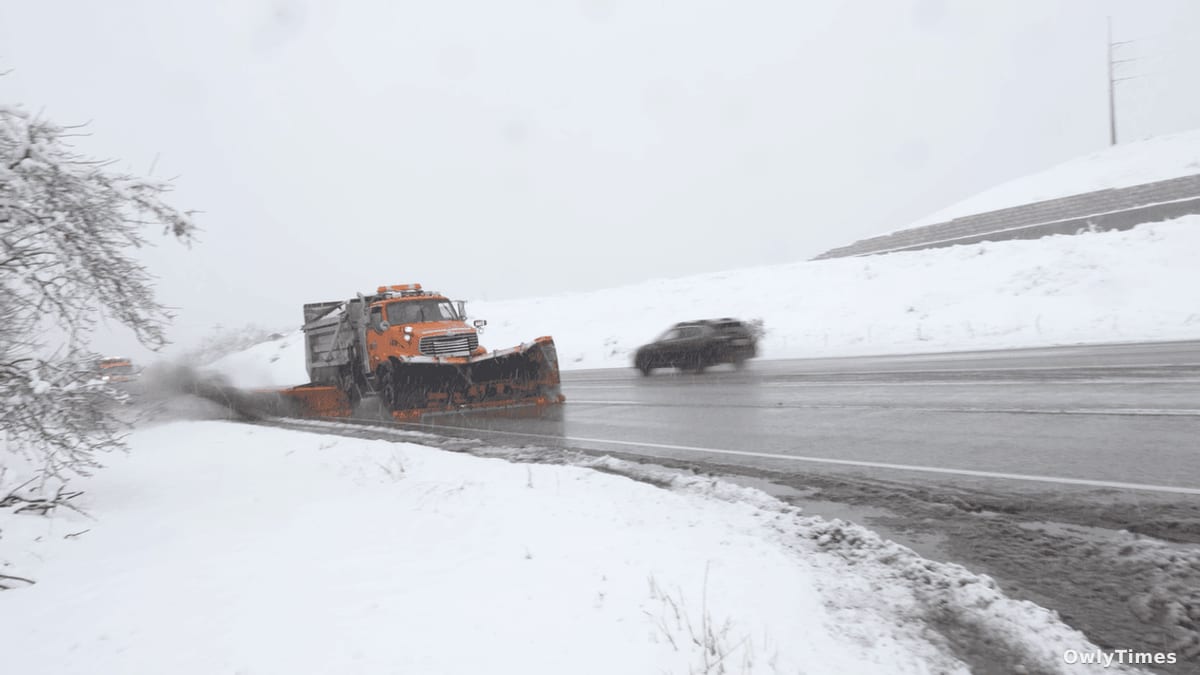

Is a green light really a symbol of progress when it’s reserved for snowplows? Utah’s Department of Transportation (UDOT) thinks so, announcing a $621 million investment – alongside other ongoing projects like the Bangerter Highway conversion and a $35 million Spanish Fork Canyon underpass – to equip 259 snowplows and 1,275 intersections with “vehicle-to-everything” (V2X) technology. The real story here isn't about faster snow removal – it’s about the quiet, creeping infrastructure of a connected future, and who gets priority access to it. While UDOT frames this as a safety measure, a “digital seatbelt” as Blaine Leonard, a UDOT transportation technology engineer, put it, it’s also a very public test case for a system that will inevitably raise questions about fairness and access.
The premise is simple: plows equipped with V2X can communicate directly with traffic signals, effectively requesting and receiving green lights. Codie Alsop, a UDOT snowplow driver, highlights the practical impact: less time idling at red lights translates to more time clearing snow. During a storm, that efficiency matters. But let’s be clear, this isn’t about solving traffic for everyone; it’s about optimizing a specific, critical function. UDOT estimates this will support snow removal for over 90% of Utah’s population, but that leaves a significant minority potentially impacted by the prioritization of plow routes. The department covers over 16,000 lane miles, a vast network where even small delays can ripple outwards.
Source material: kutv.com.
Beyond the Plow: The V2X Ecosystem Takes Shape
This isn’t a standalone project. V2X is the umbrella term for technologies allowing vehicles to communicate with everything around them – other vehicles, infrastructure, even pedestrians (eventually). It’s a foundational element of autonomous driving, but its benefits extend far beyond self-driving cars. Think about emergency vehicles getting priority at intersections, or freight trucks coordinating to optimize traffic flow on major routes. UDOT’s expansion of V2X onto highly traveled roads and freight routes signals a broader strategy. The agency isn’t just clearing snow; it’s building a testbed for a future where traffic isn’t just managed, but actively orchestrated.
The Cost of Seamlessness: Who Pays for the Green Wave?
The $621 million price tag raises a crucial question: what are we sacrificing for this seamlessness? While UDOT touts the safety benefits, the investment could arguably be directed towards more fundamental infrastructure improvements – repairing potholes, expanding public transit, or addressing long-standing traffic bottlenecks. The focus on V2X feels distinctly Silicon Valley-driven, prioritizing technological solutions over potentially more impactful, albeit less glamorous, fixes. And the implications extend beyond budget allocation. As V2X becomes more sophisticated, the data generated by these connected systems will become incredibly valuable. Who owns that data? How will it be used? Will it be accessible to the public, or will it be locked behind proprietary algorithms?
The Equity Question in a Connected World
The promise of V2X is efficiency, but efficiency often comes at a cost. If snowplows consistently receive green lights, it inherently means someone else is getting a red. While the impact on individual commuters might be minimal, the cumulative effect could be significant, particularly in areas with already congested roadways. This raises a fundamental equity question: are we creating a system where those deemed “essential” – in this case, snowplow drivers – receive preferential treatment, while others are left to navigate the consequences? The potential for algorithmic bias in these systems is real, and it’s a conversation we need to be having now, before these technologies become deeply embedded in our infrastructure.
Looking ahead, watch for a surge in public-private partnerships focused on V2X implementation. UDOT’s move will likely be followed by other states and municipalities eager to demonstrate their commitment to “smart cities.” But the real test won’t be whether the technology works – it almost certainly will. The test will be whether we can build a connected transportation system that benefits all users, not just those with the most compelling use case. Specifically, in the next 18 months, expect to see the first public debates over data privacy and access related to V2X systems, and a growing demand for transparency in how these algorithms are designed and deployed.