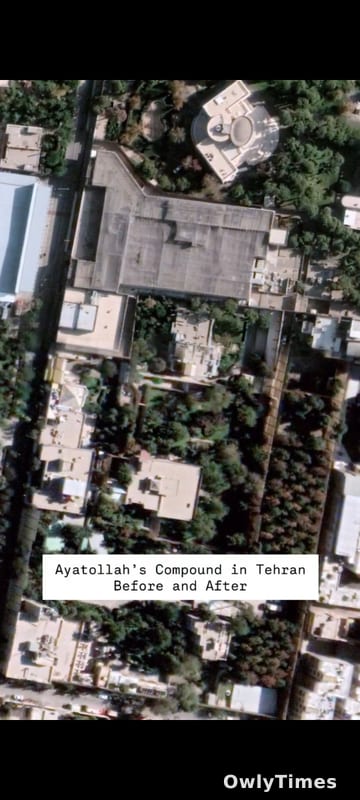

The calculated risk at the heart of the current US-Israeli operation against Iran isn’t simply about neutralizing a perceived threat; it’s a demonstration of proactive dominance, a shift from containment to pre-emptive incapacitation. The assassination of Ayatollah Ali Khamenei, confirmed by Donald Trump’s boastful declaration – “I got him before he got me” – wasn’t a spontaneous reaction, but the culmination of months of planning, leveraging intelligence gathering techniques like hacking traffic cameras to pinpoint the Supreme Leader’s movements. This isn’t merely retaliation for past actions; it’s a signal to regional adversaries and global powers alike about the willingness to directly target leadership, a tactic historically reserved for wartime scenarios.
The Strait of Hormuz and the Calculus of Disruption
The immediate consequence of these strikes, beyond the destruction of Iranian military assets like the aircraft at Bushehr airport and the attacks on facilities near Mehrabad airport in Tehran, is the disruption of global energy markets. Iran’s closure of the Strait of Hormuz, a chokepoint for roughly 20 million barrels of crude oil daily, isn’t a symmetrical response to Khamenei’s death; it’s an escalation designed to maximize economic pain and force a negotiated settlement. This mirrors the 1980s “Tanker War” during the Iran-Iraq conflict, where both sides targeted oil shipping to cripple their opponent’s economies. However, the current situation differs in that the US and its allies possess a far greater capacity for military intervention and alternative supply routes, though those alternatives come at a cost. Who benefits and who loses here is stark: Iran attempts to leverage its geographic position, while global economies, particularly those reliant on Middle Eastern oil, face instability.
This piece references the ndtv.com report.
A Joint Operation and Shifting Alliances
The joint nature of the US-Israeli operation is crucial. While Israel has long advocated for a harder line against Iran’s nuclear program and regional influence, relying on covert operations and targeted killings, the overt involvement of the US lends legitimacy – and significantly greater firepower – to the effort. This partnership, however, isn’t without its tensions. Benjamin Netanyahu’s government has historically pushed for a more aggressive stance than the US, and the current operation could be interpreted as a validation of that approach. The risk is that this emboldens Israel to pursue further unilateral actions, potentially widening the conflict beyond Iran’s borders. The attacks utilizing Tomahawk missiles from the Persian Gulf and fifth-generation fighters like the F-22 and F-35 demonstrate a coordinated effort to overwhelm Iranian air defenses and strike deep within the country.
Iran’s Response: Asymmetry and Regional Spillover
Iran’s response, characterized by a barrage of missiles and drone attacks – particularly the use of low-cost Shahed drones – highlights a strategy of asymmetric warfare. Unable to directly confront the US and Israel on conventional terms, Iran is attempting to overwhelm defenses with sheer volume and target both military and civilian infrastructure. The attacks on Gulf nations, alongside US targets like embassies and military bases, are a deliberate attempt to broaden the conflict and draw regional actors into the fray. This echoes the tactics employed by Hamas and Hezbollah, both Iranian proxies, in previous conflicts with Israel. The targeting of civilian buildings, however, represents a dangerous escalation, potentially triggering a more forceful international response.
The Next Phase: De-escalation or Entrenchment?
The immediate political chess move to watch isn’t whether Iran will reopen the Strait of Hormuz, but whether the US and Israel will respond to Iran’s escalating attacks with further strikes on Iranian soil. A continued cycle of escalation risks a full-scale regional war, drawing in countries like Saudi Arabia, Turkey, and potentially even Russia. However, a pause in offensive operations could be interpreted as weakness, emboldening Iran to continue its destabilizing activities. The key question is whether back-channel negotiations – likely mediated by countries like Oman or Switzerland – can establish a framework for de-escalation, or if the current trajectory will lead to a prolonged and increasingly dangerous confrontation. Will the Biden administration prioritize containing the conflict, or will it allow the situation to escalate further, potentially mirroring the unintended consequences of the 2003 invasion of Iraq?





