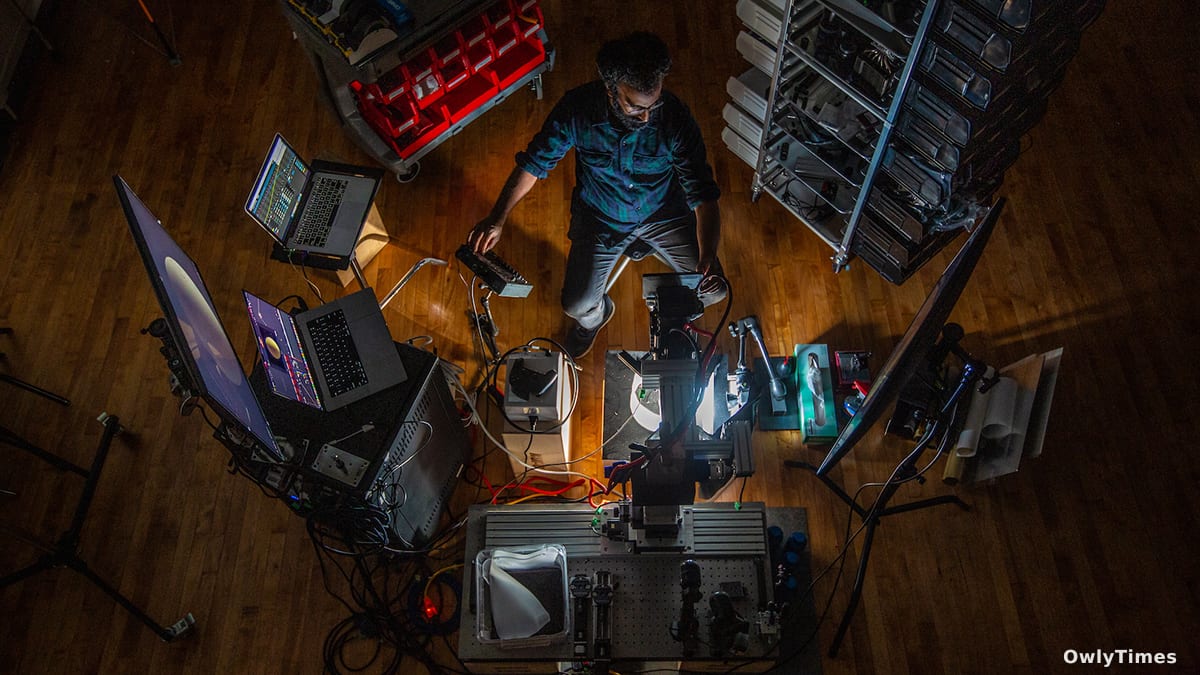

The persistent undercurrent in science communication is a tension between accessibility and accuracy. We often see striking images – a vibrant cell, a dramatic astronomical event – paired with simplified explanations that, while engaging, can sometimes obscure the nuances of the research itself. But what happens when the pursuit of visual clarity becomes the research, when the very act of making the invisible visible reveals new insights? This is the driving force behind the work of Anand Varma, a photographer whose upcoming keynote lecture at the Natural History Museum of Utah on April 21st highlights a unique intersection of art, science, and storytelling. Varma isn’t simply illustrating scientific findings; he’s actively using photographic innovation to explore and even discover biological phenomena.
For Varma, the initial path wasn’t photography at all. He began his undergraduate studies at the University of California, Berkeley, intending to become a scientist. It was a chance opportunity to assist a National Geographic photographer, David Liittschwager, that altered his trajectory. He spent the next seven years traveling with Liittschwager, learning the craft and realizing that photography could offer the same intellectual fulfillment he sought in a traditional scientific career. This isn’t a story of abandoning science, but of finding a different, equally rigorous, method of inquiry. As Varma himself puts it, “I realized that photography could give me all the opportunities that I thought only a science career could.”
Original reporting: attheu.utah.edu.
His work often focuses on subjects most people actively avoid – parasites. These often-overlooked organisms, frequently dismissed as simply harmful, are revealed by Varma’s lens as complex and fascinating players in the ecosystem. A particularly compelling example is his work documenting the nematomorph, or horsehair worm, and its manipulation of crickets. The worm lives inside a cricket, and when ready to reproduce, hijacks the cricket’s nervous system, compelling it to drown itself so the worm can emerge into the water. Capturing this process photographically required over 5,000 attempts, a testament to the challenges of visualizing such a fleeting and unsettling event. The final image, however, isn’t a sensationalistic depiction of horror, but a carefully constructed composition using diffuse lighting, water-repellent treatments, and precise temperature control to highlight the worm without overwhelming the viewer. It’s a demonstration of how photographic technique can shape perception and understanding.
It’s crucial to understand what this study – or rather, this practice – actually found versus what headlines might suggest. Varma isn’t proving the existence of mind-controlling parasites; that biological reality is well-established. Instead, he’s demonstrating the power of visual storytelling to make complex scientific processes accessible and engaging. He’s not just showing us the parasite’s influence, he’s revealing the elegance and even the beauty of its strategy. This is a subtle but important distinction. The image isn’t evidence; it’s a tool for communication, and a remarkably effective one at that. His hummingbird project further illustrates this point. Faced with the challenge of photographing a subject that felt visually exhausted – “Every photo of a hummingbird that can be taken has already been taken,” he was told – Varma collaborated with researchers studying hummingbird flight mechanics, recreating their experiments to offer a fresh perspective.
However, it’s important to consider the limitations. Varma’s work, while scientifically informed, is ultimately an artistic interpretation. The lighting, composition, and even the choice of subject are influenced by aesthetic considerations. While he strives for accuracy, the images are not objective recordings of reality. They are constructed narratives, and as such, are subject to the biases and perspectives of the artist. Furthermore, the intensive setup and specialized equipment required for his photography are not easily replicable, meaning his methods aren’t necessarily a broadly applicable tool for scientific research. The accessibility of the Canon EOS 5D Mark II and 100-millimeter macro lens he uses, as he points out, doesn’t negate the significant expertise and resources needed to achieve his results.
Looking ahead, Varma’s work extends beyond individual photographic projects. He founded WonderLab, an experimental science photography studio in Berkeley, funded by the National Geographic Society. This space serves as a hub for interdisciplinary collaboration, bringing together photographers, scientists, and educators to explore new ways of connecting people to the natural world. The development of digital resources for visual science storytelling is also underway. This is a critical next step. The true impact of Varma’s work won’t be solely in the stunning images he creates, but in the broader shift he encourages – a move towards a more visually literate and engaging approach to science communication. The question now is whether this model, combining artistic skill with scientific rigor, can be scaled and integrated into mainstream science education and outreach. Will we see more institutions prioritizing visual exploration as a legitimate form of scientific inquiry, or will it remain a niche practice celebrated for its aesthetic value but largely divorced from the core of scientific research?





