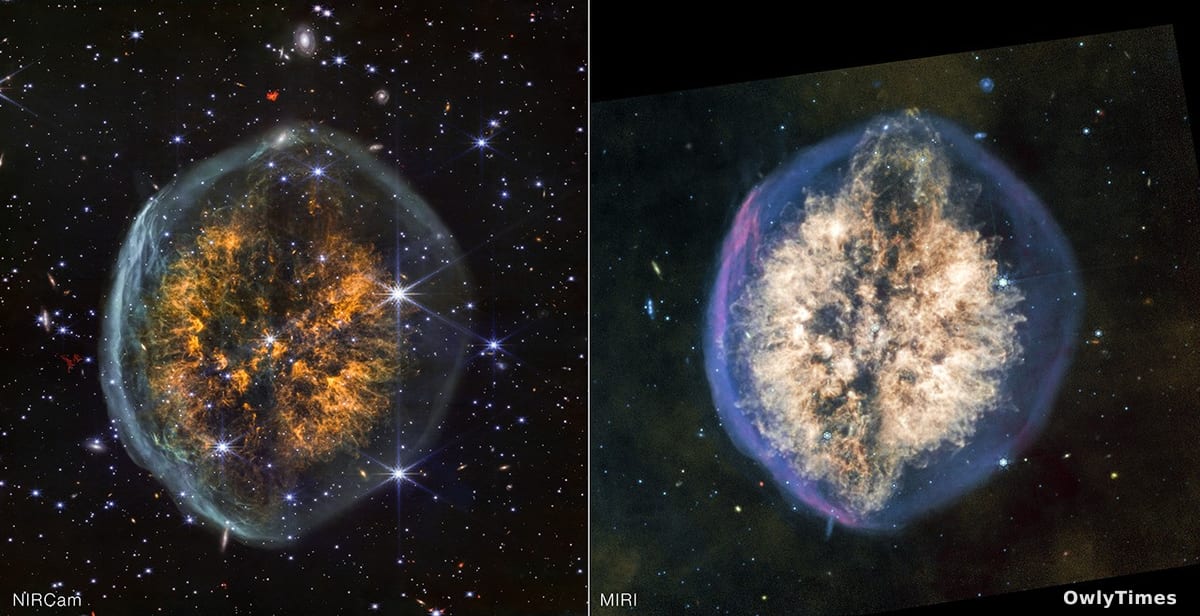

The image of a brain within a skull is a potent one, evoking thoughts of consciousness and mortality. Now, thanks to the James Webb Space Telescope, that very image is being returned to us from the cosmos, not as a philosophical prompt, but as a detailed astronomical observation. The “Exposed Cranium” nebula, formally known as PMR 1, isn’t prompting existential reflection simply because of its shape; it’s offering a rare glimpse into the final, turbulent stages of a star’s life, and revealing how different wavelengths of light can tell radically different stories about the same celestial object. This isn’t merely a visually striking image, but a demonstration of how our understanding of stellar evolution is being refined by the ability to see beyond the visible spectrum.
The nebula was initially detected over a decade ago by NASA’s Spitzer Space Telescope, but it was the advanced capabilities of Webb – specifically its NIRCam (Near-Infrared Camera) and MIRI (Mid-Infrared Instrument) – that truly brought its structure into focus. Initial reports focused on the nebula’s uncanny resemblance to a brain, but the real story lies in what those instruments are revealing about the processes unfolding within it. Headlines proclaiming a “brain nebula” risk overshadowing the crucial scientific detail: PMR 1 isn’t just shaped like a brain, it’s exhibiting distinct phases of stellar evolution, visible as layered shells of gas and dust. NIRCam’s view allows more stars and distant galaxies to be seen through the nebula, while MIRI highlights the glowing cosmic dust, revealing structures obscured at shorter wavelengths.
See the original science.nasa.gov story for the full account.
The nebula’s structure itself is key to understanding its origins. Both NIRCam and MIRI images show a prominent dark lane bisecting the nebula, creating the illusion of two hemispheres. This lane, researchers suggest, isn’t merely a visual artifact, but likely represents an outflow or outburst from the central star. Evidence supporting this interpretation is particularly strong in MIRI’s data, where the inner gas appears to be actively ejected outwards. This ejection isn’t a smooth, uniform process; it’s a dynamic event, occurring on a timescale that, while rapid in cosmic terms, still represents a relatively brief window into the star’s decline. The observation captures a fleeting moment in a process that will ultimately determine the star’s fate.
What that fate will be remains uncertain, hinging on the star’s mass – a crucial piece of information that hasn’t yet been determined. Stars nearing the end of their lives expel their outer layers, a process that can lead to two dramatically different outcomes. If the star is sufficiently massive, it will end its life in a spectacular supernova explosion, scattering heavy elements into the interstellar medium. Less massive stars, similar to our Sun, will gently shed their layers, eventually leaving behind a dense white dwarf that will slowly cool over billions of years. The current images from Webb don’t tell us which path this star will take, but they provide invaluable data for refining models of stellar evolution and predicting its ultimate destiny.
It’s important to acknowledge the limitations of this study. While Webb’s resolution is unprecedented, interpreting the data requires complex modeling and assumptions about the composition and density of the nebula. The observed structures could be influenced by factors beyond a simple bipolar outflow, such as interactions with surrounding interstellar gas. Furthermore, the images represent a single snapshot in time; a long-term monitoring campaign is needed to fully understand the nebula’s evolution. The data also relies on accurate calibration of the instruments, a process that is continually refined as Webb continues its mission.
The next crucial step is to determine the mass of the central star. Spectroscopic analysis, breaking down the star’s light into its component wavelengths, will reveal its chemical composition and temperature, allowing astronomers to estimate its mass with greater precision. Future observations with Webb, combined with data from other telescopes, will also focus on mapping the velocity of the ejected gas, providing further clues about the nature of the outflow. Ultimately, understanding PMR 1 isn’t just about one dying star; it’s about understanding the lifecycle of stars in general, and the processes that enrich the universe with the elements necessary for life. We should watch for further publications detailing the spectroscopic analysis of the central star – that data will be the key to unlocking the full story of the “Exposed Cranium” nebula.





