
The Ghostly Precursor: How a Dusty Star Solves a Supernova Puzzle
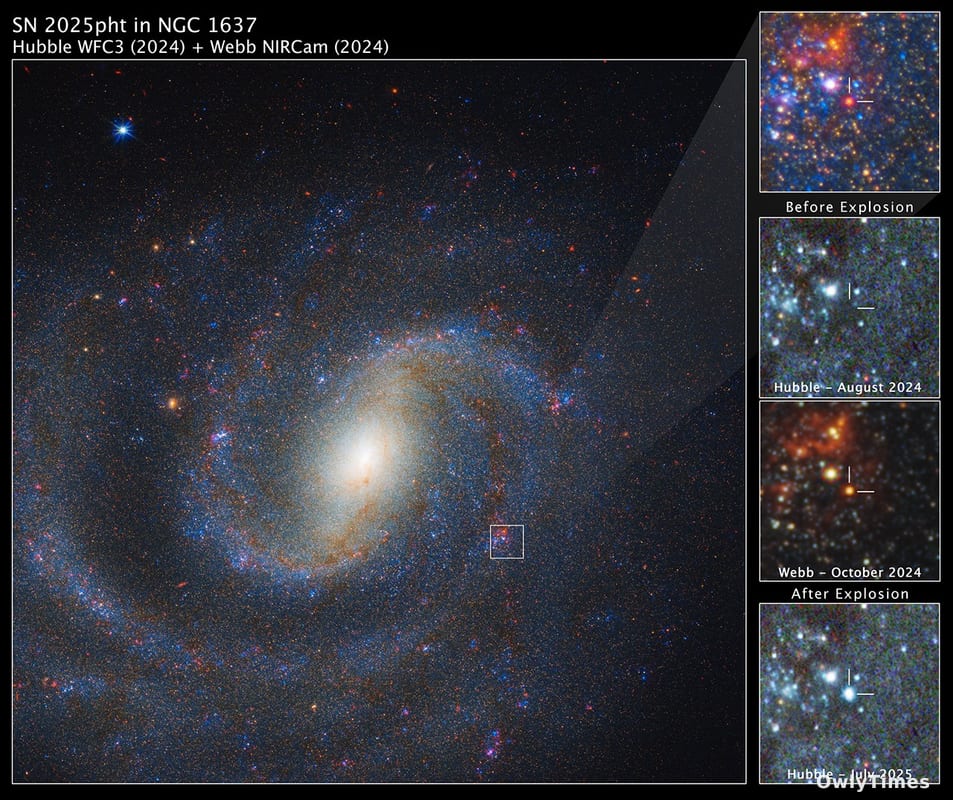
For decades, astronomers have faced a peculiar discrepancy: theoretical models predict we should see many more massive stars nearing the end of their lives – bright, luminous red supergiants – than we actually observe. These are the stars destined to explode as spectacular supernovas, yet they seem to vanish before their grand finale. The detection of supernova 2025pht, first flagged by the All-Sky Automated Survey for Supernovae on June 29, 2025, isn’t remarkable simply because it’s a supernova forty million light-years away in the galaxy NGC 1637. It’s remarkable because, for the first time, astronomers have definitively identified the star before it exploded, and the findings, published in the Astrophysical Journal Letters, suggest a surprising reason for the missing supergiants: they’re hidden in plain sight, shrouded in dust.
This article draws on reporting from science.nasa.gov.
The team, led by Charlie Kilpatrick of Northwestern University, didn’t rely on immediate follow-up observations alone. Instead, they meticulously combed through archival data, specifically images captured by both the Hubble Space Telescope and, crucially, NASA’s James Webb Space Telescope. While Hubble, a veteran of astronomical observation, failed to detect the progenitor star, Webb’s infrared capabilities revealed a single red supergiant precisely where the supernova now resides. This wasn’t a lucky guess; the team painstakingly aligned the Hubble and Webb images, confirming the connection with unprecedented precision. “We combined Hubble and Webb data sets to completely characterize this star for the first time,” explained Kilpatrick. This isn’t simply about finding a star before it explodes; it’s about demonstrating a new method for systematically studying the final moments of stellar evolution.
What makes 2025pht particularly intriguing is the sheer amount of dust surrounding the star. Graduate student and co-author Aswin Suresh described it as “the reddest, most dusty red supergiant that we’ve seen explode as a supernova.” This redness isn’t an aesthetic quality; it’s a direct indicator of dust obscuring shorter, bluer wavelengths of light. The dust effectively dimmed the star, potentially explaining why so many similar stars remain undetected in pre-supernova surveys. For context, previous attempts to identify supernova progenitors relied heavily on visible light observations, which are easily blocked by even moderate amounts of dust. The fact that Webb, operating in the infrared, could penetrate this veil is a game-changer.
The implications extend beyond simply accounting for the “missing” red supergiants. The composition of the dust itself presented another surprise. Models based on the Webb observations suggest the dust is carbon-rich, rather than the silicate-rich composition astronomers typically expect in these stars. The team hypothesizes that this carbon was brought to the surface from the star’s core in the final stages of its life, a process known as dredging. This finding challenges existing models of stellar evolution and suggests that the internal processes of massive stars may be more dynamic and complex than previously thought. “Having observations in the mid-infrared was key to constraining what kind of dust we were seeing,” Suresh emphasized, highlighting the unique contribution of Webb’s instrumentation.
Limitations to Consider
It’s important to note that this is a single observation. While 2025pht provides compelling evidence for the dust-shrouded supergiant hypothesis, it doesn’t definitively prove that all missing supergiants are similarly obscured. There may be other factors at play, such as variations in stellar mass or different evolutionary pathways. Furthermore, the team’s analysis relies on complex computer models to interpret the Webb data, and these models are inherently subject to uncertainties. The carbon-rich dust composition, while intriguing, is based on preliminary analysis and requires further investigation. The team acknowledges that alternative explanations for the observed infrared signature cannot be entirely ruled out at this stage.
The Future of Supernova Forensics
The success with 2025pht has already spurred a new wave of research. Kilpatrick and his team are actively searching for other red supergiants that may be on the verge of exploding, hoping to build a larger sample size and refine their understanding of the phenomenon. Crucially, they’re anticipating data from NASA’s upcoming Nancy Grace Roman Space Telescope, which promises to be even more sensitive to infrared light and capable of detecting subtle variations in the brightness of these stars – potential “burps” of dust signaling their imminent demise. Roman’s wider field of view will also allow astronomers to survey a much larger area of the sky, increasing the chances of catching a supernova in the act.
The question now isn’t just why we haven’t seen these stars, but how many are out there, hidden in dusty cocoons, waiting to explode. Will Roman reveal a population of dusty supergiants far exceeding current estimates? And, perhaps more fundamentally, will future observations confirm that carbon-rich dust is a common feature of massive stars nearing the end of their lives, forcing a revision of our understanding of stellar evolution? The story of 2025pht isn’t just about one supernova; it’s about opening a new window onto the dramatic final moments of the universe’s most massive stars.