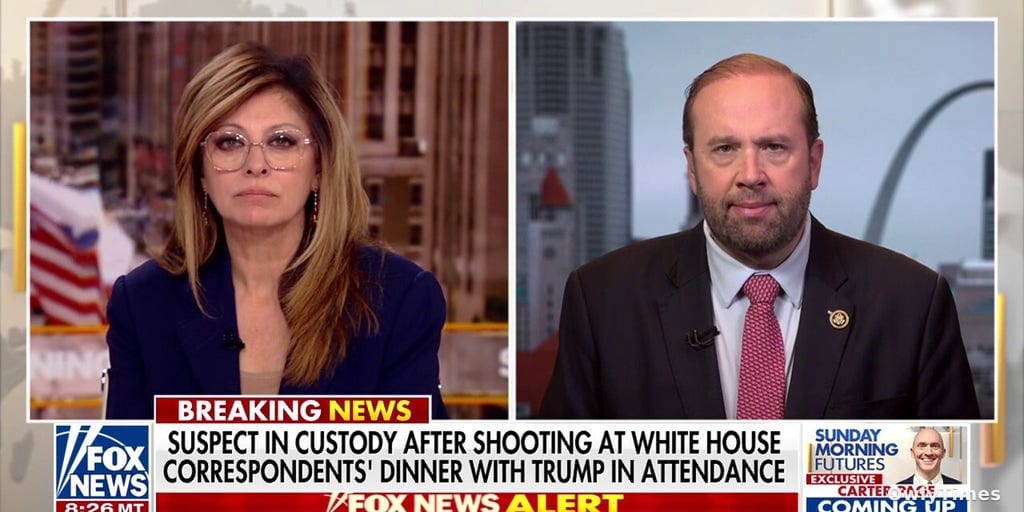

The security breach at the White House Correspondents’ Dinner (WHCD) on April 26, 2026, serves as a stark inflection point in the current administration’s legislative agenda. While the immediate focus remains on the safety of Donald Trump and Vice President JD Vance, who were evacuated as shots were fired at the venue, the strategic aftermath centers on the immediate weaponization of this crisis to resolve long-standing fiscal stalemates. By linking the presence of an armed suspect, identified as Cole Allen, to the necessity of Department of Homeland Security (DHS) funding, political stakeholders are moving to bypass months of legislative inertia.
The Calculus of Institutional Security
The tactical response from the Secret Service, which successfully pinned the suspect, has become the focal point of a broader debate over federal protection capabilities. Todd Blanche has already framed the incident as a "wake-up call" for Congress regarding the urgency of DHS funding, suggesting that the event will be used to apply maximum pressure on holdouts in the appropriations process. Those who stand to benefit from this narrative are the proponents of increased security spending, who can now point to the "chaos" described by Bret Baier to justify higher budget allocations. Conversely, the losers in this political repositioning are the fiscal hawks who had previously stalled these funding measures, as they now face a public environment where opposing security spending is increasingly framed as a failure of basic governance.
Precedent and Power Dynamics
This sequence of events mirrors the way security breaches in high-profile venues historically shift the balance of power toward executive and protective agencies. Much like the legislative shifts that followed the 2008 financial crisis, which fundamentally altered regulatory oversight, this incident is being leveraged to force a realignment of federal spending priorities. The fact that cabinet members were evacuated "immediately," as reported by Aishah Hasnie, highlights the vulnerability of the executive branch in public spaces. The incident has effectively paralyzed the traditional media-politics spectacle, as evidenced by the abrupt cancellation of the WHCD, removing a platform for debate and replacing it with a singular focus on national security.
The Conflict of Narratives
The incident has also deepened the ideological divide regarding the optics of the event itself. S.E. Cupp publicly criticized the decision to invite Trump to the dinner, asserting that "he wants journalism dead," a sentiment that complicates the bipartisan sympathy usually generated by threats against political figures. This tension indicates that the shooting will not lead to a period of political unity, but rather an acceleration of existing hostilities. While Trump has publicly called for "peacefully" resolving differences, the rhetoric from various political factions suggests that the investigation into Cole Allen—who was armed with multiple weapons—will be used as a proxy battle in the broader struggle over national discourse and social media’s impact on political violence, as noted by Paul Mauro.
Monitoring the Fiscal Trigger
The political chess move to watch is the legislative movement on the DHS funding bill. With the WHCD canceled and the security failure under intense scrutiny, the next reading of the DHS budget allocation in the House and Senate will indicate whether this event effectively broke the deadlock. The escalation of charges against the suspect, as projected by Gregg Jarrett, will serve as the primary indicator for how long this security-focused narrative remains at the center of the legislative calendar.





