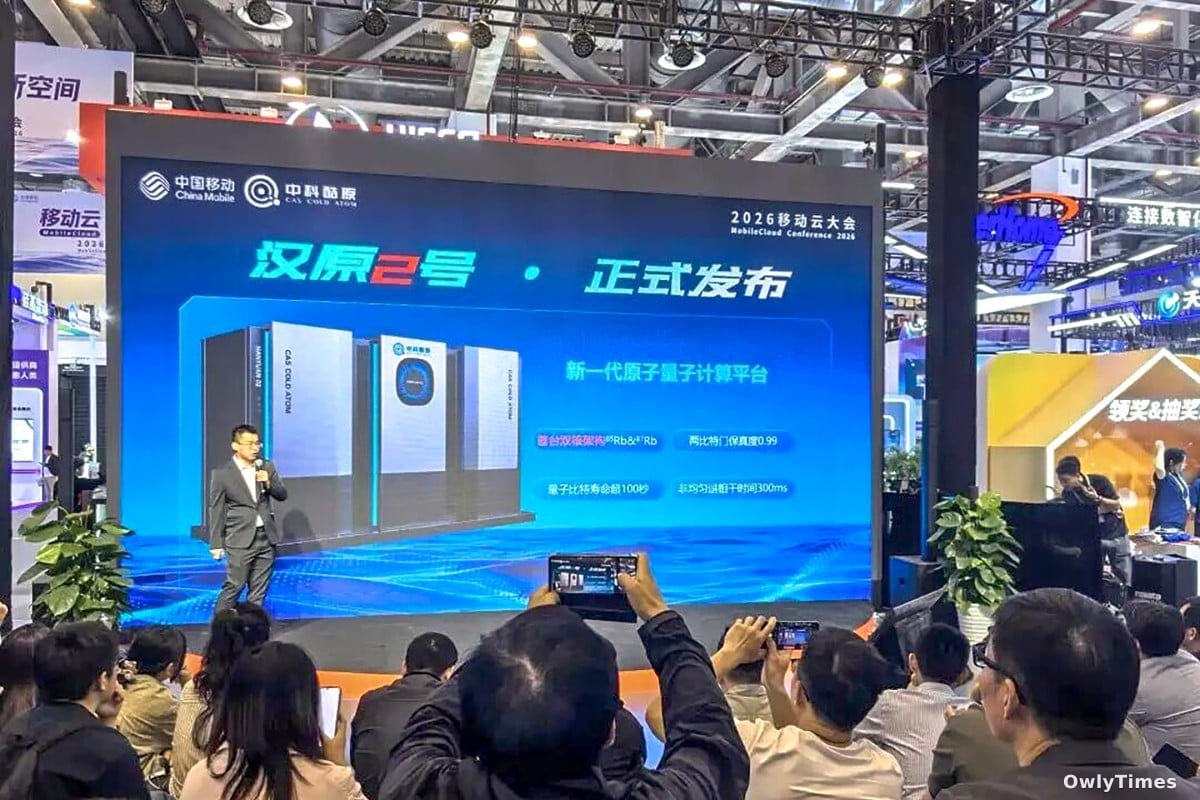

Why are we still pretending that the future of quantum computing requires the frozen, cavernous infrastructure of a high-energy physics lab? For years, the industry has been obsessed with the “cryogenic arms race,” pushing machines to absolute zero with massive dilution refrigerators. But the real story here isn’t the total number of qubits a company can cram into a fridge; it’s the shift toward making quantum hardware look more like a standard office server rack.
The recent unveiling of the Hanyuan-2 by CAS Cold Atom Technology in Wuhan is a direct challenge to the status quo. By utilizing a dual-core neutral atom architecture, the system manages to function at room temperature. This is a massive departure from the superconducting circuits that dominate the current landscape, which typically require extreme cooling to maintain their quantum state.
The End of the Cryogenic Bottleneck
If you think of traditional quantum computers as giant, liquid-helium-cooled industrial freezers, the Hanyuan-2 is more like a modern, efficient desktop tower. Because the system uses neutral atoms—specifically Rubidium-85 and Rubidium-87—it relies on laser cooling rather than expensive, space-consuming cryogenic hardware.
This isn't just a technical curiosity; it has immediate, practical implications for the user. With a total power consumption of under 7 kW, the Hanyuan-2 fits neatly into the footprint of an ordinary IT server rack. For any organization looking to move quantum research out of specialized labs and into standard data centers, that power profile is a game changer. It suggests that quantum computing is finally transitioning from a scientific experiment into an industrial utility.
Why Two Cores Are Better Than One
The 200-qubit system splits its power between two independent 100-qubit arrays. This dual-core approach is a clever workaround for one of the most stubborn problems in the field: how to run complex algorithms without the whole system collapsing under the weight of its own noise. By designating one core as the “main” engine and the other as an “auxiliary,” the machine can dedicate its secondary resources to real-time error correction.
In practical terms, this allows the system to decompose difficult problems—like those found in materials science or geological exploration—and execute them in parallel. It is the architectural equivalent of moving from a single-lane road to a multi-lane highway, where the auxiliary lane acts as a dedicated service route that keeps the primary traffic flowing smoothly.
Moving Beyond the Hype
General Manager Tang Biao has signaled that this modular design is merely the first step toward reaching the thousand-qubit threshold. While the industry is often guilty of inflating expectations with abstract qubit counts, the Hanyuan-2 is notable for its focus on operational stability and lower cost-to-entry. If the goal is to make quantum computing accessible for sectors like cryptography, the barrier to entry has historically been the absurdly high price of keeping the machine alive.
The official report from the Science and Technology Daily and the accompanying technical briefing underscore that this is not a one-off prototype, but a follow-up to the commercially delivered Hanyuan-1. We are seeing a clear, iterative move toward modularity.
The next reading of the system's error correction efficiency during complex, real-world algorithmic tasks will show whether this dual-core approach can truly sustain the stability required to replace classical supercomputing for industrial-scale problems.