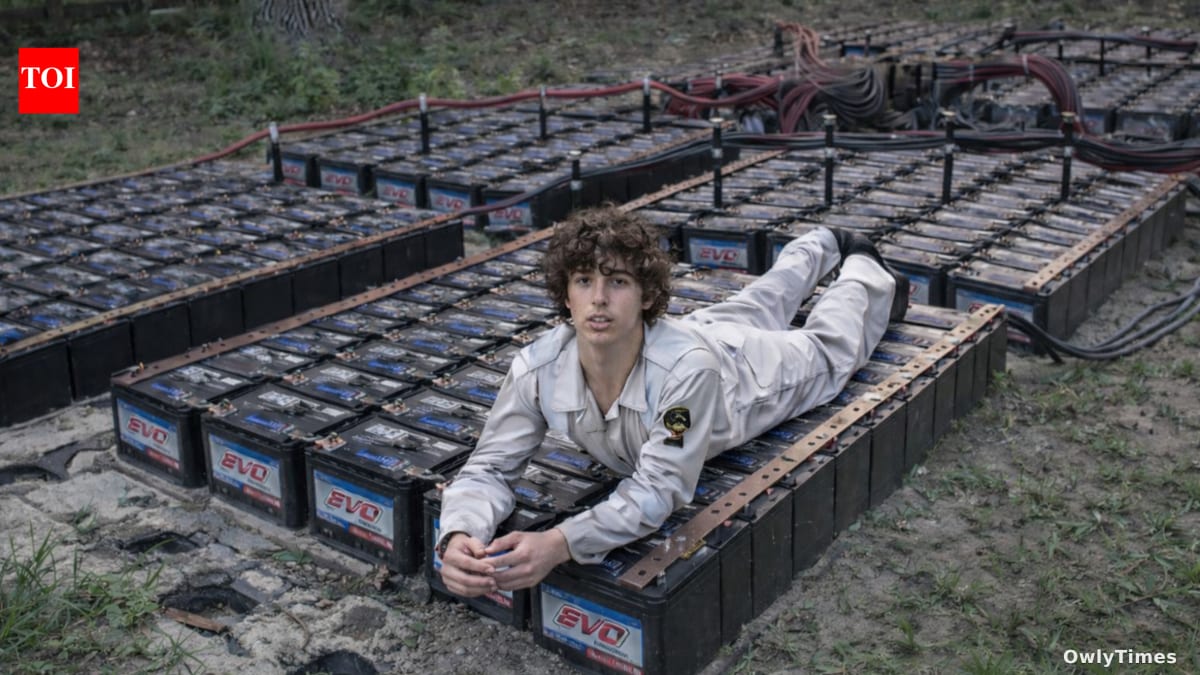

The persistent question of energy storage – how to reliably capture, hold, and release power – often focuses on futuristic technologies like solid-state batteries and fusion reactors. But a recent experiment conducted not in a national laboratory, but in the backyard of a self-described “science maniac,” highlights a surprisingly potent, if unconventional, source: the humble car battery. Drake Anthony Styropyro, a chemist and YouTuber, has demonstrated the astonishing power unlocked by wiring together 400 of these everyday components, achieving currents exceeding 160,000 amps. While headlines proclaim a backyard lightning storm, the true significance lies in what this experiment reveals about the physics of extreme currents and the limitations of our current understanding of energy discharge.
From a modest beginning of 100 batteries, Anthony has systematically scaled his project, driven by a curiosity to explore the behavior of electricity at levels rarely seen outside specialized research facilities. The setup itself is deceptively simple in concept – batteries connected in series to increase voltage, and then strategically arranged to maximize current – but the execution demanded significant engineering. No commercially available switch could handle the anticipated load, forcing Anthony to design and build a custom mechanism using over 1,000 pounds of copper. This isn’t merely about brute force; it’s about understanding material science and electrical engineering at a practical, hands-on level. The resulting current, while operating at a relatively low 65 volts, dwarfs that of typical electrical systems, allowing Anthony to melt metal, deform pipes, and even create a dramatic explosion with ferrofluid.
This article draws on reporting from timesofindia.indiatimes.com.
The choice of car batteries over capacitors, a common energy storage component for high-current applications, is particularly insightful. While capacitors can deliver immense bursts of power, Anthony explains they are limited by discharge duration. Car batteries, conversely, can sustain these extreme currents for a significantly longer period. “The benefit with car batteries is that they can dump those currents for far longer than a brief pulse,” he states in his video. This sustained discharge capability is key to the demonstrations, allowing for observable effects beyond fleeting flashes. He frames the scale of the project as comparable to that found in national labs, but with the freedom to experiment more creatively – and visually – than might be possible in a more regulated environment.
The demonstrations themselves are compelling, showcasing the destructive power of concentrated electrical energy. Steel rods vaporize, metal pipes warp and break, and various materials react violently when subjected to the intense current. However, it’s crucial to understand that these are demonstrations of potential energy release, not necessarily efficient energy conversion. The experiment isn’t about creating a practical power source; it’s about visualizing the effects of extreme current and exploring the boundaries of what’s possible. Anthony repeatedly emphasizes safety, acknowledging the inherent dangers and the importance of understanding the risks involved, a point underscored by his past run-ins with YouTube’s content policies. His channel has faced demonetization and even potential closure due to the perceived recklessness of his experiments, leading to a running joke among his followers that they’re simply glad to see him still alive.
Limitations to consider are significant. This experiment is conducted in a highly controlled, albeit unconventional, setting. Replicating it safely requires a deep understanding of electrical engineering and a substantial investment in materials and safety equipment. The energy efficiency of the system is likely low, with a significant portion of the energy lost as heat. Furthermore, the experiment doesn’t address the broader challenges of energy storage, such as scalability, cost, and environmental impact. It’s a fascinating exploration of what can be done, not a blueprint for a new energy solution. The ferrofluid explosion, while visually stunning, is a demonstration of magnetic forces interacting with a high-current field, not a novel energy generation technique.
The next crucial step isn’t necessarily to build a 1,000-battery array. Instead, researchers should focus on analyzing the data generated by Anthony’s experiment – the precise measurements of current, voltage, and energy dissipation – to refine our models of electrical behavior at extreme scales. Understanding how different materials respond to these currents could have implications for fields ranging from materials science to plasma physics. More importantly, this experiment raises a fundamental question: if we can unlock this level of power from readily available components, what other untapped potential lies within existing technologies, waiting to be revealed through unconventional experimentation? Will we see a shift towards re-evaluating established energy storage methods, or will the focus remain solely on developing entirely new systems? The answer will likely determine the pace of innovation in the energy sector for years to come.





