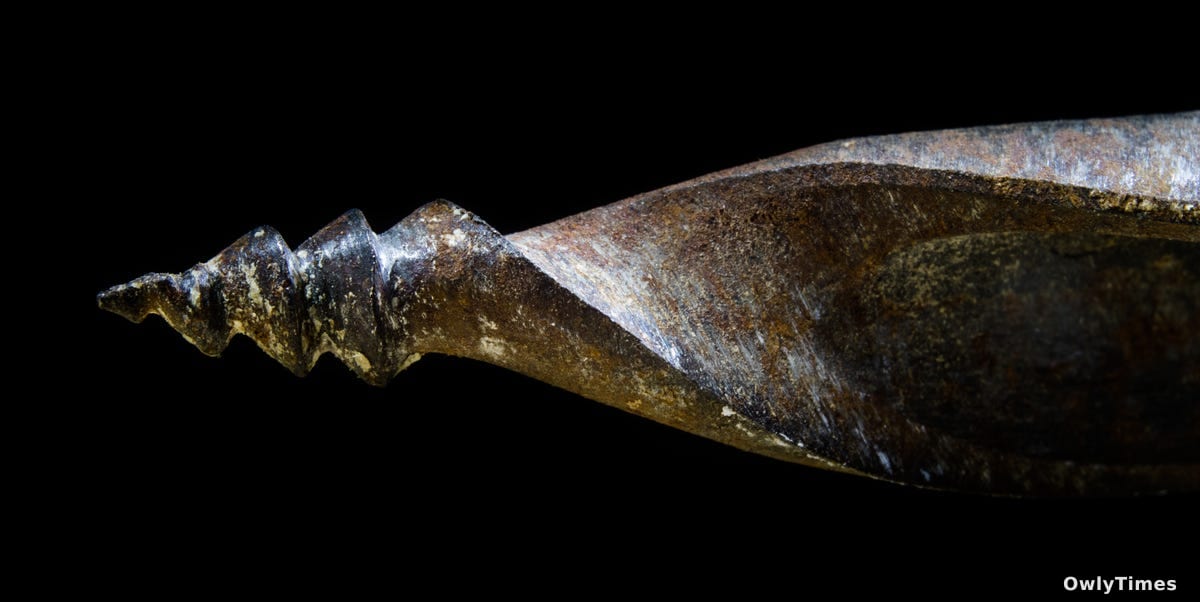

The persistent question of how ancient civilizations achieved feats of engineering and artistry often focuses on monumental structures – the pyramids, the temples. But a new look at a seemingly unremarkable artifact from Egypt is shifting our attention to the foundational technologies that made those achievements possible. Researchers are now recognizing a small copper tool, dismissed for a century as a simple awl, as the oldest known example of a bow drill, pushing back the timeline of rotary drilling technology by over 2,000 years. This isn’t simply about adding a date to a record; it’s about recalibrating our understanding of early Egyptian ingenuity and the surprisingly sophisticated metallurgical knowledge they possessed.
The artifact in question was originally excavated in the 1920s from Grave 3932 at Badari in Upper Egypt. Catalogued with a brief description – “a little awl of copper, with some leather thong wound round it” – it remained largely unstudied until recently. A team led by Martin Odler of Newcastle University and Jiri Kmosek of the Academy of Fine Arts, Vienna, revisited the object, applying modern analytical techniques and a fresh perspective. Their findings, published in Egypt and the Levant, demonstrate that the tool, weighing a mere 1.5 grams and just over two inches long, was in fact a functional bow drill. The key wasn’t a dramatic revelation, but a meticulous examination revealing wear patterns – fine striations, rounded edges, and a subtle curvature – consistent with rotary motion, not simple piercing.
What’s crucial to understand is that headlines proclaiming “oldest drill” aren’t the full story. Previous archaeological discoveries had revealed bow drills, but these dated to around 1500 B.C.E., significantly later than this new find, which dates back to approximately 3300 B.C.E. This means that the Egyptians weren’t simply adopting the technology from elsewhere; they were pioneering it. The six fragile coils of leather remaining on the shaft are identified as remnants of the bowstring, demonstrating a clear understanding of how to translate linear motion into rotational force – a principle still used in many modern tools. The drill’s design allowed for faster, more controlled drilling than simply twisting an awl by hand, enabling more precise work in materials like wood, stone, and beads.
Based on the original popularmechanics.com report.
The implications extend beyond woodworking. The ability to drill precise holes was fundamental to the production of jewelry, a significant aspect of ancient Egyptian culture and economy. The researchers emphasize the “technological continuity” observed across nearly two millennia, suggesting the bow drill remained a vital tool for both practical and artistic purposes. However, it’s important to acknowledge the limitations to consider. The artifact is a single example. While the wear patterns strongly suggest its function, definitively proving its use requires further contextual evidence – ideally, traces of the materials it was used to drill, or depictions of similar tools in contemporary artwork. The preservation of organic materials like the leather is also exceptionally rare, making it difficult to assess how common these drills were.
Further analysis revealed the copper alloy used to create the drill wasn’t a standard composition. Chemical analysis, including portable X-ray fluorescence, showed the presence of arsenic, nickel, lead, and silver. According to Jiri Kmosek, this “recipe would have produced a harder, and visually distinctive, metal compared with standard copper.” The presence of these elements isn’t accidental; it suggests deliberate alloying choices, potentially indicating access to wider networks of materials and metallurgical knowledge extending into the Eastern Mediterranean. This raises a compelling question: was this technology developed independently in Egypt, or was it influenced by interactions with other cultures? The presence of silver and lead, in particular, hints at potential trade routes and the exchange of expertise.
The next crucial step is to broaden the search for similar artifacts, not just in Egypt, but across the wider region. Researchers are now re-examining existing collections with a renewed focus on identifying potential bow drill components. Equally important is investigating the sources of the metals used in the drill’s construction. Tracing the origin of the copper, arsenic, and other elements could reveal valuable insights into ancient trade networks and the spread of metallurgical technology. We should also be looking for microscopic evidence of drill use on other artifacts from the same period – tiny drill holes in beads, wood fragments, or stone tools – to corroborate the findings and build a more complete picture of this pivotal moment in technological history. The question isn’t just when the Egyptians invented the drill, but how this invention shaped their world, and what it tells us about the interconnectedness of early civilizations.





