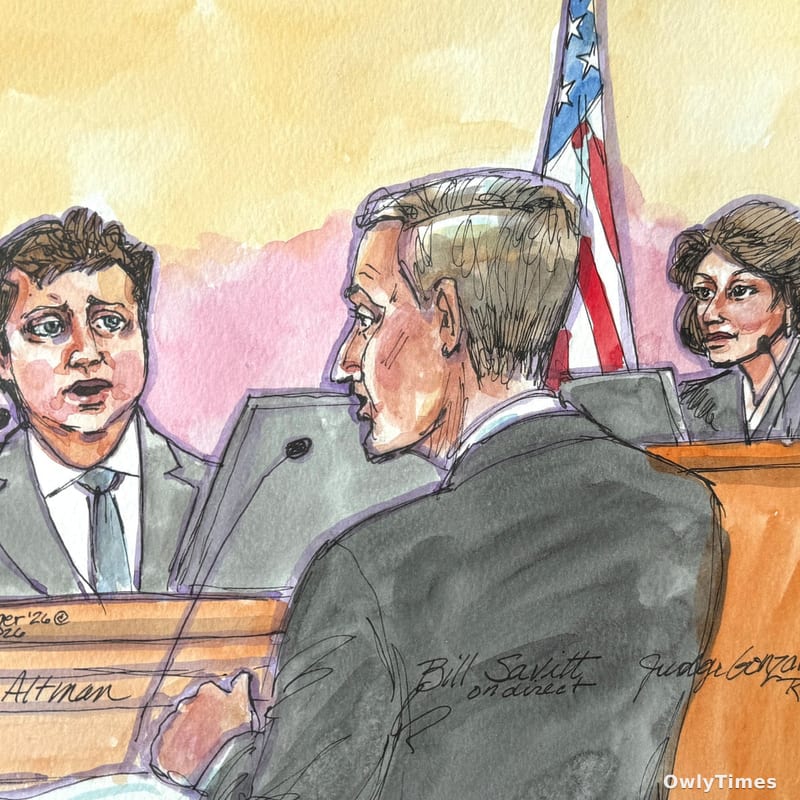

Who truly owns the future of artificial intelligence? Is it a public utility, a philanthropic endeavor, or a corporate behemoth destined for a trillion-dollar valuation? This isn't a philosophical debate happening in academic halls; it's the central, visceral question currently being thrashed out in an Oakland, California federal courthouse, where Sam Altman, CEO of OpenAI, took the stand on Tuesday to defend his company against a lawsuit from former co-founder Elon Musk. The real story here isn't the celebrity mudslinging between two tech titans — it's the fundamental battle over the governance model for the most transformative technology of our era, and what that means for every ordinary user who will interact with AI in their daily lives.
The Trillion-Dollar Question of AI's Soul
Musk, who co-founded OpenAI as a non-profit, alleges that Altman and the company broke their founding agreement by restructuring into a for-profit enterprise. He claims Altman unjustly enriched himself, seeking his removal, the redistribution of a staggering $134bn back to the non-profit, and the undoing of its for-profit conversion. OpenAI and Altman, in turn, have rejected all of Musk’s claims. They argue that Musk is motivated by jealousy, stemming from a failed bid to take over the AI firm in 2018 and his subsequent departure from its board. For OpenAI, the stakes couldn't be higher, as it seeks to go public at an estimated $1tn valuation later this year. This trial isn't just about past agreements; it's about whether the foundational promise of "open AI" can survive the immense pressures of commercialization and the pursuit of unfathomable wealth.
The Tug-of-War Over Total Control
Altman’s testimony, delivered just before 9am local time, offered a stark counter-narrative to Musk’s allegations. He recounted discussions in 2017 about creating a for-profit structure, which he claimed fell through due to disagreements over ownership. According to Altman, Musk insisted on total control, including becoming CEO and even suggesting that control of the company could pass to his children if he died. Altman found this request "extremely uncomfortable," asserting, "What would you say to the suggestion that OpenAI was Mr Musk’s startup? I would not agree with that characterization at all." He further characterized Musk as an erratic and vindictive leader during his time at OpenAI, alleging he "demotivated some of our key researchers." This contentious history of control isn't just internal Silicon Valley drama; it highlights the critical tension between visionary ambition and centralized power, a tension that dictates whether AI development prioritizes broad access or proprietary advantage.
A Battle of Character in the Courtroom
Musk’s legal team, led by attorney Steven Molo, has attempted to paint Altman as deceptive and self-serving. Molo’s combative cross-examination delved into accusations of Altman misleading former colleagues and investors, directly asking if he was "completely trustworthy." Altman conceded, "I have heard people say that," when pressed on statements from former OpenAI executives and coworkers who accused him of falsehoods. Notably, Mira Murati, OpenAI’s former chief technical officer, testified that Altman was untrustworthy and accused him of "creating chaos." This character assassination, though seemingly personal, reflects the broader scrutiny faced by leaders of powerful, opaque tech companies. It’s a reminder that as AI becomes more embedded in our infrastructure, the integrity of those steering its development is no longer just an internal HR matter, but a matter of public trust.
The three-week trial, which has also seen Microsoft's CEO make an appearance, is set to hold its closing arguments on Thursday, after which a nine-person jury will deliberate on the liability of Altman, OpenAI, and president Greg Brockman. Whatever the verdict, the outcome will ripple far beyond the courtroom. The real question isn't whether OpenAI goes public, but what kind of OpenAI emerges: one committed to a decentralized, publicly beneficial AI, or one that has firmly cemented its place as a corporate empire. The jury’s decision will undoubtedly set a precedent for how future AI ventures balance their founding ideals with the irresistible pull of commercialization, directly influencing the accessibility, ethics, and ultimate impact of artificial intelligence on everyone’s future.