
Beyond the Potato: Unraveling Earth’s Deepest Gravity Anomaly
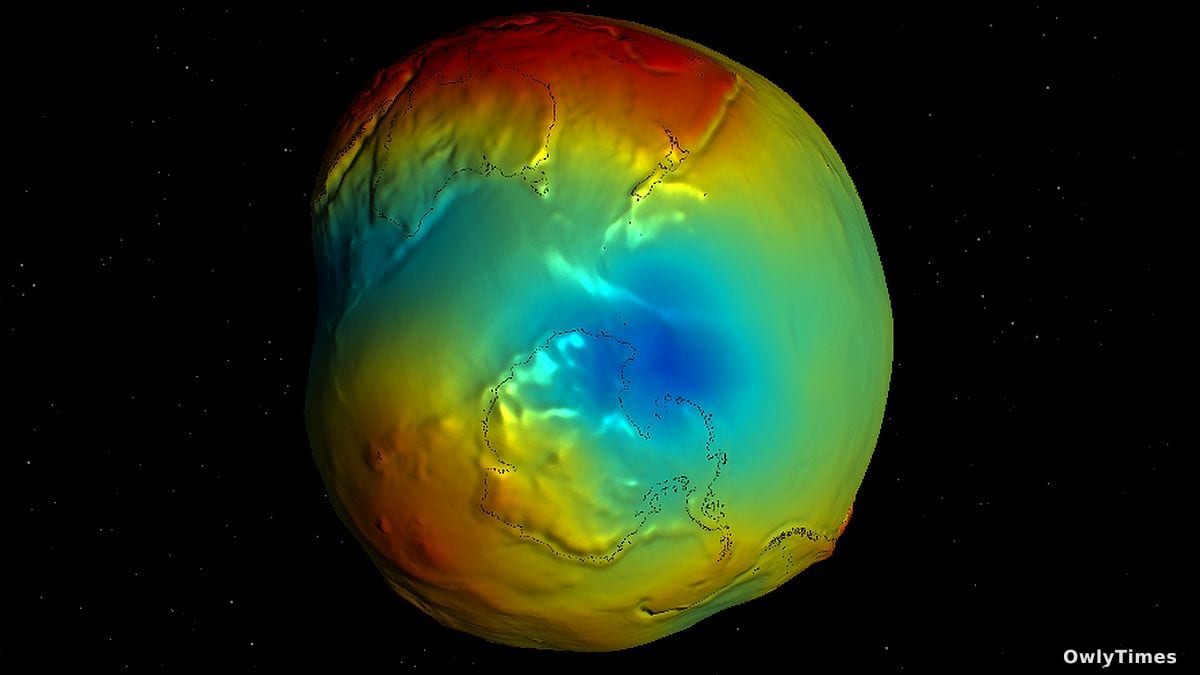
We often picture Earth as a sphere, but its gravitational pull doesn’t conform to that simple geometry. Instead, it’s more akin to a bumpy potato, with areas of stronger and weaker gravity. While these variations are too subtle for us to feel directly – a difference of only a few grams on a scale – they offer a unique window into the planet’s hidden interior. Recent research, led by Alessandro Forte of the University of Florida and Petar Glišović of the Paris Institute of Earth Physics, isn’t just mapping these gravitational ‘dips’ but tracing their evolution over tens of millions of years, revealing a strengthening anomaly beneath Antarctica and prompting questions about its connection to the continent’s ice sheets. The headlines often proclaim a “gravity hole,” but the story is far more nuanced: it’s not about something missing but about a long-term, dynamic shift in Earth’s mass distribution.
The Antarctic Geoid Low, as it’s known, represents a region where gravity is weaker than average. This isn’t due to a lack of mass, but rather to variations in density within Earth’s mantle. Different rock compositions have different densities, and these density differences create the uneven gravitational field. What’s new isn’t the existence of this low, but the demonstration that it’s been growing stronger for the past 40 million years, a finding that challenges previous assumptions about the relative stability of Earth’s deep interior. Forte explains their approach as akin to a “CT scan of the whole Earth,” but instead of X-rays, they utilize the waves generated by earthquakes. These seismic waves change speed and direction as they travel through the planet, revealing the composition and density of the materials they encounter.
Drawn from ScienceAlert.
To reconstruct the geoid’s history, Forte and Glišović created a detailed 3D model of Earth’s mantle using earthquake data, then fed this model into a physics-based simulation of mantle convection – the slow churning of rock within Earth’s interior. By “rewinding” the simulation back 70 million years, they were able to observe how the geoid evolved over time. Crucially, the model wasn’t just tested for accuracy in the present day; it also had to reproduce known shifts in Earth’s rotational axis, known as True Polar Wander. The fact that it did both lends significant weight to their conclusions. Their findings indicate that a gravitational depression has existed near Antarctica for at least 70 million years, but its intensification began around 50 million years ago, coinciding with a notable change in Earth’s axis.
The driving force behind this strengthening appears to be a combination of tectonic activity and mantle plumes. As tectonic slabs sank beneath Antarctica, they altered the gravity field. Simultaneously, a region of hot, buoyant material rose from the deep mantle, further contributing to the geoid low. This interplay between sinking and rising material is a fundamental process in Earth’s internal dynamics, and this research provides a rare glimpse into its long-term effects. It’s important to note that while the model accurately reproduces observed changes, it doesn’t definitively prove the causal link between these processes and the geoid’s evolution. Correlation doesn’t equal causation, and other factors could be at play.
However, the most intriguing aspect of this research lies in its potential connection to Antarctic glaciation. The geoid shapes sea level, and as the geoid lowered around Antarctica, the local sea surface would have followed suit. This could have created conditions favorable for ice sheet growth, potentially influencing the onset of glaciation around 34 million years ago. Forte is careful to emphasize that this is a speculative link, requiring further investigation. But the possibility that deep Earth processes could have played a role in shaping the Antarctic ice sheet is a compelling one. The next steps involve refining the model to incorporate more detailed data on mantle composition and temperature, and exploring the sensitivity of the geoid to different scenarios of tectonic and mantle activity. Ultimately, understanding the evolution of the Antarctic Geoid Low isn’t just about understanding Earth’s interior; it’s about understanding the forces that shape our planet’s climate and sea levels, and predicting how those forces might change in the future. Will continued strengthening of the geoid low accelerate ice sheet melt, or could it contribute to greater stability? That’s the question researchers are now racing to answer.