
Beyond Robots and Rockets: Why Bettendorf’s STEAM Expo Focuses on Responsible Innovation
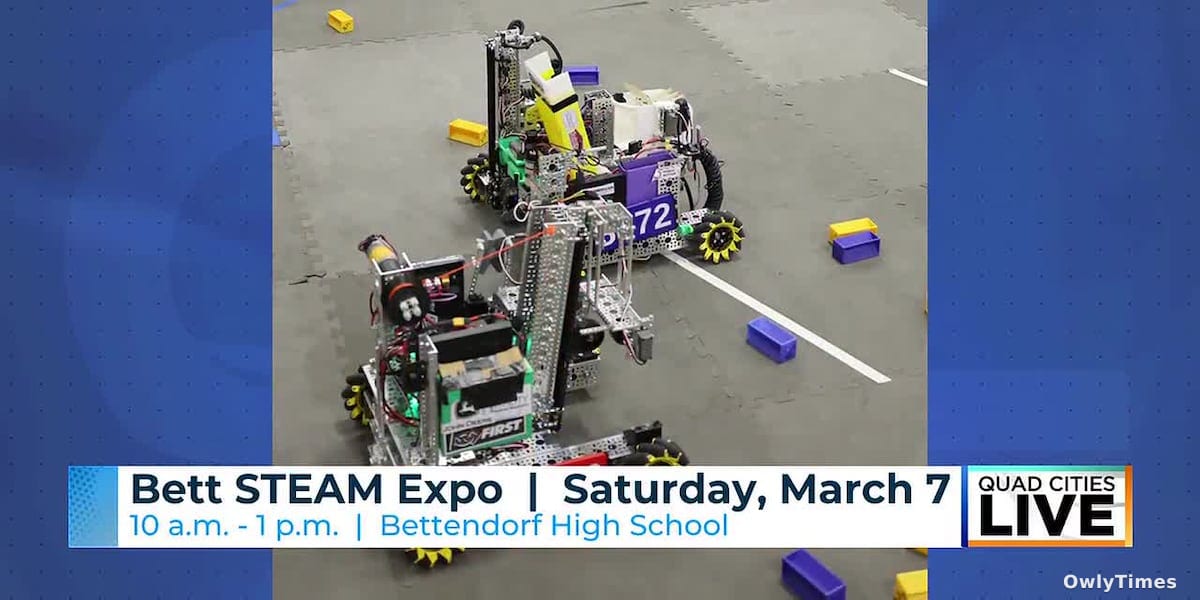
The Bettendorf Community School District’s annual STEAM Expo, held this Saturday, March 7th, at Bettendorf Middle School, isn’t simply a showcase of cool gadgets and colorful experiments. While the event – running from 10 a.m. to 1 p.m. – promises over 40 hands-on activities spanning science, technology, engineering, art, and mathematics, its inclusion of Alex Turner, a 2012 Bettendorf High School graduate now researching artificial intelligence safety at Google DeepMind, signals a deliberate shift in focus. It’s a move that reflects a growing national conversation: STEM education isn’t just about building the future, but about building a responsible future. This isn’t a new concept – STEAM intentionally incorporates the Arts to foster creative problem-solving – but the explicit link to AI risk mitigation is noteworthy.
The Expo’s breadth is impressive, ranging from the tangible excitement of live raptor presentations by Scott County Conservation to the virtual precision of welding and excavator simulators. Children can learn block-based coding with Putnam Museum educators using Dot and Dash robots, or test engineering principles with a classic spaghetti-and-marshmallow building challenge hosted by Russell Construction. Constellation Energy’s “Nuclear Safety: Source Seekers” exhibit, complete with protective gear and radiation monitors, offers a surprisingly accessible introduction to a complex field. These activities are valuable, providing crucial early exposure to potential career paths and fostering a general scientific literacy. However, the presence of Turner elevates the event beyond simple career exploration. He’s not demonstrating a finished product; he’s discussing the ethical and practical challenges of creating future products – specifically, highly intelligent AI.
What’s crucial to understand is that Turner’s work isn’t about predicting a dystopian robot uprising, a common trope in science fiction. Rather, his research at Google DeepMind centers on “reducing risks associated with superintelligent AI systems.” This means developing methods to ensure that AI, as it becomes increasingly capable, remains aligned with human values and goals. The field is intensely theoretical, and the risks are difficult to quantify. A 2023 report by the Center for AI Safety, for example, identified existential risks from AI, but the probability of these scenarios remains highly debated. The Expo isn’t presenting a solution, but it’s introducing the question of AI safety to a young audience, framing it not as a futuristic fantasy but as a current engineering challenge.
Reporting from kwqc.com informs this analysis.
The Expo’s diverse offerings – from beekeeping demonstrations (“Inside the Hive”) to stormwater management exhibits from the City of Bettendorf – also highlight the interconnectedness of STEAM fields. This is a deliberate pedagogical choice. The event isn’t compartmentalizing knowledge; it’s demonstrating how scientific principles underpin everyday life and how artistic creativity can inform technological innovation. The “Instrument Petting Zoo” by West Music, for instance, demonstrates the physics of sound while fostering an appreciation for the arts. This holistic approach is particularly important given the increasing demand for interdisciplinary skills in the modern workforce. According to the U.S. Bureau of Labor Statistics, jobs requiring STEM skills are projected to grow 10.8% from 2022 to 2032, faster than the average for all occupations.
Limitations to consider: the Expo is a single-day event, and its impact will depend on follow-up engagement from schools and families. A brief exposure to AI safety concepts won’t transform students into AI ethicists. Furthermore, the simulated experiences – virtual welding, for example – are valuable but cannot fully replicate the complexities of real-world applications. The planetarium shows, offered from 12 to 1 p.m. at the Donald A. Schaefer Planetarium, while engaging, are limited by available showtimes and capacity. The event’s success will be measured not just by attendance numbers, but by its ability to spark curiosity and encourage further exploration.
Looking ahead, the Bettendorf School District’s commitment to bringing in a “Visiting Science Scholar” like Turner – with a follow-up visit planned for 2026 – suggests a long-term investment in fostering critical thinking about emerging technologies. The crucial question now is: how will educators build upon this initial exposure? Will curriculum be adapted to incorporate discussions about AI ethics and responsible innovation? Will students be provided with opportunities to explore these concepts in greater depth? The Bettendorf STEAM Expo isn’t just a fun Saturday activity; it’s a test case for how communities can proactively prepare the next generation for a future increasingly shaped by powerful, and potentially unpredictable, technologies.