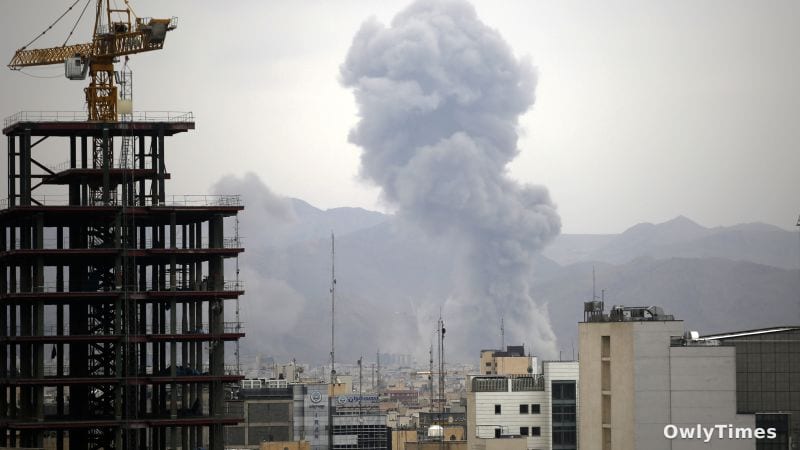

The current escalation with Iran isn’t simply a reaction to recent attacks; it’s a calculated risk by the Biden administration – and a potential trap for Donald Trump – to redefine the parameters of containment in the Middle East. The strategic calculus isn’t about eliminating Iran’s military capabilities entirely, an unrealistic goal, but about raising the cost of regional aggression to a level that compels a recalibration of Iranian foreign policy. This isn’t a war aiming for regime change, at least not initially, but a demonstration of resolve designed to deter further escalation and re-establish a credible threat of force. Who benefits and who loses hinges on whether the US can successfully navigate this delicate balance, and whether regional actors interpret the signals correctly.
The situation is further complicated by the unpredictable nature of leadership on both sides. As Brett McGurk, a veteran of multiple administrations, points out, much now rests on the decisions of individuals like President Trump and Iran’s untested new supreme leader, Mojtaba Khamenei. Trump’s Monday statements – simultaneously suggesting a “short-term excursion” and demanding Iran’s complete disarmament – exemplify this ambiguity. This isn’t simply rhetorical inconsistency; it’s a deliberate strategy to keep all options open, appealing to both hawkish and dovish constituencies while maintaining maximum leverage. The White House’s confirmation of a four-to-six-week timeframe for military operations, despite Pentagon officials’ reluctance to discuss specifics, underscores the tension between projecting strength and avoiding open-ended commitment.
Inside the White House, crisis planning traditionally involves modeling potential end-state scenarios – base case, best case, and worst case – drawing on expertise across the US government. The current military objective, as articulated by the Pentagon, is to degrade Iran’s ability to project power beyond its borders: targeting missiles, drones, naval forces, air forces, command and control, and remnants of its nuclear program. This is a defined military mission, distinct from the more ambitious – and arguably unattainable – goal of fundamentally altering the Iranian political system. However, the success of this mission is contingent on time, and military planners are likely advising Trump that weeks, at a minimum, are required to achieve meaningful results.
Drawn from CNN.
The economic variables are critical, and Iran is actively attempting to leverage them. Tehran aims to increase economic pain – particularly through disruption of the Strait of Hormuz – to pressure Trump into declaring a swift, limited victory. This is a calculated gamble, predicated on the assumption that Trump’s aversion to prolonged economic disruption will outweigh his desire for a comprehensive dismantling of Iran’s military capabilities. The assumption that energy prices will remain elevated, even with a resumption of shipping traffic, is a key component of this calculation. This echoes the oil shocks of the 1970s, where geopolitical instability directly translated into economic hardship, forcing policy adjustments in Washington.
Based on current information, a base-case scenario – with a roughly 60% probability – sees Trump allowing the military to complete its defined mission of degrading Iran’s power projection capabilities. This would involve containing economic shocks, maintaining international sanctions, and establishing a deterrent posture similar to Iraq in the 1990s: a weakened, contained state under constant surveillance. While not promising regime change, this scenario anticipates future political unrest within Iran, potentially leading to a gradual erosion of the current regime. Militarily, the US and Israel would likely maintain a patrol presence, ready to strike any attempts to reconstitute Iran’s offensive capabilities.
The worst-case scenario – estimated at 25% probability – involves economic pressures forcing Trump to declare victory prematurely, leaving Iran’s power structures intact and emboldened. This would destabilize the region, leaving Gulf states vulnerable to Iranian missile and drone attacks and potentially drawing the US deeper into a long-term security commitment. This outcome mirrors the aftermath of the first Gulf War, where a failure to fully dismantle Saddam Hussein’s military apparatus led to years of containment and eventual renewed conflict. President Dwight D. Eisenhower’s warning about the unpredictable consequences of war is particularly relevant here; a premature halt to the campaign risks a more precarious regional balance.
A best-case scenario – with only a 10% probability – envisions the military pressure triggering widespread protests within Iran, leading to the overthrow of the Islamic Republic. However, this outcome is unlikely without organized internal opposition and a direct assault on the regime’s repressive apparatus – something the current military plan doesn’t prioritize. The violent crackdown on protests in January 2020, reportedly resulting in thousands of deaths, demonstrates the regime’s willingness to suppress dissent. This scenario requires a level of internal upheaval that is not currently evident, and relies on factors beyond the control of US military operations.
The succession of Mojtaba Khamenei as supreme leader introduces another layer of uncertainty. His legitimacy rests primarily on inheritance, a departure from the revolutionary origins of the Islamic Republic. This could create internal divisions and weaken the regime’s long-term stability. Regardless of the immediate outcome, US engagement with Iran – including deterrence, containment, and the possibility of further military action – is likely to continue indefinitely. The most probable result isn’t a clean resolution, but a weaker, more contained Iran, with shifting regional power dynamics and enduring uncertainty. The political chess move to watch next isn’t a dramatic escalation, but whether Trump will adhere to the four-to-six-week timeframe, or succumb to pressure for a premature declaration of victory – a decision that will define the future of US-Iran relations for years to come.





