
Is Samsung finally admitting defeat in the voice assistant wars? After years of pushing Bixby as a Google Assistant killer, the company isn’t so much “rebooting” the assistant as it is quietly repurposing it. The real story here isn't a triumphant return for Bixby – it’s a strategic retreat, acknowledging that users aren’t looking for another digital personality, but rather a smarter way to actually use their phones. This isn’t about beating Google; it’s about not being irrelevant.
For years, Samsung has poured resources into Bixby, hoping to create a cohesive ecosystem around its own voice commands. The problem? Most people found Google Assistant – or even Apple’s Siri – more intuitive and capable. The initial January attempt at a Bixby overhaul fizzled, suggesting internal struggles to define the assistant’s purpose. Now, with the re-announcement of the Bixby reboot arriving in One UI 8.5, the focus has dramatically shifted. Instead of trying to be a digital assistant, Bixby is becoming a hyper-specific device control system.
This article draws on reporting from 9to5Google.
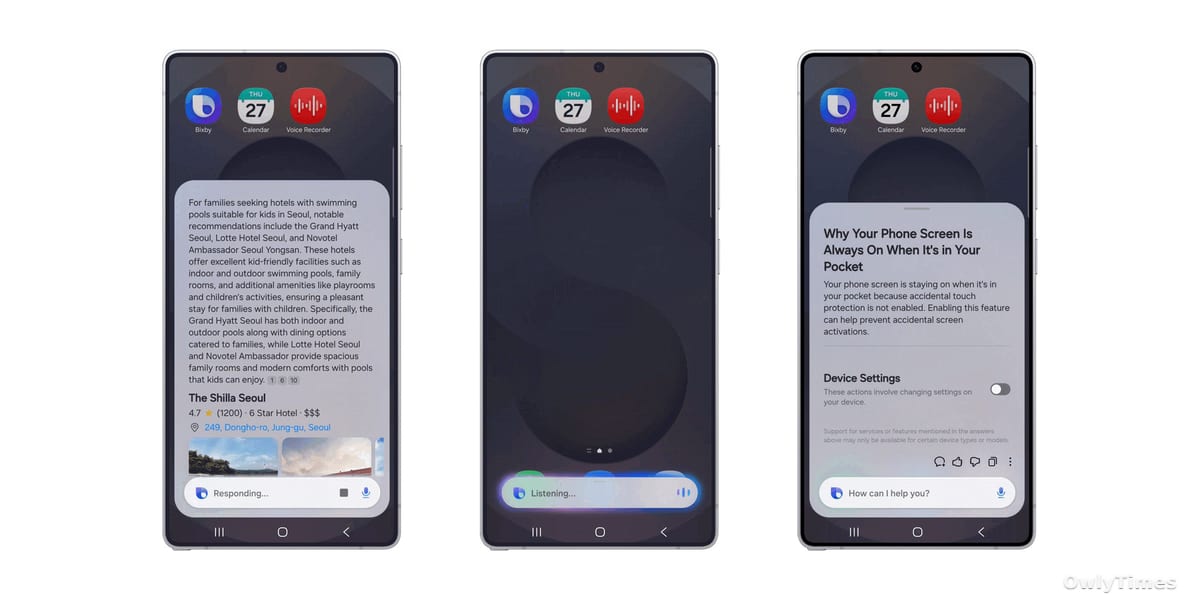
The core of the new Bixby isn’t about asking it the weather or setting timers. It’s about natural language control of phone settings. Samsung highlights examples like saying, “I don’t want the screen to time out while I’m still looking at it,” and having Bixby automatically enable “Keep Screen on While Viewing.” This is a subtle but crucial difference. It’s not about what you ask, but that Bixby understands the intent behind the request, bypassing the need to memorize obscure menu options. This is particularly valuable for less tech-savvy users, who represent a significant portion of Samsung’s customer base. The company is betting that simplifying access to core features will be more impactful than adding yet another voice that answers trivia questions.
This shift also addresses a common frustration: accidental settings changes. Samsung points to Bixby’s ability to recognize context – like a phone frequently turning on in a pocket – and suggest relevant settings like “Accidental Touch Protection.” This isn’t groundbreaking AI, but it’s a practical application of machine learning that directly solves a user problem. The integration of real-time web results, potentially powered by Perplexity, adds another layer of utility, though Samsung remains tight-lipped about the specifics. This feels less like a direct competitor to Google Search and more like a contextual information layer within the device control framework.
Currently, the Bixby reboot is limited to beta testing in Germany, India, Korea, Poland, the UK, and the U.S., available on the Galaxy S25 series via One UI 8.5 beta builds based on Android 16. The full rollout is expected after the launch of the Galaxy S26 series next week. This phased approach is smart; it allows Samsung to gather real-world usage data and refine the system before unleashing it on millions of users. The fact that they’re testing on the S25 before the S26 launch suggests a level of confidence – or perhaps a desperate need to prove the concept works.
But here’s the tension: Samsung is simultaneously hyping up the AI capabilities of the Galaxy S26 camera, promising a “brightest” and “easiest” experience. This suggests a broader AI strategy, but one that feels fragmented. Will Bixby become a unified AI layer across the entire Samsung ecosystem, or will it remain a niche tool for device control? The reports of “dead displays” on the Galaxy Z TriFold also cast a shadow, reminding us that even the most advanced tech is prone to glitches. The shiny new features are meaningless if the underlying hardware isn’t reliable.
The question isn’t whether Bixby will become the next Siri or Alexa. It’s whether Samsung can successfully reposition it as a genuinely useful tool that simplifies the user experience. Watch for this: in six months, will people be actively seeking out Bixby to adjust settings, or will it remain a forgotten feature buried in the menus? If it’s the latter, this reboot will be remembered as another expensive experiment gone wrong.