
How do we quantify the influence of a void? While black holes are often defined by their capacity to consume matter, their most profound impact on the surrounding cosmos may actually be what they expel. By analyzing Cygnus X-1, a binary system residing 7,200 light-years away, researchers have finally transitioned from long-term averages to capturing the instantaneous, high-energy dynamics of these gravitational giants.
Decoding the Mechanics of a Stellar Predator
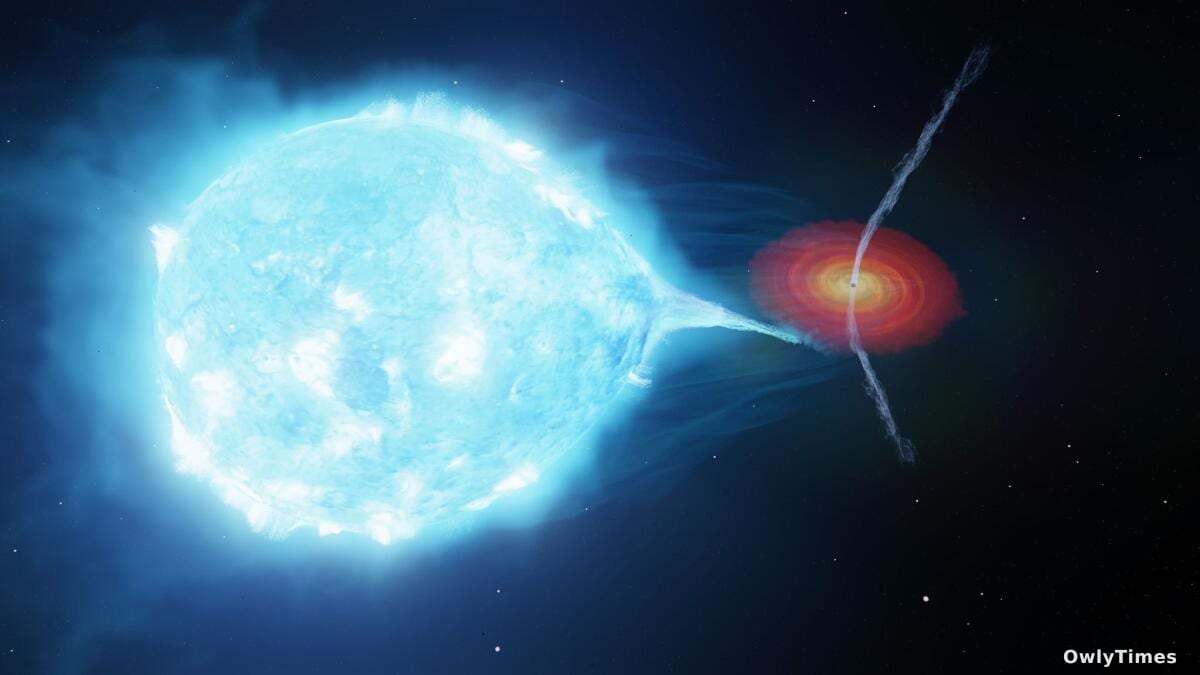
Located within the Milky Way’s Cygnus constellation, the Cygnus X-1 system has been a focal point for astronomers since its discovery in the 1960s. It was the first black hole ever identified, yet its behavior remains a masterclass in cosmic interaction. The system pairs a black hole with a blue supergiant star, which serves as a consistent source of fuel. As the black hole pulls gases from its companion, it converts a portion of that gravitational energy into powerful, high-speed jets.
An international research team, led by Steve Prabu—then of Australia’s Curtin University and now of the University of Oxford—has successfully measured the sheer force of these emissions. According to the study published in Nature Astronomy, the jet power emanating from this system is equivalent to 10,000 suns. Furthermore, the team tracked these jets traveling at approximately 355 million mph, a velocity reaching half the speed of light.
Moving Beyond Long-Term Averages
The scientific community has historically been limited to averaging the power of black hole jets over tens of thousands of years. The methodology employed by Prabu’s team represents a significant shift in precision. By utilizing 18 years of high-resolution radio imaging from a global telescope network, the researchers observed how the blue supergiant’s stellar wind physically bends the jets.
By integrating this observational data with sophisticated computer modeling, the team determined that 10% of all energy released as matter falls toward the black hole is effectively carried away by these jets. This figure is critical for understanding the "budget" of a black hole’s growth and its influence on its environment. While headlines may focus on the extreme speeds, the core scientific advancement lies in this newfound ability to calculate the energy conversion rate in near real-time.
The Constraints of Cosmic Observation
Despite the breakthrough, there are limitations to consider regarding the scope of these findings. Cygnus X-1 is considered relatively "skimpy" in terms of its mass compared to other, more gargantuan black holes found elsewhere in the universe. Because the team relied on the interaction between the jets and the stellar wind of a specific companion star, the methodology is currently tied to systems where such a "stellar playmate" exists to provide the necessary visual distortion for measurement.
Translating these results to isolated black holes or those with different accretion environments remains a challenge. The 7,200 light-year distance—where a single light-year is nearly 6 trillion miles—also reminds us that even our most "local" neighbors in the galaxy require massive, multi-year datasets to resolve these minute, high-energy interactions.
Future Applications for Galactic Evolution
The next steps for this research involve applying these same imaging and modeling techniques to a broader range of black hole systems. Prabu has noted that expanding the sample size is essential to confirm whether this 10% energy-carryover rate is a universal constant or a variable tied to specific binary configurations. The next readings of jet power in other systems will show whether these "dancing jets" serve as a consistent mechanism for shaping galaxies through large-scale shocks and turbulence. By observing how these structures disperse energy, scientists move closer to understanding the feedback loops that regulate the evolution of the cosmos.