
$28 Trillion in Question: The Fading Promise of BRICS
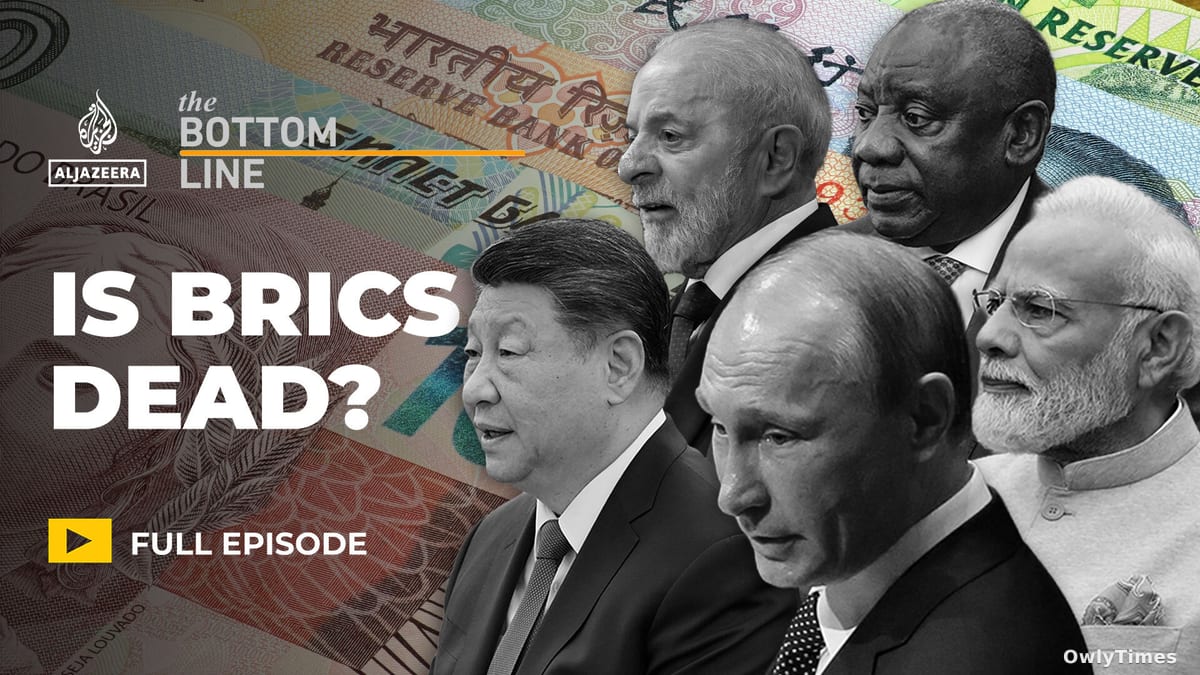
$28 trillion. That’s the combined GDP of the original BRICS nations – Brazil, Russia, India, China, and South Africa – a figure that once symbolized a seismic shift in global economic power. But according to Jim O’Neill, the economist who literally named the bloc 25 years ago, the BRICS coalition is losing its coherence, and its initial promise of a viable alternative to the Western-dominated financial order is fading. This isn’t simply a reassessment of acronymic relevance; it’s a critical signal about the evolving dynamics of global power, and a potential inflection point for investors betting on a multipolar world. O’Neill’s analysis, delivered on February 22, 2026, isn’t a dismissal of China and India’s continued growth, but a pointed critique of the increasingly fractured political and economic realities within the BRICS framework.
Drawn from Al Jazeera.
The Internal Contradictions of a Rising Powerhouse
The initial vision of BRICS, conceived in 2001, was predicated on a shared desire to reform global institutions and challenge the hegemony of the United States dollar. At its peak, the collective weight of these emerging economies offered a compelling counter-narrative to the Group of Seven (G7) and institutions like the World Bank and International Monetary Fund (IMF). However, O’Neill now argues that divergent political agendas are actively undermining the coalition’s potential. This isn’t a new observation – tensions between China and India, for example, have been simmering for decades – but the scale of these internal contradictions is now, according to O’Neill, a fundamental impediment to BRICS’s effectiveness. Consider Russia’s current economic isolation following sanctions; its inclusion within a bloc ostensibly designed to challenge Western financial structures now appears strategically counterproductive, creating friction rather than leverage. The bloc’s expansion to include nations like Egypt, Ethiopia, Iran, and the United Arab Emirates – while increasing its overall population and resource base – further complicates the picture, introducing new geopolitical complexities and diluting the original core objectives.
US Policy and the Shifting Global Landscape
O’Neill’s assessment isn’t solely focused on internal BRICS dynamics. He posits that the United States’ own economic policies may be accelerating its relative decline, inadvertently creating space for China and India to ascend. This is a crucial point often overlooked in discussions about global power shifts. While the US remains the world’s largest economy with a GDP of roughly $27.94 trillion (as of Q4 2025), persistent fiscal deficits, rising debt levels, and protectionist trade policies are eroding its economic foundations. The US national debt currently stands at over $34 trillion, a 1,200% increase since 1980. This isn’t to suggest imminent collapse, but rather a gradual weakening of US economic leadership, creating a vacuum that China – with a GDP of $18.56 trillion – and India – rapidly approaching $4 trillion – are increasingly positioned to fill. The key difference, O’Neill implies, is that China and India are benefiting not necessarily because of BRICS, but despite it.
India’s Ascent: A Divergence from the BRICS Narrative
The trajectory of India is particularly noteworthy. While initially grouped with Brazil, Russia, and China as a developing economic power, India’s growth story has increasingly diverged from the others. In 2025, India’s GDP growth rate was 7.6%, significantly outpacing China’s 4.9% and dwarfing Brazil’s 2.1% and Russia’s 2.3%. This divergence is driven by a combination of factors, including a young and rapidly growing workforce, a burgeoning middle class, and a proactive government focused on economic liberalization and infrastructure development. India’s increasing attractiveness as a manufacturing hub – fueled by supply chain diversification away from China – further solidifies its position as a key player in the global economy. This success, however, doesn’t necessarily translate into a stronger BRICS. India is pursuing its own strategic interests, often independently of the bloc, and its economic relationship with the United States remains strong.
What This Means for Your Wallet
The unraveling of the BRICS narrative doesn’t signal the end of emerging market growth, but it does necessitate a recalibration of investment strategies. The initial promise of a BRICS-led alternative financial system – one that would challenge the dominance of the US dollar – is unlikely to materialize in the short to medium term. Investors who previously allocated capital based on the BRICS thesis should now focus on individual country fundamentals, rather than relying on the collective strength of the bloc. Specifically, monitor India’s continued economic reforms and infrastructure investments, as these are likely to generate significant returns. Simultaneously, be cautious about Russia and Brazil, whose economic prospects are increasingly tied to volatile commodity prices and geopolitical risks. The key takeaway is this: the future of global economic power isn’t about a unified challenge to the West, but a more fragmented and competitive landscape where individual nations – like India – are forging their own paths. The question now is, will the US adapt its economic policies to maintain its leadership position, or will it continue to cede ground to a rising, but increasingly independent, China and India?