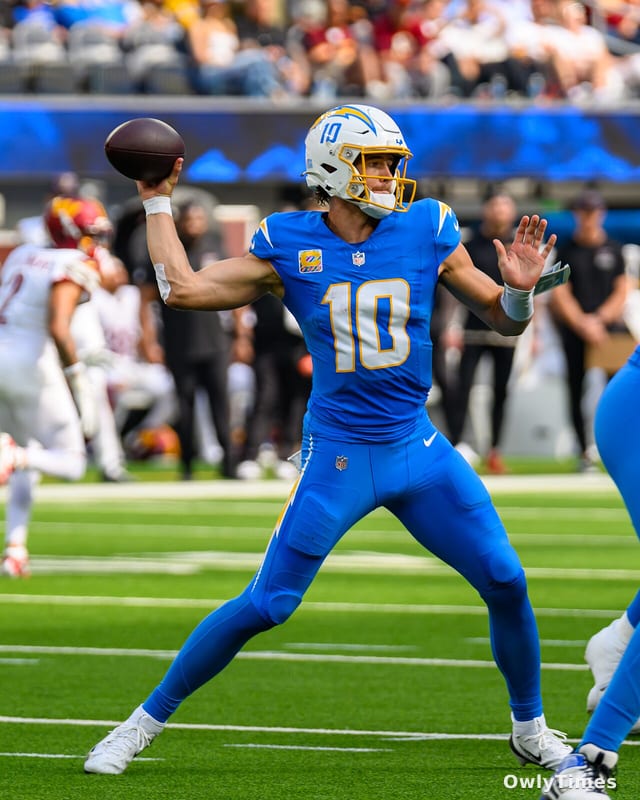

The air in Los Angeles feels different this year, not just with the unseasonably warm winter, but with a quiet desperation clinging to the Chargers faithful. It’s the kind of desperation that doesn’t scream for a Super Bowl – not yet – but pleads for a clean pocket, a consistent running game, and a quarterback who isn’t constantly looking over his shoulder. Last season wasn’t just a disappointment; it was a brutal, visible breakdown, and the numbers tell a story of systemic failure. As Justin Herbert spent a league-leading 268 times bracing for impact, the Chargers’ offensive line wasn’t just a weakness, it was a liability, and now, with free agency looming, the team is finally acknowledging the depth of the problem.
The Anatomy of a Collapse
The Chargers finished 2025 ranked dead last in pass-block win rate at a dismal 54.4%. To put that in perspective, the league average hovers around 63%, meaning Herbert faced significantly more pressure than almost any other quarterback in the NFL. That pressure translated into a staggering 54 sacks – the second-most in the league – and a 38.4% pressure percentage on dropbacks, the second-highest in the NFL. These aren’t just statistics; they’re the visible scars of a season where potential was suffocated by a crumbling foundation. The running game suffered too, ranking 28th in yards per rush up the middle, further compounding the offensive woes. It’s a pattern of failure that goes beyond bad luck or individual underperformance; it’s a systemic issue demanding immediate and substantial correction.
This piece references the Yahoo Sports report.
Beyond the Roster: A Reflection of NFL Priorities
Joe Hortiz, the Chargers’ general manager, didn’t mince words when addressing the team’s free agency plans. “Yeah, we're looking at all positions,” he stated, but quickly zeroed in on the critical need to “shore up the offensive line.” The retirement of center Bradley Bozeman only amplified a problem that was already glaringly obvious. But this isn’t simply about replacing a retiring player or filling a vacant spot. It’s about a league-wide trend: the increasing emphasis on skill position players at the expense of the trenches. For years, teams have prioritized flashy quarterbacks, dynamic receivers, and explosive running backs, often neglecting the unglamorous but essential work of building a strong offensive line. The Chargers’ struggles are a stark reminder that even the most talented quarterback can’t succeed without adequate protection.
The Herbert Factor and the McDaniel Effect
The urgency to fix the offensive line isn’t just about improving the team’s overall performance; it’s about protecting the investment in Justin Herbert. He’s a franchise quarterback, a potential superstar, and his long-term health and development depend on reducing the constant barrage of pressure he faced last season. The Chargers’ recent hiring of offensive guru Mike McDaniel signals a shift in philosophy, a commitment to building a more balanced and sustainable offense. But McDaniel’s innovative schemes will be rendered ineffective if Herbert doesn’t have time to execute them. The offensive line overhaul isn’t just a personnel upgrade; it’s a prerequisite for McDaniel’s success. The pending free agency of left guard Zion Johnson and the possibility of cutting the right guard further complicate matters, adding to the pressure to find immediate solutions.
What Happens When the Money Talks?
The Chargers’ free agency strategy will be a fascinating case study in NFL priorities. Will they be willing to spend big on proven offensive linemen, potentially sacrificing resources at other positions? Or will they opt for a more cost-effective approach, relying on draft picks and developmental players? The market for offensive linemen is competitive, and top-tier players command hefty contracts. The Chargers have the cap space to make a splash, but they also need to consider the long-term implications of their spending. The success or failure of their free agency period will not only determine their chances of a playoff run in 2026 but will also set a precedent for how the league values the often-overlooked heroes in the trenches. Will the Chargers’ commitment to protecting Herbert force a broader re-evaluation of NFL spending priorities, or will they simply become another cautionary tale of a talented quarterback undone by a weak offensive line? That’s the question everyone in the league will be watching closely.

