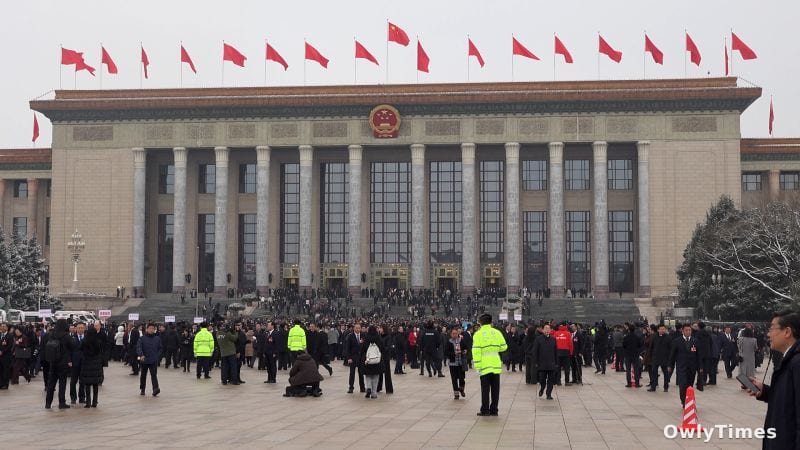

The Illusion of Control: Beijing’s NPC and the Tightrope Walk with Global Instability
The opening of the National People’s Congress (NPC) this Thursday isn’t simply a scheduled political event; it’s a carefully orchestrated demonstration of control, timed to project stability onto a world increasingly defined by cascading crises. While Western media frames the NPC as a “rubber-stamp legislature,” that characterization misses the core strategic calculation at play: the NPC is a domestic signaling mechanism with significant international implications. Xi Jinping’s government isn’t seeking genuine legislative debate, but rather a unified front to reassure internal stakeholders – the Party, the military, and increasingly anxious economic actors – while simultaneously conveying a message of resolute strength to a world watching the unfolding conflicts in the Middle East and escalating tensions with the United States. The agenda, as reported by Mike Valerio of CNN, is less about specific policy breakthroughs and more about reinforcing the narrative of a China confidently navigating global turbulence.
This piece references the CNN report.
The immediate beneficiaries of this display are, predictably, the internal power structures within the Chinese Communist Party. A show of unity and purpose strengthens Xi Jinping’s position, particularly as he faces ongoing economic headwinds and the lingering effects of the zero-COVID policy. The NPC allows the Party to reaffirm its core tenets – economic development, social stability, and national sovereignty – and to present a cohesive response to external challenges. Conversely, those who lose in this scenario are any voices advocating for internal reform or greater transparency. The NPC’s tightly controlled environment actively suppresses dissent and reinforces the Party’s monopoly on power. The economic implications are also nuanced; while the NPC will likely announce growth targets, the underlying fragility of the property sector and the ongoing trade disputes with the West remain unaddressed, creating a potential disconnect between rhetoric and reality.
This emphasis on projecting strength through a controlled political spectacle isn’t new. The historical parallel lies in the Soviet Union’s carefully choreographed Party Congresses during the Cold War. Like the NPC, these events were designed to project an image of monolithic unity and unwavering ideological commitment, even as internal contradictions and economic weaknesses festered beneath the surface. The Soviet model ultimately proved unsustainable, but the impulse to project strength through controlled political theater remains a consistent feature of authoritarian regimes. What distinguishes the current Chinese approach is its integration with a sophisticated economic strategy – the Belt and Road Initiative, for example – designed to build influence and dependencies abroad, offering an alternative to the Western-led international order.
The timing of the NPC, coinciding with heightened tensions in the Middle East, is particularly noteworthy. The flurry of CNN reports detailing the US response to Iranian attacks, the security situation in Tehran, and even the US submarine’s recent torpedo exercise, all underscore the volatile geopolitical landscape. China’s position in this context is delicate. It maintains economic ties with Iran, but also seeks to avoid direct confrontation with the United States. The NPC provides a platform for Xi Jinping to reiterate China’s commitment to a “multipolar world” – a diplomatic euphemism for a world less dominated by the US – while simultaneously signaling a preference for de-escalation. This balancing act is further complicated by the ongoing war in Ukraine, where China has attempted to position itself as a neutral mediator, despite its tacit support for Russia.
The key political chess move to watch isn’t what emerges from the NPC, but what happens in response to it. Specifically, the world should be watching for any shift in China’s rhetoric regarding Taiwan. A more assertive tone, framed as a response to perceived Western interference in the region, would signal a significant escalation in tensions and a willingness to risk a direct confrontation with the United States. The NPC’s carefully constructed facade of stability could quickly unravel if Beijing chooses to leverage the current global instability to advance its territorial claims. The question isn’t whether China can project strength, but whether it will choose to translate that projection into concrete action.





