
Are we really building a future with lighter, stronger materials if the cost is a manufacturing process that’s stubbornly stuck in the past – and actively harming the planet? Silicon Valley loves to talk about disruption, but the world of composite materials, crucial for everything from airplanes to wind turbines, is facing a surprisingly analog bottleneck. The real story here isn't the impressive strength-to-weight ratio of carbon fiber; it’s the desperate need to automate and green the way we make the stuff, before the promise of these materials becomes a sustainability liability.
The Automation Imperative: Beyond Hand-Laid Carbon Fiber
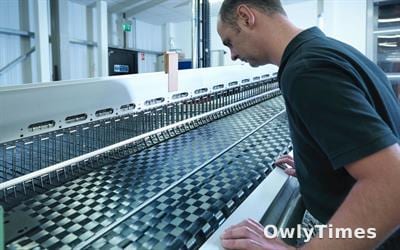
For years, the production of continuous fiber reinforced polymers (FRPs) – the technical term for these composites – has relied heavily on manual labor. Think skilled technicians painstakingly layering carbon fiber sheets, a process that’s slow, expensive, and prone to inconsistencies. While the aerospace and automotive industries are clamoring for more composites to meet fuel efficiency and performance goals, scaling production with these methods is a non-starter. Frontiers recently launched a Research Topic dedicated to addressing this, focusing on advanced manufacturing processes like Filament Winding, Automated Fiber Placement, and Pultrusion – all geared towards removing human hands from the equation. These aren’t futuristic concepts; they’re established techniques that need serious optimization to become truly viable for mass production. The challenge isn’t inventing new materials, but inventing new ways to build with them.
This piece references the frontiersin.org report.
Digital Twins and the Pursuit of Perfect Parts
Automation alone isn’t enough. The complexity of composite manufacturing demands a level of precision that requires integrating digital technologies. Artificial Intelligence (AI) and machine learning are being explored to optimize everything from fiber orientation to curing cycles, essentially creating “digital twins” of the manufacturing process. This allows engineers to simulate and refine designs before a single piece of carbon fiber is laid down, reducing waste and improving component performance. The Research Topic specifically highlights the importance of process monitoring and data-driven optimization, moving beyond reactive quality control to proactive process management. This isn’t about replacing engineers; it’s about giving them superpowers – the ability to analyze vast datasets and predict potential problems before they occur.
The Hidden Environmental Cost of Lightweighting
The push for lightweight materials is often framed as an environmental win – lighter cars mean better fuel economy, lighter planes mean lower emissions. But that narrative conveniently ignores the environmental impact of composite manufacturing itself. Traditional composite production generates significant waste, relies on energy-intensive processes, and often uses materials with questionable end-of-life scenarios. Life Cycle Assessment (LCA) is a key focus of this Research Topic, aiming to quantify the environmental footprint of composite materials from cradle to grave. This isn’t just about ticking a sustainability box; it’s about identifying genuine opportunities to reduce waste, improve material utilization, and design for recyclability. The industry needs to move beyond simply using less material to fundamentally rethinking how composites are made and disposed of.
Beyond the Lab: What This Means for Your Next Car (and Beyond)
This isn’t just an academic exercise for materials scientists. The outcome of this research will directly impact the cost and availability of products we use every day. If automated composite manufacturing can deliver on its promise, we could see wider adoption of lightweight materials in everything from consumer electronics to construction. But if the industry fails to address the sustainability challenges, the benefits of composites could be offset by their environmental cost. The publishing fees associated with articles accepted by Frontiers – charged to authors, institutions, or funders – underscore the financial investment being made in this field, signaling a serious commitment to finding solutions.
The Coming Composite Crossroads
Here’s what to watch for: over the next three years, keep an eye on the development of closed-loop recycling processes for carbon fiber. Right now, recycling these materials is expensive and technically challenging. If researchers can crack that code – and the industry can scale those solutions – we’ll see a genuine shift towards a circular economy for composites. But if recycling remains a niche endeavor, we’re heading towards a future where lightweighting comes at a steep, and unsustainable, environmental price.