
The challenge facing scientific progress isn’t a lack of ideas, but a bottleneck in execution. For decades, the scientific method has relied on a fundamentally linear process – hypothesize, experiment, analyze, repeat – a rhythm dictated by human time and prone to human limitations. Now, a shift is underway at the Pacific Northwest National Laboratory (PNNL) that aims to break that constraint, not by replacing scientists, but by augmenting their capabilities with the speed and scalability of artificial intelligence and robotics. This isn’t simply about automating existing lab procedures; it’s about building systems capable of autonomous scientific discovery, and the implications for American competitiveness in science, energy, and national security are substantial.
Bob Runkle, a physicist leading PNNL’s autonomous discovery strategy, frames the urgency succinctly: “We are building out and demonstrating what an autonomous science infrastructure can accomplish at the scale of an entire national laboratory.” This statement isn’t hyperbole. The core problem PNNL is addressing is the sheer volume of data generated by modern experiments, and the time it takes to interpret that data and adjust experimental parameters. As scientific questions become more complex, the traditional linear approach becomes increasingly unwieldy, slowing the pace of innovation. Imagine attempting to optimize a process with dozens of interacting variables – a common scenario in materials science or biotechnology – and requiring weeks or months between each experimental iteration. The potential for breakthroughs is stifled by the logistical realities of human-driven research. PNNL’s solution is to create a closed-loop system where robotic platforms conduct experiments, AI agents analyze the results, and the system autonomously designs and executes the next round of experiments, all with minimal human intervention.
Drawn from newswise.com.
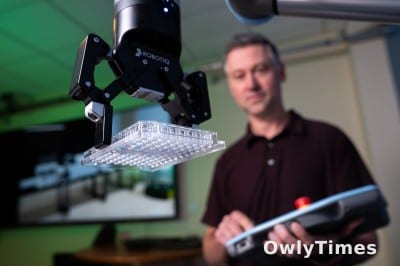
This vision is spearheaded by Draguna Vrabie, whose work has been instrumental in aligning AI, control systems, and automation with the demands of scientific discovery. The physical manifestation of this effort is the new Autonomy Studio, a facility designed to demonstrate the “art of the possible” in autonomous science. It’s crucial to understand the distinction between automation and autonomy. Automation, as Elias Nakouzi points out, involves robots performing pre-programmed tasks. Autonomy, however, introduces a layer of decision-making powered by AI, allowing the system to adapt and learn. “Robots give you automation, but AI gives you autonomy at the level of decision-making,” Nakouzi explains, highlighting the critical leap PNNL is attempting. Currently, the studio showcases robots moving samples for microscopic analysis, removing tedious tasks from scientists’ workloads and freeing them to focus on higher-level interpretation and goal setting.
One immediate application of this technology focuses on securing the supply chain for critical minerals – lithium, cobalt, and nickel – essential for modern technology and national security. The U.S. currently relies heavily on foreign suppliers for these materials. Maxim Ziatdinov, a physical scientist at PNNL, describes the “SciLink” AI platform developed to address this challenge. SciLink doesn’t just analyze data; it conducts economic analyses, proposes experiments, and refines hypotheses, effectively acting as a virtual research assistant. The team is building a self-driving lab specifically for critical mineral separations, aiming to economically recover these valuable resources from industrial waste, such as discarded permanent magnets and wastewater from oil and gas extraction. This isn’t simply a theoretical exercise; PNNL is actively collaborating with industry partners to translate lab-scale successes into commercially viable processes.
Beyond materials science, PNNL is applying autonomous science to the complexities of biotechnology. The Anaerobic Microbial Phenotyping Platform (AMP2) tackles the challenge of optimizing growth conditions for microorganisms used in bioproduction – the creation of organic acids used in pharmaceuticals, food preservatives, and other industries. Biologists often face an overwhelming number of variables when attempting to maximize yield and efficiency. AMP2 allows for thousands of simultaneous experiments, guided by AI to identify promising avenues and eliminate unproductive ones. Rob Egbert, team lead for synthetic biology at PNNL, envisions a future where AI prioritizes samples for further analysis and robotic liquid-handling systems automatically conduct the next logical experiment, accelerating the optimization process.
However, it’s important to acknowledge the limitations. While the Autonomy Studio represents a significant step forward, it’s still in its early stages of development. The audacious goal of incorporating autonomy into every experiment within five years is ambitious, and success will depend on overcoming significant technical hurdles. The AI algorithms require extensive training data, and the robustness of the robotic systems needs to be proven in real-world conditions. Furthermore, the ethical implications of autonomous scientific discovery – ensuring transparency, accountability, and preventing unintended consequences – require careful consideration. The current focus is on well-defined problems with measurable outcomes; extending this approach to more open-ended research questions will be a substantial challenge.
The next crucial step is the deployment of the Genesis Mission, a project focused on building a powerful AI infrastructure to seamlessly integrate with these autonomous science platforms. This infrastructure will be essential for scaling up the technology and applying it to a wider range of scientific problems. Looking ahead, the key question isn’t if autonomous science will transform research, but how quickly and how broadly. Will we see similar autonomous labs emerge across other national laboratories and universities? And, perhaps more importantly, will these systems truly empower scientists to tackle the most pressing challenges facing humanity, or will they simply accelerate existing trends in scientific specialization and inequality?





