
The resurgence of preventable diseases – measles cases in the first seven weeks of this year already exceeding the total for the past four years, a surge in whooping cough, and reversals in HIV prevention – isn’t simply a public health blip. It’s a stark signal, not of a system failing gradually, but of deliberate disruption. While headlines celebrate Congress’ recent defense of science agency budgets against drastic White House cuts, the reality is far more nuanced. The immediate crisis isn’t solely about how much funding science receives, but how that funding is being allocated, and the chilling effect of an administration actively undermining scientific consensus, particularly regarding public health interventions like vaccination. This isn’t a story of restored funding; it’s a story of damage control, and a warning about the fragility of scientific progress in the face of ideological opposition.
The narrative pushed by some is that Congressional action has “restored” science funding. However, a closer look reveals a “double-edged sword,” as Joanne Padrón Carney, chief government relations officer for the American Association for the Advancement of Science (AAAS), describes it. While Congress did indeed reject the White House’s proposed slashing of the National Institutes of Health (NIH) and National Science Foundation (NSF) budgets – cuts exceeding 50% for the NSF and nearly 40% for the NIH – the budgets were merely preserved at current levels. This isn’t growth, and it’s a far cry from the investment needed to address emerging challenges or capitalize on scientific breakthroughs. More critically, preserving a budget on paper is meaningless if the funds are deliberately stalled or redirected.
Drawn from timeshighereducation.com.
The true extent of the disruption is being meticulously documented by Scott Delaney, a former Harvard scientist who lost his funding last year and now leads Grant Witness, a website tracking terminated research grants. According to Grant Witness, over 5,400 NIH grants, totaling approximately $520 million, and nearly 2,000 NSF grants, worth $700 million, have been terminated or frozen. While some grants have been legally reinstated, around 2,600 remain in limbo. This isn’t simply about money; it’s about careers derailed, research momentum lost, and a generation of scientists potentially discouraged from pursuing critical work. The claim that “science in the US is back to full speed” is, as Delaney states, “just not consistent with what’s happening on the ground.”
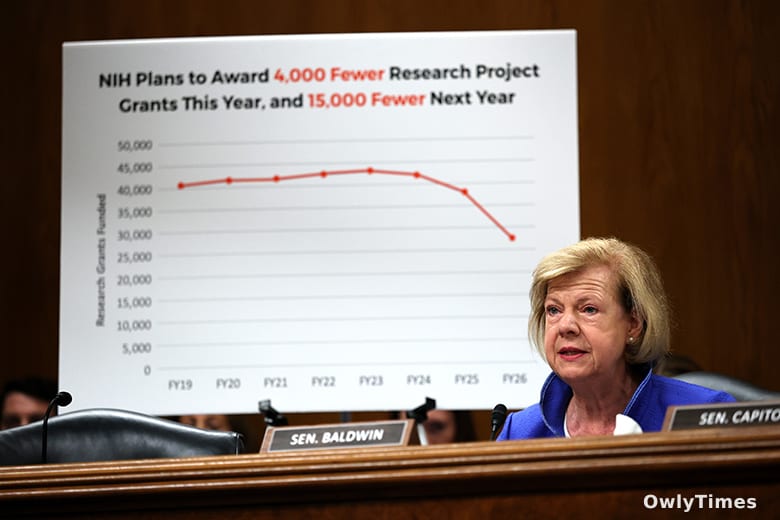
The problem extends beyond outright cuts. Even with Congressional support, the Office of Management and Budget (OMB), under the direction of Russell Vought, a long-time advocate for reducing science funding, is actively delaying the release of allocated funds. An OMB circular allows the agency to limit spending to “salaries and essential expenses” for 30 days, effectively putting projects on hold. Data analyzed by Jeremy Berg, professor at the University of Pittsburgh and former director of the National Institute of General Medical Sciences, reveals that the NIH has awarded roughly two-thirds the usual number of grants by this point in the year, while the NSF has awarded only about one-quarter. This isn’t a bureaucratic slowdown; it’s a deliberate bottleneck, designed to frustrate researchers and potentially shift priorities.
This deliberate slowing of funds is compounded by staffing losses within the science agencies themselves. Agencies lost around 20% of their administrative staff last year, including crucial program managers responsible for evaluating grant applications and distributing funds. David Ho, a professor at the University of Hawai’i at Mānoa, notes that this shortage means even with funding available, agencies struggle to distribute it efficiently. The result is a system favoring established scientists with proven track records, at the expense of innovative, early-career researchers. David Sanders, an associate professor of biological sciences at Purdue University, observes that this disruption is “devastating” to younger colleagues, adding “additional burdens that are really discouraging a lot of people at multiple levels of career engagement with the sciences.”
The ideological undercurrent driving these actions is undeniable. Sanders points to the “largely ideological” opposition to vaccination programs and vaccine research, reinforced by messaging from individuals in positions of public trust, like Robert F. Kennedy Jr., the current head of the Department of Health and Human Services. This isn’t simply a disagreement over policy; it’s a rejection of evidence-based science in favor of unsubstantiated claims. The appointment of individuals lacking scientific expertise to key positions – such as the potential nomination of biotechnology investor Jim O’Neill to lead the NSF – further exacerbates these concerns. The specter of a “Lysenko-esque” scenario, where political ideology dictates scientific validity, as warned by Berg, is a chilling reminder of the dangers of politicizing science.
While philanthropic donations can offer some support to fields facing political headwinds, Berg cautions that the scale of federal funding is beyond the reach of private donors. Moreover, the very sources of philanthropic wealth are often reliant on government contracts, creating a disincentive for challenging the administration. The AAAS’ Carney acknowledges that the situation remains precarious, anticipating further battles over funding in the coming years. The current reprieve is not a return to normalcy, but a temporary holding action in a longer, more fundamental struggle over the role of science in American society.
Looking ahead, the critical question isn’t simply whether Congress will continue to defend science budgets, but whether it can compel the administration to actually release those funds. Watch closely for the 2027 budget requests this spring, and, more importantly, track the actual disbursement rates of currently allocated funds. The true measure of support for science won’t be found in press releases, but in the labs and research institutions where discoveries are made – or, increasingly, where they are stalled. The health of the American public, and the future of scientific innovation, depend on it.





