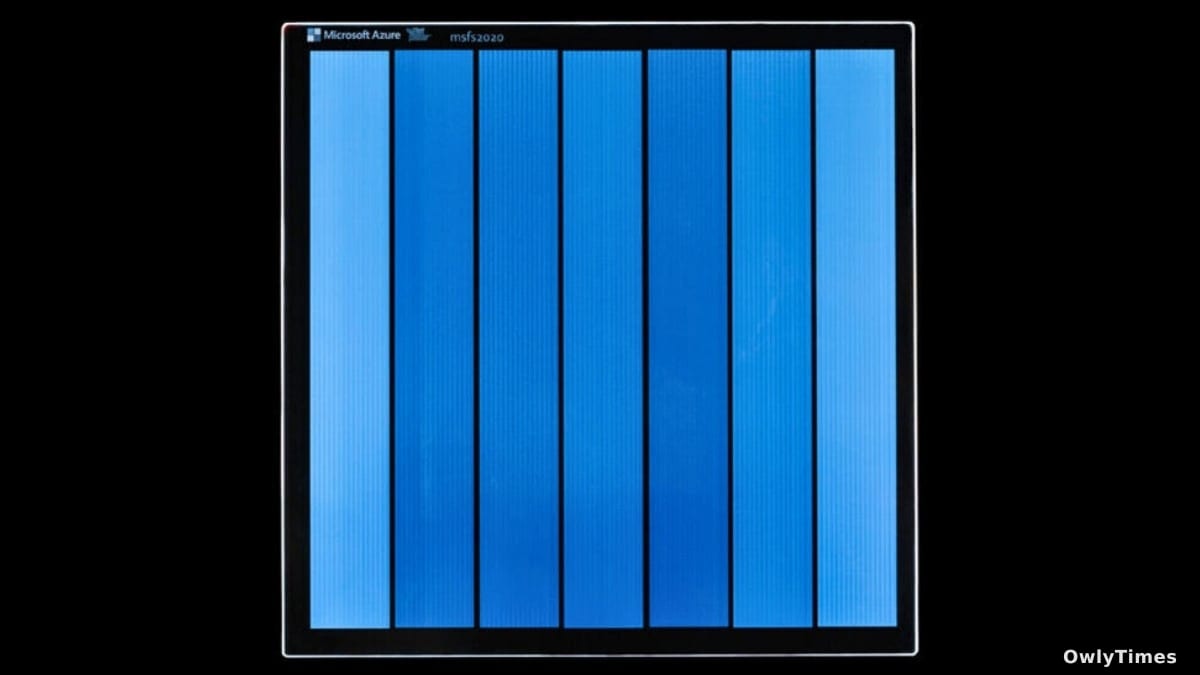

Is the future of data storage… glass? While Silicon Valley chases the next flash memory breakthrough, and cloud providers build ever-larger server farms, a team at Microsoft Research is quietly demonstrating a technology that feels ripped from science fiction: storing data, for millennia, in ordinary glass. The real story here isn't just about denser storage – it’s about fundamentally rethinking how we archive information in an age drowning in it, and acknowledging the inherent fragility of our current systems. We’ve become reliant on magnetic tapes and spinning disks, formats that require constant migration and are demonstrably vulnerable to decay and obsolescence.
The system, dubbed Silica, uses incredibly short pulses of laser light – measured in quadrillionths of a second (femtoseconds, or 10<sup>-15</sup> s) – to inscribe data into glass. To grasp the scale, consider this: comparing ten femtoseconds to a single minute is akin to comparing one minute to the entire age of the universe. These aren’t just theoretical curiosities; the underlying physics, pioneered by researchers like Ferenc Krausz, Anne L'Huillier, and Pierre Agostini (awarded the 2023 Nobel Prize in Physics for their work with attosecond pulses – a thousandth of a femtosecond), is now mature enough for practical application. The lasers don’t burn through the glass, but subtly alter its molecular structure, creating tiny three-dimensional “voxels” – essentially, microscopic changes that represent bits of data.
Source material: ScienceAlert.
This isn’t a new idea. Researchers like Eric Mazur at Harvard University were exploring volumetric optical storage in the 1990s, and in 2014, Peter Kazansky and colleagues at the University of Southampton reported data storage in fused quartz glass with a “seemingly unlimited lifetime.” In fact, Kazansky has since founded SPhotonix, a company commercializing “5D glass nanostructuring,” a concept so compelling it even made a cameo in Mission: Impossible – Dead Reckoning Part One as a secure vault for a rogue AI. What Microsoft Research has achieved with Silica isn’t a singular breakthrough, but a complete, functioning system – encoding, writing, reading, decoding, and crucially, error correction.
Silica explores two methods for creating these voxels. One uses laser-driven “micro-explosions” to create tiny voids, achieving a storage density of 1.59 gigabits per cubic millimeter. The other alters the glass’s refractive index, offering faster writing speeds and lower energy consumption, but at a lower density of 65.9 megabits per cubic millimeter. The team reports writing speeds of 65.9 megabits per second with the latter method, and believe this could be significantly increased with multiple laser beams. But the truly remarkable claim is longevity: accelerated aging experiments suggest data could remain readable for over 10,000 years. Compare that to magnetic tape, which typically requires refreshing every few decades, or even solid-state drives, which have a limited lifespan even when not in use.
The implications extend far beyond simply backing up your family photos. Think about scientific data – climate models, genomic sequences, astronomical observations – that must be preserved for centuries to be meaningful. Consider the legal and historical records that underpin our societies. Currently, we’re relying on a precarious chain of data migration, constantly updating formats and hoping future generations can decipher our digital hieroglyphics. Silica offers a potential escape from this cycle, a truly archival solution. It’s also worth noting the energy efficiency. While the initial laser setup is complex, the long-term energy cost of maintaining this data is negligible compared to the constant power demands of data centers.
However, let’s not get carried away. The current system is still a prototype. Scaling up production, reducing costs, and developing user-friendly interfaces are significant hurdles. The density, while impressive, is still lower than the latest NAND flash memory. And the initial investment in the laser technology is substantial. But the trajectory is clear. As ultrafast photonics matures – and it is maturing, with lasers now readily available off the shelf – the cost and complexity will decrease.
My prediction? Within the next decade, we’ll see specialized “glass libraries” emerge, offering ultra-long-term archival services for institutions and governments. These won’t replace your cloud storage for everyday use, but they will become the de facto standard for preserving humanity’s most critical data. The question isn’t if glass storage will become viable, but who will control access to these digital time capsules, and what safeguards will be in place to ensure the information they contain remains accessible – and interpretable – for millennia to come.