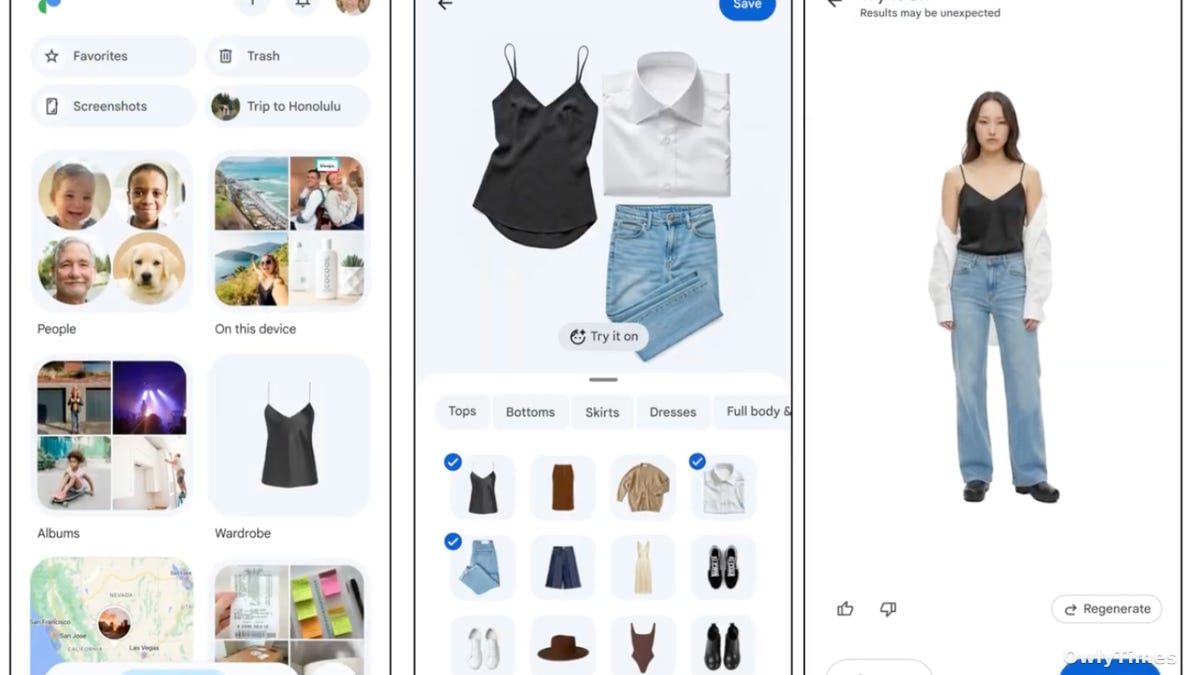

Is your digital photo library a graveyard of forgotten outfits, or is it the untapped stylist you never knew you needed? Silicon Valley is betting that your personal history—specifically, what you wore to that wedding in 2022—is the next frontier for generative AI.
The real story here isn’t that Google is trying to help you get dressed in the morning—it’s that they are turning your private camera roll into a high-fidelity data set for a personal wardrobe. With the new Google Photos wardrobe feature, slated to roll out this summer starting on Android and then iOS, the company is pivoting from being a passive archive of your memories to an active participant in your daily routine.
Turning Your Camera Roll Into a Digital Closet
The mechanics of this feature are surprisingly invasive yet undeniably convenient. The AI scans your existing photos to identify and catalog specific pieces of clothing you have worn in the past. Once indexed, these items are sorted into categories like "tops" or "jewelry," effectively building a digital inventory of your physical belongings without you ever having to upload a single item manually.
This moves the needle from the traditional search-by-keyword approach to an automated, persistent cataloging system. Users can then leverage this data to build mood boards for specific occasions, such as "work outfits" or "wedding guest" attire. It is a direct attempt to capture the utility of platforms like Pinterest while keeping the user locked within the Google ecosystem, theoretically saving you from the "try on 10-plus outfits" ritual that currently plagues anyone trying to get ready for an event.
The Illusion of the Virtual Fitting Room
The most ambitious—and arguably most flawed—part of this update is the virtual "Try it on" functionality. By selecting items from your digital collection, the software uses an AI image generation model, such as Nano Banana, to project how a specific garment might look on your body.
However, we need to be clear about the technical limitations: this is an approximation, not a mirror. As CNET’s Abrar Al-Heeti observed while testing a similar AI-powered try-on feature in Search last year, the technology can result in strange artifacts, such as the generation of bare arms to showcase a sleeveless dress. Because the AI lacks a fundamental understanding of fabric tension, sizing, or structural tailoring, it is essentially creating a digital hallucination of your outfit rather than a functional preview.
This functionality mirrors the "Find the Look" tool currently found on Samsung Galaxy S26 and Google Pixel phones, which integrates into Circle to Search. Both tools prioritize the idea of an outfit over the technical reality of how a specific garment fits. Google has stated that images uploaded for this feature will not be used for AI training, sold to third parties, or used for other services, a necessary disclaimer given the sensitivity of users effectively uploading their own bodies to an image generation model.
The Next Hurdle for Personal AI
We are watching a shift where the barrier between "what I own" and "what I might buy" is being eroded by generative models. While this might simplify the process of choosing an outfit, it fundamentally changes our relationship with our clothes by treating them as abstract data points in a mood board.
The next reading of the Google Photos wardrobe adoption rate will show whether users are willing to trade the privacy of their personal photo history for the convenience of an AI-curated closet.