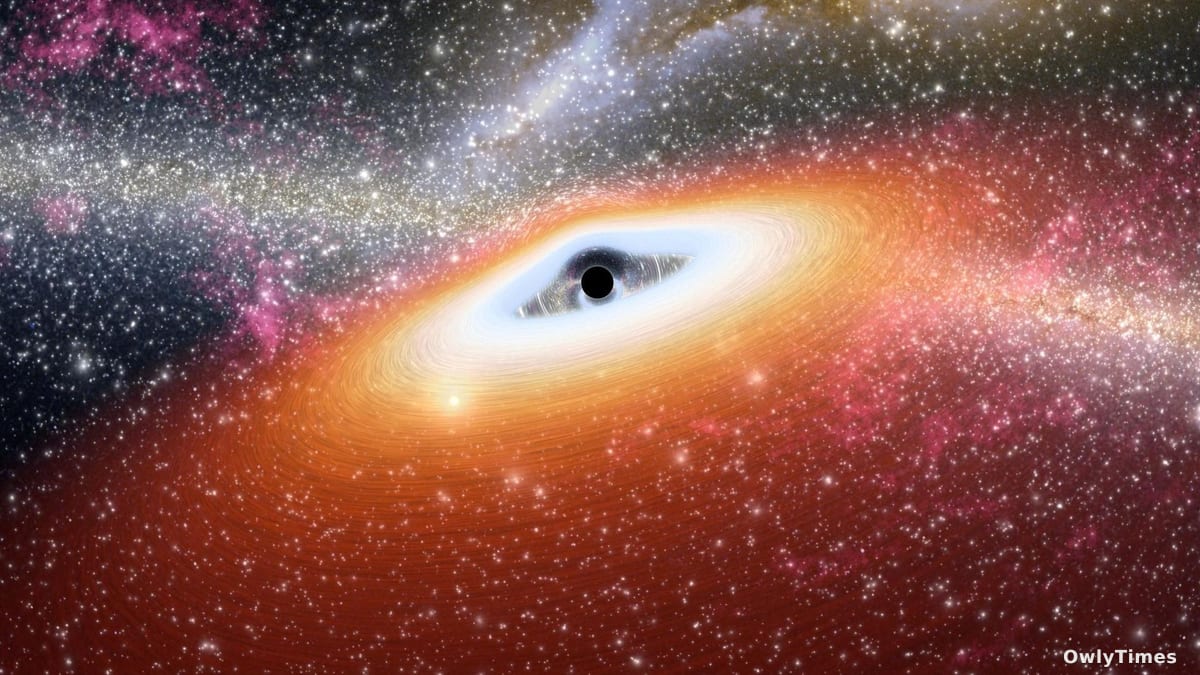

The enduring image of a black hole – a cosmic vacuum relentlessly consuming everything in its path – was fundamentally challenged fifty years ago this month, not by observation, but by a deceptively short paper published in Nature. In March 1974, Stephen Hawking proposed that black holes aren’t entirely one-way streets; they aren’t eternal prisons, but rather slowly leak energy, and ultimately, could even explode. While headlines often proclaim “black holes evaporate,” the nuance of Hawking’s original work, and the decades of research it spurred, reveals a far more complex and fascinating picture of these enigmatic objects. It’s a story not just about theoretical physics, but about the ongoing tension between our most successful, yet often contradictory, understandings of the universe.
Hawking’s breakthrough stemmed from a daring marriage of seemingly incompatible theories: Albert Einstein’s general relativity, which describes gravity as a curvature of spacetime, and quantum mechanics, the rules governing the subatomic world. General relativity dictates that nothing, not even light, can escape a black hole’s event horizon. Yet, Hawking, building on the earlier work of Jacob Bekenstein, began to explore how quantum effects might alter this picture. He reasoned that the seemingly empty space around a black hole isn’t truly empty, but rather teeming with “virtual” particles – fleeting pairs of particle and antiparticle that spontaneously appear and annihilate. Near the event horizon, Hawking proposed, one particle of a pair could fall into the black hole while the other escapes, appearing as radiation emitted from the black hole. This radiation, now known as Hawking radiation, carries away a tiny amount of the black hole’s mass, causing it to slowly shrink.
This piece references the Live Science report.
The implications were profound. For stellar-mass black holes – those formed from the collapse of massive stars – this evaporation process is incredibly slow, taking far longer than the current age of the universe (approximately 13.8 billion years). However, Hawking also theorized about the existence of primordial black holes, formed not from stellar collapse, but from density fluctuations in the very early universe. These primordial black holes, potentially much smaller than an atom, would have had a much shorter lifespan, rapidly evaporating in spectacular, albeit relatively small, explosions. As Hawking himself wryly noted in his 1974 paper, such an explosion would be equivalent to roughly one million one-megaton hydrogen bombs – a significant event, but hardly universe-shattering. Recent observations by the James Webb Space Telescope of an ancient galaxy could potentially be explained by the presence of these primordial black holes, though this remains speculative.
It’s crucial to understand that the popular explanation of Hawking radiation – the virtual particle pair popping into existence – has been significantly refined. While a useful analogy, later research demonstrated it’s an oversimplification. The radiation isn’t caused by particle-antiparticle annihilation, but rather arises from the acceleration of an observer near the black hole’s event horizon. This illustrates a key point about scientific progress: initial models are often approximations, refined and adjusted as our understanding deepens. The core concept of black hole radiation remains valid, but the mechanism is more intricate than initially proposed.
However, Hawking radiation didn’t just open new avenues of research; it ignited a decades-long paradox. If black holes evaporate, what happens to the information contained within the matter they’ve consumed? Quantum mechanics dictates that information cannot be destroyed. If information falls into a black hole and then disappears with the black hole’s evaporation, it violates this fundamental principle. For over forty years, Hawking grappled with this “black hole information paradox,” eventually proposing that information might escape via wormholes, theoretical tunnels connecting different points in spacetime, or even into other universes.
Limitations to consider are significant. Detecting Hawking radiation directly is currently beyond our technological capabilities. The radiation is incredibly faint, and the temperatures involved are extremely low. Furthermore, the existence of primordial black holes remains unproven. While the Webb Telescope’s observations are intriguing, alternative explanations for the observed galaxy are also possible. The paradox itself, while seemingly resolved by recent theoretical work suggesting information is “regurgitated” as subtle ripples in spacetime – gravitational waves – requires further validation through observation. Detecting these subtle signals amidst the cacophony of gravitational waves from other cosmic events will be a monumental challenge.
The next crucial step is to refine our ability to detect and analyze gravitational waves. Current observatories like LIGO and Virgo are already providing unprecedented insights into the universe, and future, more sensitive detectors will be essential for searching for the telltale signatures of information escaping black holes. Beyond that, continued theoretical work is needed to reconcile general relativity and quantum mechanics, potentially leading to a more complete understanding of black hole physics and the fundamental nature of spacetime. The question isn’t simply if black holes evaporate, but how they do so, and what secrets their demise reveals about the universe we inhabit. Will we find evidence of primordial black holes in the early universe, or will the information paradox continue to challenge our understanding of reality? The answers, undoubtedly, will reshape our understanding of the cosmos.