
Is our infrastructure—digital or physical—actually built to withstand the realities of an increasingly volatile climate? When we talk about "resilience" in Silicon Valley, we usually mean cloud servers and redundant data centers, but this weekend’s events in Southern China serve as a grim, physical reminder that the most sophisticated tech stack in the world is useless when the wind hits 90 mph.
The real story here isn't just the raw power of Typhoon Noul; it’s the massive, human-scale logistical failure that occurs when modern urban density meets extreme weather. According to CBS News, the storm made landfall in Huidong county at approximately 3:50 a.m. local time on Sunday, July 26, 2026. While the BBC notes the storm is the strongest to hit China so far this year, the cascading effects across the region reveal just how fragile our interconnected systems really are.
The Logistics of a Shutdown
The disruption to air travel provides the clearest metric for the storm's reach. Data regarding flight cancellations varies slightly by outlet, which is a common byproduct of the "fog of war" during natural disasters. The BBC reports that Hong Kong airport canceled around 360 passenger flights, while CBS News and the ABC News wire service both cite a figure of approximately 350. ABC News adds the human element to these numbers, noting that roughly 2,000 passengers were left stranded at the airport over the weekend.
The scale of the mass mobilization required to mitigate the damage is staggering. The number of people evacuated highlights a massive divergence in reporting: CBS News puts the figure at more than 715,000 residents in Guangdong province, whereas ABC News reports that the number had risen to more than 801,000 by Sunday. Such discrepancies remind us that during a state-managed response, official data can shift rapidly as regional reports are consolidated.
Urban Engineering Under Pressure
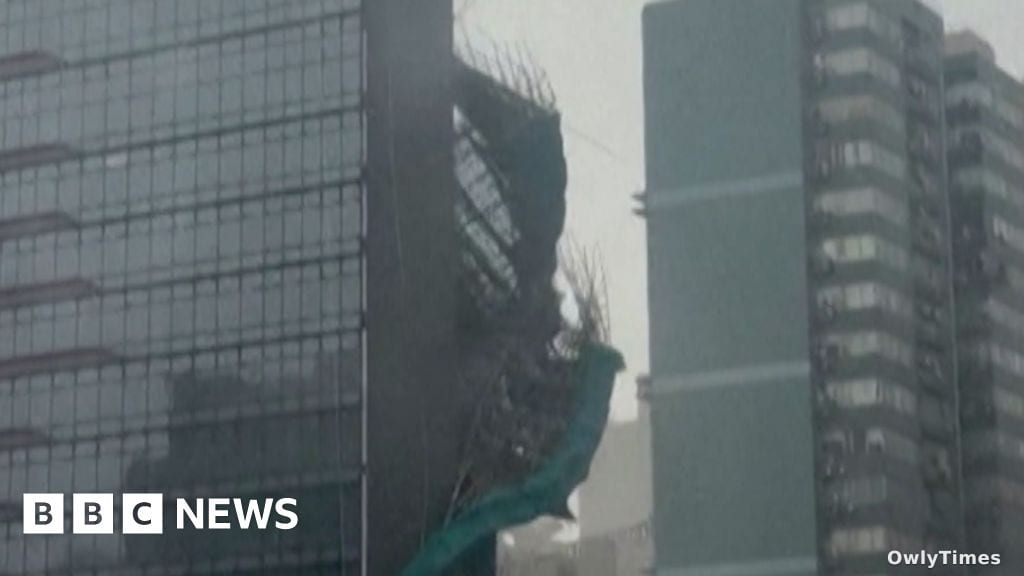
In Hong Kong, the physical reality of the storm manifested in the collapse of multi-story scaffolding along Cheung Sha Wan Road. While the BBC reported no injuries from that specific incident, ABC News notes that at least 21 people were injured across the city during the typhoon period. It is a stark reminder that even in a hyper-modern metropolis, the external "shell" of our cities—the glass, steel, and support structures—remains deeply vulnerable to extreme wind shear.
The financial fallout is already being codified by government intervention. According to ABC News, China’s National Development and Reform Commission has allocated 100 million yuan, roughly $14.8 million, to support recovery efforts in Guangdong. This follows a month of relentless weather patterns, as Noul was the third typhoon to hit the region in quick succession, following Bavi and Maysak.
A Pattern of Fragility
The most immediate signal to watch is the ongoing disaster response. While the storm has weakened to a tropical storm, the ABC News report highlights that the Ministry of Water Resources has upgraded its flood-control emergency response due to high risks of mountain floods. Keep an eye on the provincial rainfall totals in Guangdong and Fujian in the coming 48 hours; if those numbers exceed current forecasts, expect the economic impact to shift from immediate flight cancellations to long-term supply chain disruptions.