
$50 Million Warning: Huntington Beach’s Budget Deficit Signals a Looming Infrastructure Crisis
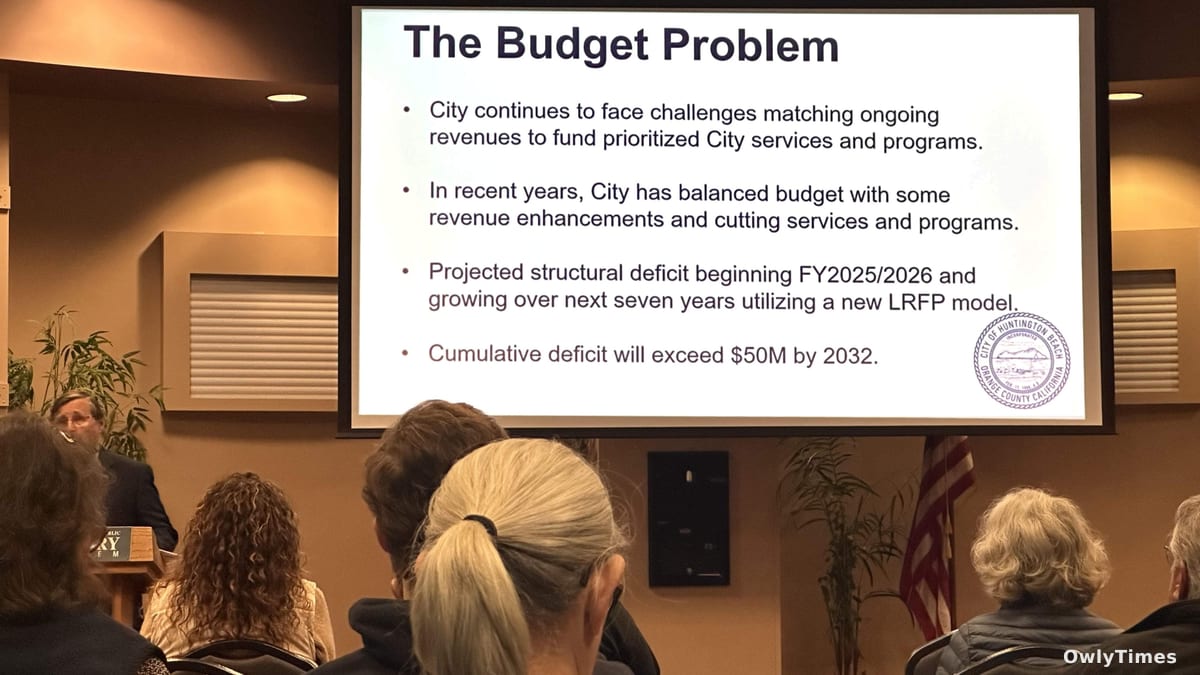
A projected $50 million cumulative deficit by 2032, revealed in a March 12, 2025 budget staff meeting and flagged by resident Buzz McCord, isn’t simply a line item in a city report – it’s a flashing red indicator of systemic underinvestment in Huntington Beach’s core services. While the current City Council focuses on high-profile events and public relations, a deeper look at city documents and financial commitments reveals a pattern of deferred maintenance, reliance on short-term fixes, and escalating long-term financial risks. This isn’t a question of political preference; it’s a matter of basic financial sustainability, and the numbers paint a concerning picture.
Original reporting: voiceofoc.org.
The city’s own 2024 Infrastructure Report Card explicitly states that major infrastructure components are operating beyond their intended lifespan. This isn’t speculation, but a formal acknowledgement of decades of underinvestment. Consider this: the average lifespan of a concrete road is 40-50 years. Huntington Beach’s report doesn’t specify the age of all infrastructure, but the implication is clear – significant portions are nearing or exceeding their useful life, requiring increasingly expensive repairs or complete replacement. This deferred maintenance isn’t free; it’s effectively accruing debt, as McCord succinctly puts it, “deferred maintenance is just debt with potholes.”
The current budgetary approach exacerbates this problem. FY 2025-26 budget reports detail a reliance on drawing down reserves and utilizing “one-time sleights-of-hand” to balance the books. While not inherently irresponsible, this practice creates a structural imbalance. Reserves are finite, and one-time revenue sources – like asset sales or unexpected grants – are unpredictable. For every dollar used to cover recurring expenses with a temporary fix, the city pushes a future financial burden onto taxpayers. Nationally, cities with similar reliance on one-time funds experienced an average 8% increase in property taxes within three years to address the resulting shortfalls, according to a 2023 report by the National League of Cities.
The controversial Pacific Airshow deal further illustrates this pattern of prioritizing spectacle over stability. Voice of OC reporting highlighted the city’s 25-year commitment and financial obligations to the vendor, raising questions about the justification of benefits. While long-term contracts aren’t inherently problematic, the lack of transparency and potentially lopsided terms – particularly regarding public safety and parking costs – represent a significant financial risk. A 25-year commitment in a rapidly changing economic landscape requires robust exit clauses and measurable performance metrics, neither of which appear to be adequately addressed.
Adding to the financial strain are escalating risks related to coastal hazards. Huntington Beach’s Emergency Operations Plan acknowledges vulnerability to sea level rise and liquefaction, particularly in low-lying areas. These aren’t distant threats; they are increasingly likely events that will necessitate substantial emergency spending. The city’s proactive installation of surveillance cameras in Oak View – a $100,000+ contract quietly approved – demonstrates a focus on security, but raises questions about resource allocation. While public safety is paramount, investing in preventative infrastructure maintenance would arguably mitigate larger, more costly emergencies down the line. The city spent $1.2 million on emergency storm preparedness in January 2024 alone, a figure that could increase exponentially with more frequent and severe weather events.
The November 2026 election represents a critical juncture for Huntington Beach. The current trajectory – characterized by deferred maintenance, short-term fixes, and questionable long-term commitments – is unsustainable. Voters must demand fiscal responsibility, transparent budgeting, and a clear prioritization of core services.
What this means for your wallet: Huntington Beach residents should anticipate potential property tax increases, service cuts, or further reliance on debt if the current financial trends continue. Specifically, watch for the city’s response to the projected $50 million deficit – will they address the root causes of underinvestment, or continue to rely on temporary patches? The answer will determine the long-term financial health of the city, and the burden borne by its taxpayers.