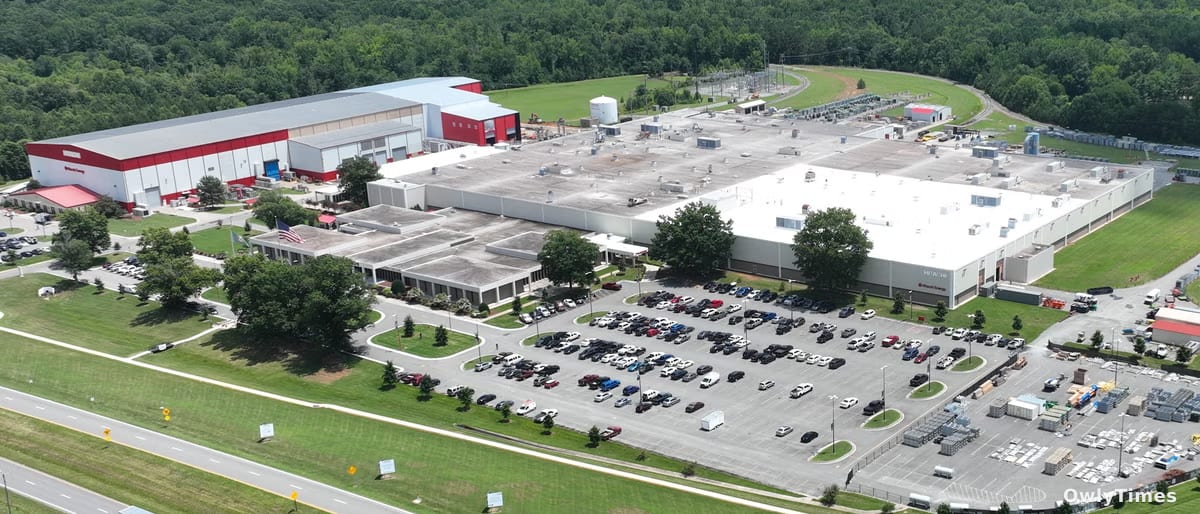

$457 million is the figure reshaping the economic landscape of South Boston, Virginia, and it’s not about tobacco anymore. Hitachi Energy’s commitment to expand its power transformer production facility isn’t simply a local win; it’s a bellwether for a national infrastructure build-out driven by surging electricity demand, and a calculated bet on a workforce increasingly vital to the energy transition. Follow the money, and you’ll find this investment isn’t about a single factory, but about positioning a Swiss-Japanese multinational at the epicenter of America’s grid modernization.
The expansion, slated to create 825 new jobs alongside the existing 670, builds on a history stretching back to 1968 when Westinghouse Electric Corp. first established a transformer plant in the town. That legacy, passed through ABB and ultimately acquired by Hitachi in 2020, provides a foundation of skilled labor and established supply chains – a key factor in Hitachi’s decision, according to Head of External Communications Kurt Steinert, who emphasized the company’s “very good experiences” in the region. This isn’t a greenfield operation; it’s a strategic amplification of existing assets. The $457 million investment represents roughly 46% of Hitachi Energy’s previously announced $1 billion U.S. investment plan, concentrating a disproportionate share of capital in Halifax County and neighboring Bland and Smyth counties, which received a combined $22.5 million earlier this year.
The timing is critical. Demand for large power transformers is escalating, fueled by three converging forces: the explosive growth of data centers, the accelerating electrification of transportation, and the broader push to modernize the aging U.S. electrical grid. Data centers, in particular, are power-hungry behemoths, and Virginia has become a magnet for them, attracting billions in investment. This creates a feedback loop – more data centers require more transformers, justifying further investment in manufacturing capacity like Hitachi’s. While the $457 million expansion is substantial, it’s worth noting that the U.S. power grid requires an estimated $2.4 trillion in investment by 2030, according to the American Society of Civil Engineers, meaning Hitachi’s move is a single, albeit significant, piece of a much larger puzzle.
This article draws on reporting from virginiabusiness.com.
However, the investment isn’t without its dependencies. Chuck Perrine, Hitachi Energy’s North America Vice President of Operations for Power Transformers, anticipates shipping transformers from the expanded South Boston facility by 2028. This timeline hinges on securing a “skilled personnel” base, a concern Perrine explicitly voiced. To address this, Hitachi is simultaneously constructing a training center, acknowledging that simply “turning wrenches” won’t suffice. The company needs engineers, warehouse operators, managers, and even on-site medical staff. This proactive approach to workforce development is crucial, as the unemployment rate in Halifax County currently sits at 3.8% as of April 2024, meaning Hitachi will be competing for a limited pool of qualified candidates.
The local government is responding with a multi-pronged approach. Brian Brown, Executive Director of the Halifax County Industrial Development Authority, highlights the county’s donation of 10 acres for affordable housing – 96 apartments and 16 single-family homes – a $35 million project partially funded by state grants totaling $3.5 million and a waiver of permit and connection fees. Furthermore, plans are underway to build a new childcare facility, recognizing the needs of a workforce likely to include employees working multiple shifts. This level of public-private partnership, including a potential $29.4 million state grant pending General Assembly approval, demonstrates a concerted effort to remove barriers to employment and ensure the project’s long-term success.
What this means for your wallet: Expect incremental increases in electricity rates as utilities pass through the costs of grid modernization, including the purchase of these new transformers. However, a more resilient and robust grid is essential to prevent widespread outages and support the continued growth of energy-intensive industries, ultimately protecting consumers from far more significant economic disruptions. The key question now is whether Hitachi Energy can successfully navigate the workforce challenges and deliver on its 2028 timeline – a delay could exacerbate existing supply chain bottlenecks and slow the pace of critical infrastructure upgrades. Investors should watch for updates on the training center’s enrollment numbers and the county’s housing project completion rates as leading indicators of the project’s overall health.