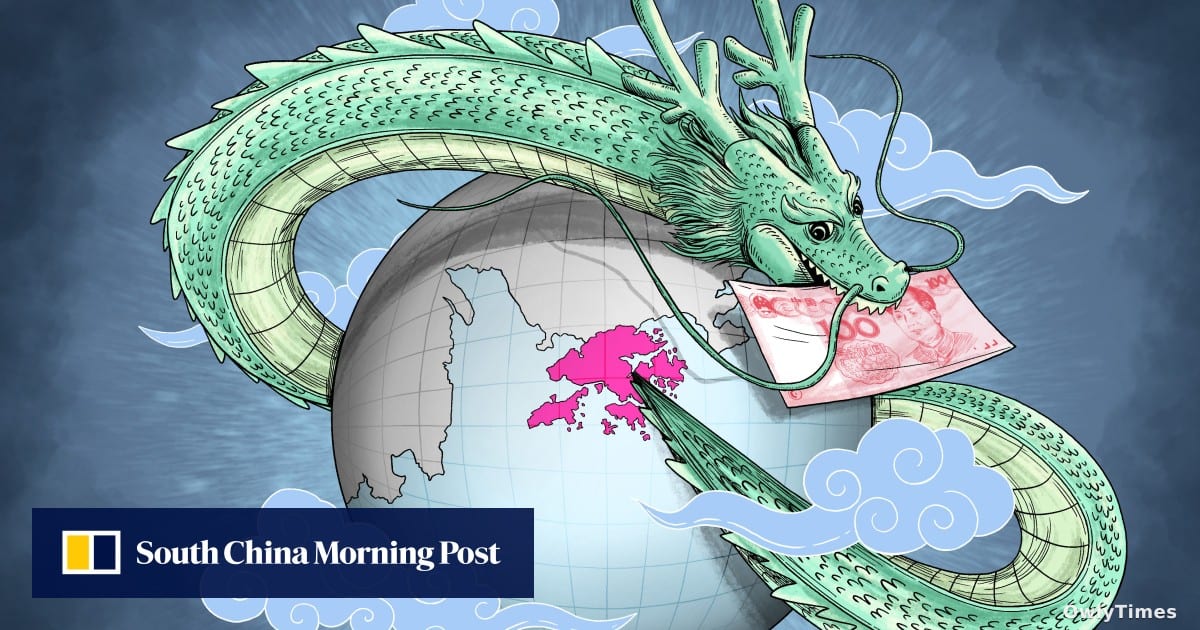

The $3.9 Trillion Shift: How Hong Kong Fuels China’s Financial Ambitions
In 2009, the volume of Chinese yuan traded internationally was negligible. Today, it accounts for approximately 4.8% of global foreign exchange transactions, representing a $3.9 trillion daily turnover according to the Bank for International Settlements – a figure that underscores the speed and scale of China’s financial ascent and Hong Kong’s central role in it. Wilson Chan Fung-cheung’s four-decade career in Hong Kong’s banking sector vividly illustrates this transformation; a career that began trading dollars, pounds, and yen, but now routinely handles the yuan. This isn’t simply about currency exchange rates; it’s about a deliberate, decade-long strategy by President Xi Jinping to position China as a global financial power, with Hong Kong as a critical launchpad.
From Offshore Hub to Digital Frontier
The 2009 decision to internationalize the yuan wasn’t accidental. It was a calculated move to reduce reliance on the US dollar and increase China’s economic leverage. Chan notes that Hong Kong rapidly became the primary “offshore yuan hub,” facilitating trade finance and providing mainland banks and companies access to international capital markets. This function remains vital, but Beijing’s ambitions now extend far beyond simply increasing the yuan’s share of trade. The recent republication of Xi Jinping’s 2024 speech on becoming a “financial superpower” in Qiushi, the Communist Party’s leading journal, signals a renewed commitment to this goal, particularly as the country embarks on its next five-year plan. The timing, coinciding with the annual “two sessions” meetings, isn’t coincidental – it’s a clear directive to prioritize financial development.
Drawn from scmp.com.
Beyond the Yuan: Testing Grounds and Investor Bridges
Hong Kong’s value proposition isn’t solely tied to the yuan’s internationalization. The city’s established common-law system, robust financial infrastructure, and deep talent pool position it as a crucial testing ground for new financial technologies. Specifically, analysts point to the potential for accelerating digital yuan adoption, a project that could circumvent the existing SWIFT system and offer China greater control over cross-border payments. This is a direct challenge to the US dollar’s dominance. Furthermore, Hong Kong is expected to play a key role in connecting global investors with mainland Chinese companies seeking listings, and in cautiously exploring the regulatory framework for cryptocurrency assets. This last point is particularly sensitive, given Beijing’s historically restrictive stance on crypto, but Hong Kong’s relative autonomy allows for a more nuanced approach.
The Political Calculus: Autonomy and Control
The emphasis on Hong Kong’s contribution, as articulated by lawmaker Robert Lee Wai-wang, – “Hong Kong can contribute to the country’s ambition to be a financial superpower by being the best international financial centre that we can be” – is carefully worded. It highlights the city’s continued importance while implicitly acknowledging the need to align with Beijing’s broader strategic objectives. This creates a tension: Hong Kong’s strength as a financial center depends on its international character and rule of law, yet Beijing’s control over the city is increasing. The National Security Law, enacted in 2020, has demonstrably altered the political landscape, raising concerns among some investors about potential interference. While capital continues to flow, the long-term impact of these political shifts on Hong Kong’s attractiveness as a financial hub remains a significant risk factor.
What This Means for Your Wallet
The rise of China as a financial superpower, facilitated by Hong Kong, isn’t a distant economic theory – it has tangible implications for global investors and consumers. Increased competition in the financial system could lead to lower transaction costs and greater access to capital, but it also introduces new geopolitical risks. Watch for the pace of digital yuan adoption outside of China; a successful rollout could significantly alter the landscape of international payments and potentially challenge the dollar’s reserve currency status. More immediately, monitor the volume of Chinese companies listing in Hong Kong versus the US – a sustained shift towards Hong Kong would signal a deliberate effort to channel investment flows through Beijing’s sphere of influence. The question isn’t if China will become a financial superpower, but how – and whether Hong Kong can maintain its unique position within that evolving power dynamic.