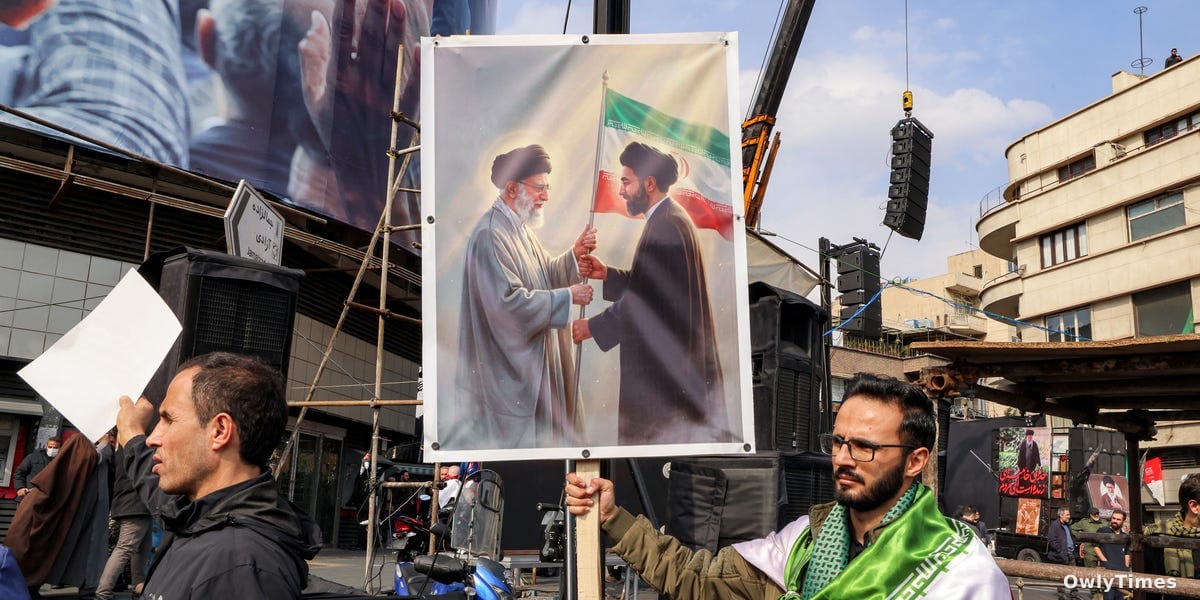

The Succession Was the Plan All Along: Khamenei’s Son Consolidates Power Through Financial and Forceful Control
The immediate reaction to the anticipated succession of Mojtaba Khamenei to the Supreme Leadership of Iran – dismissed by the current US administration as a promotion from “lightweight” to “light heavyweight” – misses the strategic calculus at play. This wasn’t a failure of US policy, nor a surprising turn of events. It was the predictable outcome of a decades-long effort by the ruling elite to secure their position, not just politically, but financially, and the current administration’s nonchalant response suggests a tacit understanding of that reality. The elevation of Mojtaba Khamenei isn’t about ideological purity; it’s about consolidating control over a vast, illicit financial network and ensuring the continued dominance of the Islamic Revolutionary Guard Corps (IRGC).
Reporting from esquire.com informs this analysis.
The timing is critical. Axios reports Iran is at its most vulnerable state since the 1979 revolution, a vulnerability exacerbated by ongoing economic sanctions and internal dissent. This fragility isn’t a weakness to be exploited, but a condition that necessitates a leader perceived as unwavering – and Mojtaba Khamenei fits that profile perfectly. Born in 1969, his formative years were steeped in the fervor of the revolution and his father’s ascent, culminating in service within the IRGC’s notoriously ideological Habib Battalion during the Iran-Iraq War. This isn’t a leader emerging from the system; he was forged within its most hardline elements. The swift pledge of allegiance from the IRGC, stating they are “ready to fully obey” his commands, isn’t merely protocol; it’s a confirmation of a pre-existing alignment of interests.
Who benefits and who loses from this transition? The clear beneficiaries are the entrenched power structures within Iran – the IRGC, hardline clerics, and those directly involved in the opaque financial networks now demonstrably extending into Western markets. Bloomberg’s reporting on Mojtaba Khamenei’s extensive property holdings in London, estimated at over £100 million, and his broader investment empire spanning shipping and Swiss bank accounts, reveals a level of personal enrichment that directly contradicts the regime’s anti-Western rhetoric. The fact that these assets are held through layers of shell companies, despite US sanctions imposed in 2019, speaks to the sophistication – and impunity – of this operation. Those who lose are the Iranian people, facing continued repression and economic hardship, and any hope for meaningful reform or opening. The international community, particularly those attempting to enforce sanctions, also find themselves outmaneuvered by a regime adept at circumventing restrictions.
This situation echoes historical precedents of authoritarian succession, particularly in dynastic regimes. While Iran officially rejects the notion of dynastic rule, the reality is strikingly similar. The transfer of power from Ayatollah Ali Khamenei to his son isn’t a meritocratic selection; it’s a consolidation of family control, mirroring the practices of many historical autocracies. Consider the Al-Assad family in Syria, or the Kim dynasty in North Korea – regimes where power is maintained through a combination of force, ideological control, and, crucially, economic patronage. Mojtaba Khamenei’s alleged role in engineering the 2005 and 2009 elections, particularly his reported supervision of the IRGC’s crackdown on the 2009 protests, demonstrates a willingness to use violence to maintain power, a hallmark of such regimes. The Atlantic Council’s assessment that he is tied to the “most ideologically extremist clerics” further solidifies the expectation of increased repression.
The current US administration’s dismissive rhetoric and apparent willingness to engage with Mojtaba Khamenei on financial matters – “gilded ballrooms and how to dodge international financial regulations,” as one source put it – suggests a pragmatic, if unsettling, calculation. The focus isn’t on dismantling the regime, but on managing it, potentially through a tacit understanding that allows for continued financial maneuvering in exchange for limited concessions on other fronts. This approach, while seemingly pragmatic, risks legitimizing a deeply repressive regime and further entrenching its control. The political chess move to watch next isn’t a dramatic escalation of sanctions or military action, but rather the details of any potential bilateral agreements reached between the US and the new Iranian leadership – specifically, what concessions, if any, are being made regarding the illicit financial networks now firmly under Mojtaba Khamenei’s control.





