
The quest to reach the stars is often framed as a problem of raw power, but current research suggests the solution may lie in the elegance of light. For decades, the concept of laser-sail propulsion has captivated physicists as a way to bypass the tyranny of the rocket equation, which requires massive amounts of fuel to move even modest payloads. While previous efforts like the Breakthrough Starshot program faced the harsh realities of private-funding instability, the underlying premise—using Earth-based lasers to propel miniature spacecraft to near-relativistic speeds—remains the most viable path for interstellar exploration within this century.
A new paper, "Science from the In Situ Exploration of the Proxima Centauri System," published on the pre-print server arxiv.org, argues that we have been thinking about these missions too narrowly. Instead of a single, highly complex spacecraft, the authors—led by T. Marshall Eubanks, Chief Scientist at Space Initiatives Inc.—propose a swarm of "picospacecraft" known as Coracles. Each of these tiny probes would be equipped with a single digital camera, operating as a distributed, collective intelligence rather than a lone explorer.
It is important to distinguish this vision from earlier light-sail experiments. JAXA's IKAROS and the Planetary Society's Lightsail-2 successfully demonstrated the mechanics of photon-powered flight, but they relied on the Sun's radiation. The Coracle concept shifts the burden to powerful, Earth-based lasers capable of pushing gram-scale craft to the speeds necessary to reach Proxima Centauri—the closest star system to our own—in roughly 20 years. By distributing the scientific payload across a swarm, the mission gains a critical advantage: redundancy. If one probe fails, the mission persists.
However, the transition from theory to reality faces significant technological hurdles. Navigation remains a primary concern; without a "mothership" to guide the swarm, these tiny units must rely on methods like pulsar navigation to reach their destination. The authors explore several ways to manage data transmission, ranging from sending individual probes to organizing a "time coherent swarm" that coordinates its return signal to Earth. They explicitly reject the "Sparse Phased Array" approach, noting that the "extreme difficulty of phase coordination across the swarm" makes it currently impractical.
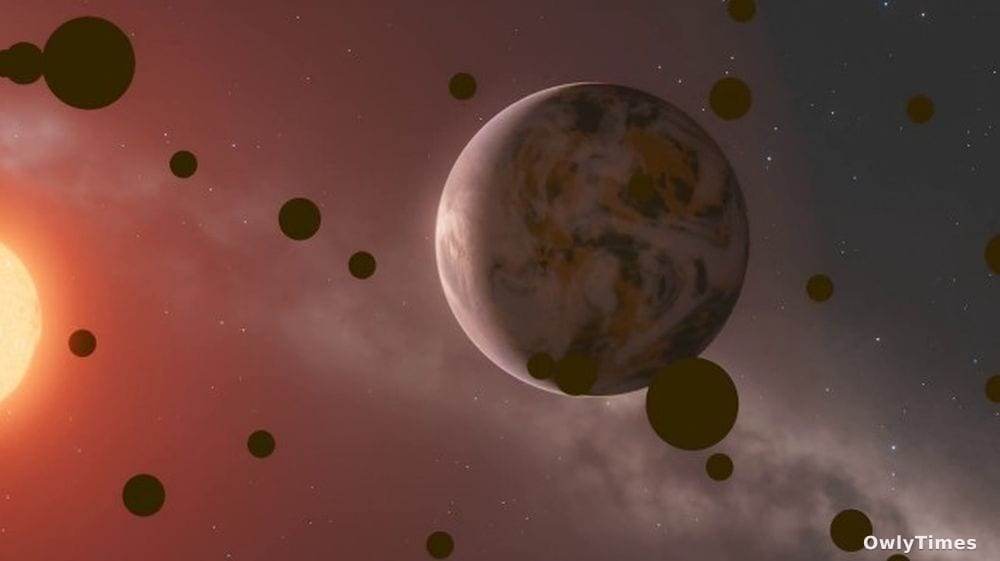
The scientific potential, if these hurdles are cleared, is profound. Eubanks and his team suggest that a swarm with a few hundred surviving members, spread across 105 kilometers, could pass within 10,000 kilometers of Proxima b. This would allow for gigapixel-resolution imaging and even transmission spectroscopy to detect potential biomarkers or technosignatures in the planet's atmosphere. By utilizing artificial intelligence for "lookahead" observations, the swarm could prioritize which data to transmit during the high-speed flyby, effectively performing real-time triage on terabytes of raw information.
Limitations to consider include the extreme difficulty of managing data transmission from over four light-years away and the sheer complexity of autonomous, in-situ decision-making. Because the flyby of Proxima b lasts less than a minute, the system must be entirely self-reliant. Furthermore, while the proposal is scientifically grounded, it remains a conceptual framework rather than a funded mission profile.
The next phase of this research will likely be defined by the development of the "lookahead" AI and the refinement of data selection algorithms. As the authors suggest, these gram-scale probes are likely the only technology capable of reaching another star in our lifetime. Whether this vision matures into a formal flight project will depend on future advancements in laser energy density and the miniaturization of optical sensors, metrics that will indicate if the dream of interstellar transit is finally moving from the pre-print server to the launchpad.





